













European Commission Proposes Quantum Act and Sovereign Tech Equity Fund to Boost Europe’s Technological Independence
By Suman Munshi, Chief Editor, IBG NEWS
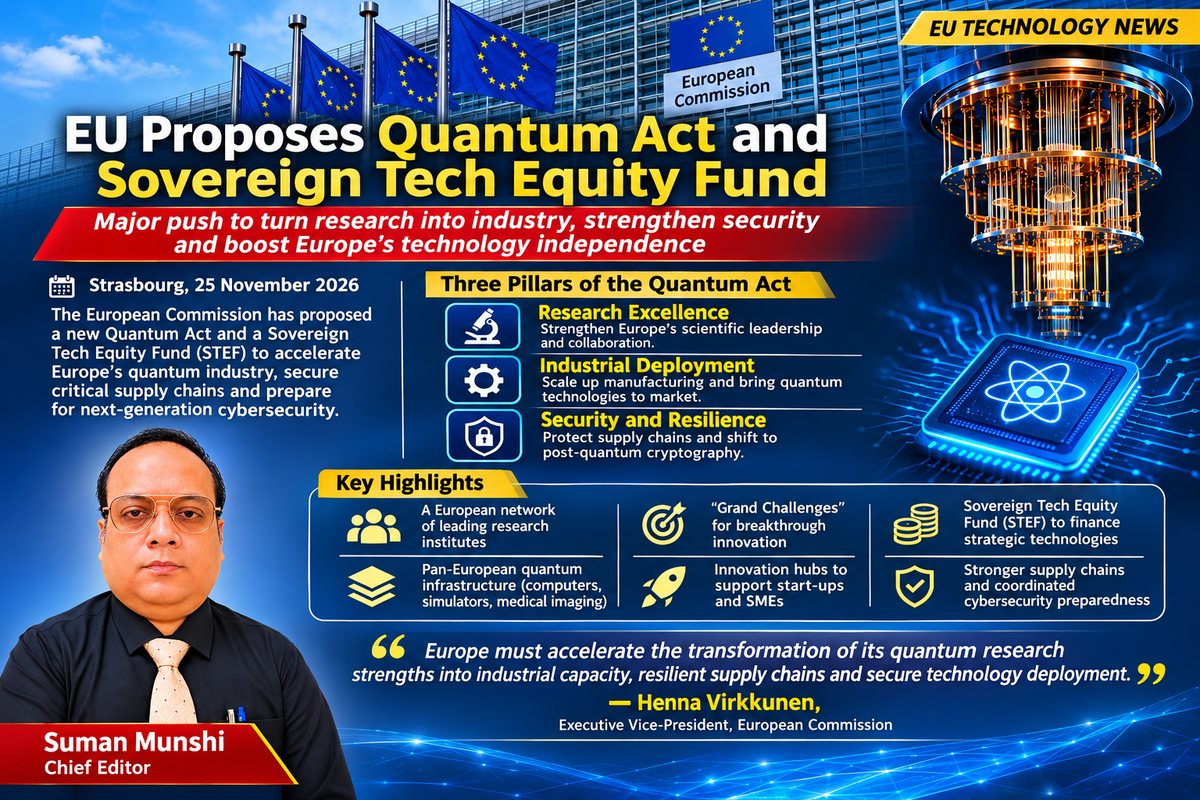
STRASBOURG, 25 November 2026: The European Commission has proposed a new legislative framework, the Quantum Act, alongside plans for a Sovereign Tech Equity Fund (STEF), in a major initiative aimed at strengthening Europe’s industrial capabilities, securing critical technology supply chains and accelerating the commercial application of quantum computing.
The proposal seeks to transform Europe’s established strength in quantum research into commercially viable products, industrial applications and secure digital infrastructure. It also aims to prepare European governments, businesses and critical infrastructure operators for the cybersecurity challenges that could emerge from increasingly powerful quantum computers.
Quantum technologies are expected to influence several important sectors, including satellite-independent navigation, pharmaceutical research, advanced battery development, medical imaging and next-generation secure communications. As these technologies move beyond laboratory research, the Commission believes Europe must accelerate industrial development and improve its ability to manufacture and deploy them at scale.
Three Strategic Pillars of the Quantum Act
The proposed legislation is structured around three central priorities:
- Research excellence: Strengthening Europe’s scientific capabilities through cooperation between leading research institutions and improved access to specialised facilities.
- Industrial deployment: Helping companies translate scientific discoveries into commercial products, manufacturing capabilities and market-ready solutions.
- Security and resilience: Protecting critical technology supply chains and preparing European digital systems for the transition to post-quantum cryptography.
The initiative will be coordinated through the proposed Quantum Europe Framework Initiative, bringing together European Union and national programmes under common research, industrial and deployment priorities.
Building a Competitive European Quantum Industry
A key element of the proposal is the creation of a network connecting leading European research institutes. The network would enable researchers to access advanced facilities across Europe and collaborate on major scientific and engineering challenges.
The Commission also plans to introduce targeted funding competitions, known as Grand Challenges, to overcome important technological barriers.
Among the proposed priorities are the development of quantum computers capable of operating reliably despite computational errors and navigation technologies that can function without satellite signals.
The proposal also envisages pan-European quantum infrastructure, including quantum computers, quantum simulators and quantum-enhanced medical imaging facilities.
Specialised Quantum Technology and Innovation Hubs would provide engineering expertise, technical knowledge and workforce skills to start-ups and small and medium-sized enterprises. These facilities are intended to help emerging companies develop products that can compete in commercial markets.
Strategic industrial projects would further support the expansion of manufacturing capabilities and other critical quantum technologies. The Commission also intends to improve companies’ access to finance and connect technology developers with public-sector buyers.
Strengthening Technology Security and Supply Chains
The Commission has placed considerable emphasis on the security implications of quantum technologies.
Quantum applications have both civilian and dual-use potential, making them increasingly relevant to economic security, communications and critical infrastructure.
Under the proposed framework, the European Union and its Member States would work together to monitor technology supply chains, identify strategically important suppliers and components, and reduce dependence on vulnerable sources.
Cooperation with international partners would also be pursued to strengthen supply-chain resilience and protect shared security interests.
Another major priority is the transition to post-quantum cryptography. Future quantum computing capabilities could threaten certain encryption methods currently used to protect sensitive information and digital communications.
The proposal therefore envisages coordinated preparedness monitoring and targeted procurement safeguards to help governments and businesses protect their digital systems against emerging cyber risks.
Sovereign Tech Equity Fund: Financing Strategic Technologies
One of the most significant financial components of the proposal is the planned Sovereign Tech Equity Fund (STEF).
The proposed fund would provide equity and similar forms of investment to technologies considered essential for Europe’s technological sovereignty and economic security.
Its intended role is to support the development and scaling of strategically important technologies, while helping finance the Quantum Europe Framework Initiative and other measures under the Commission’s Tech Sovereignty Package.
The European Commission intends to work with the European Investment Bank Group, Member States and other stakeholders to establish the fund.
The proposal does not yet specify a final investment allocation or operational timetable for the fund.
New Governance and Coordination Mechanisms
The proposed Quantum Act would introduce two important coordination structures.
A Quantum Strategy Board, bringing together the European Commission and Member States, would oversee strategic coordination between national and European programmes.
A proposed European Quantum Alliance would connect public and private stakeholders, including technology suppliers, industrial users, universities, research institutions and technology organisations.
The European High-Performance Computing Joint Undertaking, or its successor, is expected to serve as the principal body responsible for implementing EU-level quantum research, innovation and infrastructure activities.
Europe’s Ambition to Lead by 2030
The proposal supports the objectives of the Quantum Europe Strategy, which aims to position Europe as a global leader in quantum technologies by 2030.
According to the Commission, the European Union and its Member States had already committed more than €11 billion in public investment in quantum technologies, as reported in the 2025 strategy. This investment has supported scientific research, secure communications networks and the development of a European network of quantum computers.
The Commission now wants to build on these foundations by increasing industrial production, expanding commercial adoption and strengthening technological independence.
Henna Virkkunen, Executive Vice-President for Tech Sovereignty, Security and Democracy, said that Europe must accelerate the transformation of its research strengths into industrial capacity, resilient supply chains and secure technology deployment.
Legislative Process and Next Steps
The Quantum Act is currently a legislative proposal. It will now be examined by the European Parliament and the Council of the European Union before any final adoption.
Future EU funding under the proposed legislation will depend on budgetary decisions and the rules governing the relevant programmes.
The proposal represents an important step in Europe’s wider effort to strengthen its position in advanced computing, artificial intelligence, semiconductors, cloud infrastructure and other strategically important technologies.
IBG NEWS Analysis: Quantum Technology and the Future of Global Industrial Competition
The proposed Quantum Act reflects a broader change in the global technology landscape. Competition is no longer limited to scientific breakthroughs; it increasingly involves the ability to manufacture advanced systems, secure critical components, develop skilled workforces and convert research into commercially sustainable industries.
Europe’s approach combines research collaboration, industrial investment, cybersecurity preparedness and strategic financing. The proposed Sovereign Tech Equity Fund could become an important instrument for supporting companies working in technologies considered vital to European economic and security interests.
For countries such as India, the European initiative also offers an important policy and industrial reference. Building a competitive quantum ecosystem requires sustained investment in scientific research, specialised infrastructure, semiconductor capabilities, skilled professionals, technology start-ups and collaboration between universities and industry.
The coming years will determine whether quantum technologies move from promising laboratory achievements to commercially scalable industries. Europe’s proposed framework is an attempt to ensure that it plays a central role in that transformation.
Source: European Commission Press Release, IP/26/2567, Strasbourg, 25 November 2026.
IBG NEWS | Technology • Science • Global Affairs