













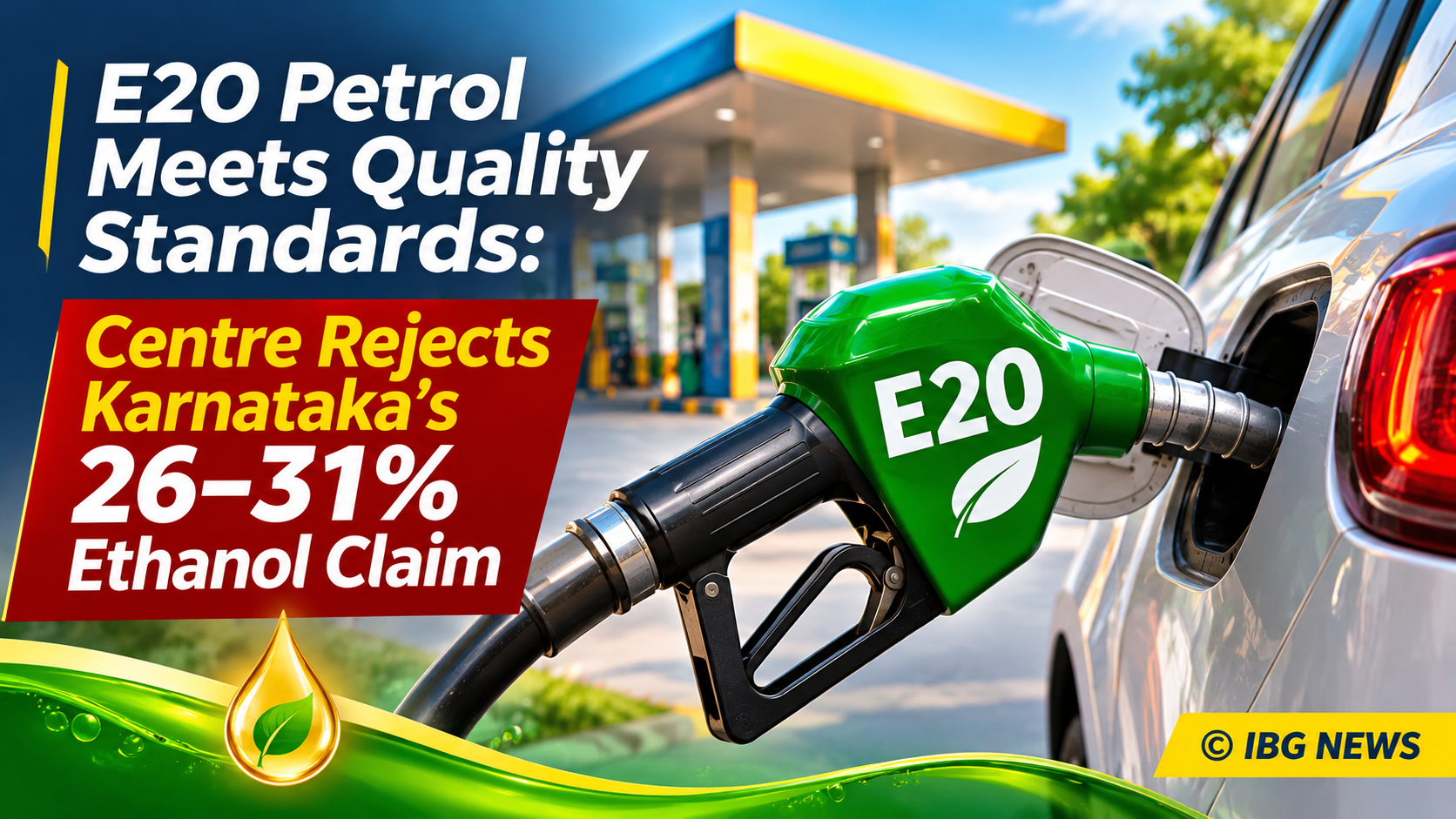

E20 Petrol Controversy: Centre Rejects Karnataka’s 26–31% Ethanol Claims, Says 893 Samples Meet BIS Standards
Oil marketing companies report compliance with prescribed E20 specifications across 27 States and Union Territories; demand joint independent testing amid dispute over sampling methods and consumer impact
By Suman Munshi | IBG NEWS
NEW DELHI, November 7, 2026: India’s nationwide ethanol-blended petrol programme has come under renewed scrutiny following conflicting claims over the actual ethanol content in fuel sold at certain retail outlets in Karnataka. The Ministry of Petroleum and Natural Gas has challenged reported findings suggesting ethanol concentrations of 26% to 31%, maintaining that petrol supplied by the three public-sector oil marketing companies (OMCs) conforms to the prescribed E20 fuel-quality standards.
In a statement issued on November 7, the Ministry said Indian Oil Corporation Limited (IOCL), Bharat Petroleum Corporation Limited (BPCL) and Hindustan Petroleum Corporation Limited (HPCL) had reported that 893 samples collected across 27 States and Union Territories complied with the Bureau of Indian Standards (BIS) specification IS 17021.
The dispute has brought three important questions into focus: whether fuel-testing procedures have been followed correctly, whether consumers are experiencing significant mileage and vehicle-maintenance costs, and how effectively India’s ambitious ethanol-blending policy is being monitored.
The controversy also highlights the importance of transparent testing and independent scientific verification when government agencies and major fuel suppliers arrive at conflicting conclusions.
Karnataka’s Allegations and the Centre’s Response
The Ministry took note of a press release issued by Karnataka’s Department of Food, Civil Supplies, Consumer Affairs and Legal Metrology, which reportedly claimed that petrol collected from certain retail outlets contained between 26% and 31% ethanol.
The three OMCs have disputed these findings, arguing that the reported figures have not been established through the sampling and laboratory-testing procedures prescribed under the applicable regulatory framework.
According to the Ministry, petrol supplied by the public-sector companies, including in Karnataka, is blended and monitored according to IS 17021 specifications.
The OMCs have also questioned the methodology adopted during an October 2026 sampling exercise, particularly the absence of their representatives during sample collection and the lack of access to corresponding retained samples and complete laboratory documentation.
The disagreement is therefore not merely about the percentage of ethanol in petrol. It concerns the integrity, reproducibility and regulatory acceptability of the testing process itself.
Why the Sampling Procedure Matters
The Motor Spirit and High Speed Diesel (Regulation of Supply, Distribution and Prevention of Malpractices) Order, 2005, issued under the Essential Commodities Act, 1955, together with the Marketing Discipline Guidelines (MDG) 2024, establishes procedures for collecting, retaining, testing and communicating fuel-quality results.
Under the prescribed procedure described by the Ministry, six one-litre samples are collected:
- Two samples are handed over to the retail dealer against acknowledgement.
- Two samples are retained by the oil company or concerned department.
- Two samples are forwarded to a laboratory specified under the applicable Control Order or notified in the Official Gazette.
The samples must carry jointly signed labels, and test results must be communicated to the dealer and oil company within the prescribed timeframe.
The OMCs maintain that the September 2026 sampling exercise followed the established procedure, with samples routed through the State Level Coordinator to designated laboratories.
However, they have raised objections regarding the subsequent October exercise, claiming that samples were collected without OMC representatives and that the companies were not provided with corresponding retention samples, complete outlet-wise information or laboratory reports.
The companies have also questioned the reliance on third-party laboratory certificates that, according to their assessment, do not contain sufficient technical information to establish whether the prescribed testing standards were followed.
This raises a fundamental issue for regulatory governance: fuel-quality allegations must be supported by transparent sampling, documented chain of custody, recognised laboratory procedures and opportunities for independent verification.
At the same time, procedural objections alone cannot conclusively establish that the reported findings are incorrect. The actual ethanol content can ultimately be determined through properly documented and reproducible laboratory testing.
Scientific Question: How Should Ethanol Content Be Tested?
The technical disagreement centres on IS 17021:2018, including Amendment No. 3 issued in August 2025.
According to the Ministry’s statement, the prescribed methods for determining ethanol content in E20 petrol include:
- Fourier Transform Infrared Spectroscopy (FTIR) under ASTM D5845.
- Water extraction under Annex C of the relevant Indian Standard.
- Gas Chromatography under ASTM D4815/D6839.
The Ministry further states that when gas chromatography is used, the sample must first be diluted in a 1:1 ratio with oxygenate-free petrol, with the result corrected against an E10 certified reference material.
The OMCs have questioned the Karnataka-reported laboratory certificates because they reportedly mention only ethanol percentage by gas chromatography without providing sufficient information about the applicable test standard, dilution procedure or reference material.
Without these details, the OMCs argue, the reported ethanol concentrations of 26% to 31% cannot be independently validated against the prescribed testing methodology.
The companies have also pointed to differences in reported fuel-density measurements.
The Karnataka certificates reportedly recorded densities between 0.742 and 0.749 g/cc for samples claimed to contain 26% to 31% ethanol. By comparison, the OMCs reported densities between 0.752 and 0.760 g/cc for their E20 samples tested under the QCC-1 and QCC-2 surveys.
Since ethanol has a higher density than conventional petrol, the OMCs argue that the reported density figures warrant further technical examination.
However, density alone cannot conclusively establish ethanol concentration. Petrol composition, temperature, blending components and measurement conditions can also influence density.
Consequently, standardised laboratory analysis using appropriate reference materials remains essential.
893 Samples Tested: What Do the Results Show?
The Ministry has cited monitoring undertaken through the Centre for High Technology (CHT), under the Ministry of Petroleum and Natural Gas, and the OMC/CHT Quality Coordination Cell.
According to the reported findings, 893 E20 samples collected from depots and retail outlets operated by the three public-sector oil companies across 27 States and Union Territories were tested for ethanol content.
The sample distribution was:
| Oil Marketing Company | Samples Tested |
|---|---|
| Indian Oil Corporation | 330 |
| Bharat Petroleum Corporation | 280 |
| Hindustan Petroleum Corporation | 283 |
| Total | 893 |
The Ministry reported that all 893 samples fell within the prescribed ethanol-content range of 19% to 21%.
Karnataka was also included in the exercise. All 56 samples tested in the State reportedly complied with the prescribed specifications.
The Karnataka results were:
- Number of samples: 56
- Reported ethanol range: 19%–20%
- Average ethanol content: 19.30%
These results provide significant evidence in support of the OMCs’ position regarding the samples examined.
However, an important distinction must be maintained: the 893 samples were tested through refinery and OMC quality-control laboratories. The results should not automatically be described as independent third-party verification.
A joint testing exercise involving representatives of the Karnataka Government, OMCs and an appropriately authorised independent laboratory would provide a stronger basis for resolving the dispute.
Can E20 Petrol Reduce Vehicle Mileage?
Beyond the regulatory disagreement, the most important issue for ordinary motorists is whether ethanol blending affects vehicle mileage, performance and maintenance costs.
Ethanol contains less energy per unit volume than conventional petrol. Consequently, a higher proportion of ethanol in a fuel blend can affect the distance a vehicle travels per litre.
The actual impact depends on several factors, including engine design, fuel calibration, vehicle category, driving conditions and compatibility with the prescribed fuel.
The Ministry has referred to studies involving the Inter-Ministerial Committee, Indian Oil Corporation, the Automotive Research Association of India (ARAI) and the Society of Indian Automobile Manufacturers (SIAM).
According to the Ministry’s previously published assessment, vehicles calibrated for E20 may experience a mileage reduction of approximately 1%–2%, while certain other vehicles may experience reductions of approximately 3%–6%, depending on their category and calibration.
These figures indicate that the impact is not uniform across the entire vehicle population.
Older vehicles, vehicles not specifically calibrated for E20 and models with different fuel-system specifications may require separate evaluation.
The Ministry has therefore questioned the use of a blanket assumption of 10% mileage loss across the country’s entire vehicle population.
Such an assumption, it argues, cannot establish a reliable national consumer-loss figure without considering vehicle-specific performance data.
The ₹1.01 Lakh Crore Consumer Cost Debate
One of the most significant economic claims associated with the controversy concerns the estimated financial burden on consumers.
The Karnataka-related claims cited by the Ministry reportedly include:
| Claimed consumer impact | Estimated amount |
|---|---|
| Annual mileage-related losses | ₹62,000 crore |
| Vehicle repair costs | ₹39,000 crore |
| Combined estimated impact | ₹1.01 lakh crore |
These estimates require detailed examination.
To establish the actual financial impact of E20, a comprehensive assessment would need to consider:
- The number of vehicles compatible with E20.
- The number of older vehicles operating with different fuel specifications.
- Actual mileage differences measured under controlled conditions.
- Regional and seasonal driving conditions.
- Vehicle maintenance records.
- Documented repair costs attributable specifically to fuel compatibility.
- The proportion of vehicle owners actually experiencing measurable additional expenditure.
The Ministry has argued that applying a uniform 10% mileage-loss assumption across all vehicles is not scientifically justified.
Similarly, the estimated ₹39,000 crore in vehicle-repair expenditure would require supporting evidence from actual repair records, materials-compatibility studies and documented mechanical failures.
Importantly, the absence of widespread reported breakdowns cannot by itself establish that no additional costs or performance changes exist. A rigorous evaluation must examine both vehicle reliability and the more gradual economic impact on motorists.
India’s Ethanol Programme: Economic and Environmental Stakes
The ethanol-blending programme is a central component of India’s broader strategy to reduce dependence on imported crude oil, strengthen domestic agricultural value chains and improve energy security.
The programme began with pilot initiatives in 2001 and subsequently developed through successive policy measures, including the National Policy on Biofuels, 2018, and the NITI Aayog Roadmap for Ethanol Blending in India by 2025.
According to the Ministry, the programme has delivered substantial economic and environmental benefits since Ethanol Supply Year (ESY) 2014–15.
The reported achievements include:
| Indicator | Reported achievement |
|---|---|
| Foreign-exchange savings | More than ₹1.97 lakh crore |
| Crude oil substitution | Approximately 316 lakh metric tonnes |
| CO₂ emission reduction | Approximately 952 lakh metric tonnes |
| Payments to farmers | More than ₹1.66 lakh crore |
These figures illustrate the scale of the programme’s intended economic and agricultural benefits.
Ethanol production creates an additional market for agricultural feedstocks and provides opportunities for farmers, distilleries and associated industries.
It also offers the potential to reduce India’s exposure to international crude oil price fluctuations and geopolitical supply disruptions.
Nevertheless, the programme’s overall benefits must be evaluated alongside fuel efficiency, vehicle compatibility, feedstock availability, water consumption, production costs and environmental sustainability.
A successful energy-transition policy must deliver measurable benefits without transferring disproportionate costs to consumers.
ESY 2025–26: Ethanol Procurement and Blending Figures
The Ministry has also provided figures for the Ethanol Supply Year 2025–26, ending October 31, 2026.
According to the statement:
- PSU OMCs procured 1,089 crore litres of ethanol.
- Total ethanol blended was reported at 1,134 crore litres.
- Petrol sales were approximately 5,673 crore litres.
The reported blending volume represents approximately 20% of the petrol-sales figure.
The difference between procurement and reported blending volumes is also worth examining through inventory, accounting and supply-chain reconciliation.
The figures indicate the scale of the national programme and the importance of maintaining consistent monitoring across refineries, depots and retail distribution networks.
The Ministry has also rejected the suggestion that OMCs have a commercial incentive to exceed the prescribed blending proportion arbitrarily.
Its argument is that ethanol procurement involves significant costs and that additional blending beyond prescribed requirements would increase procurement expenditure without an established commercial justification.
Why This Debate Matters for India’s Energy Security
India remains significantly dependent on imported crude oil. Reducing this dependence is therefore an important strategic and economic priority.
The ethanol programme offers a potential mechanism to diversify the country’s transport-fuel supply while creating domestic agricultural and industrial opportunities.
However, energy security cannot be measured only through the quantity of imported crude oil displaced.
It must also account for the economics of fuel production, the financial interests of consumers, vehicle technology, environmental outcomes and the reliability of the distribution system.
If consumers experience significant mileage losses or compatibility problems, these factors must be addressed through transparent technical evidence and appropriate policy measures.
Similarly, allegations of excessive ethanol blending must be investigated through scientifically valid procedures rather than unresolved disputes over sampling practices.
OMCs Seek Joint Testing and Independent Verification
To resolve the disagreement, IOCL, BPCL and HPCL have requested the Karnataka Government to provide:
- Complete sampling documentation.
- Outlet-wise laboratory reports.
- Details of the test methods adopted.
- Access to corresponding retained samples.
- Independent testing through an authorised laboratory using the prescribed referee method.
The companies have proposed a joint sampling and testing exercise involving representatives of the State Government and OMCs.
They have also stated that any deviation established through the prescribed testing procedures would be dealt with under the applicable regulatory guidelines.
The Ministry has reiterated its commitment to fuel quality, regulatory compliance and consumer protection.
The Way Forward: Transparency Must Come Before Conclusions
The E20 controversy presents an important test for India’s energy-transition governance.
On one side, the Ministry and public-sector oil companies have presented results from 893 samples, including 56 from Karnataka, to support their position that the supplied fuel meets the prescribed specifications.
On the other, the Karnataka-reported findings have raised questions about potentially higher ethanol concentrations at certain retail outlets.
The available statement does not provide the complete outlet-wise reports, independent laboratory documentation or the underlying data needed to conclusively resolve the conflicting claims.
A transparent joint investigation would therefore serve the interests of consumers, the State Government, the Union Government and the oil marketing companies.
The investigation should include jointly witnessed sample collection, properly documented chain of custody, recognised laboratory methods, access to retained samples and publication of outlet-wise findings.
It should also distinguish between three separate questions:
- Is the ethanol content within the prescribed BIS specification?
- Are different categories of vehicles experiencing measurable mileage or compatibility problems?
- What is the actual economic impact on consumers?
These questions require different forms of evidence and should not be conflated.
Conclusion: India’s Green Fuel Transition Needs Public Confidence
India’s ethanol-blending programme has significant implications for energy independence, agricultural development, foreign-exchange management and environmental policy.
But public confidence in the programme depends on more than national blending targets and aggregate laboratory results.
Consumers need assurance that the fuel they purchase meets prescribed quality standards and that any genuine vehicle-performance concerns are investigated objectively.
The Karnataka controversy should therefore become an opportunity to strengthen fuel-testing transparency, improve independent quality monitoring and establish a reliable mechanism for addressing consumer complaints.
The real measure of India’s energy transition will not simply be how much ethanol is blended into petrol, but whether the transition remains scientifically sound, economically fair, technically reliable and trustworthy for every motorist.
By Suman Munshi
IBG NEWS | Energy, Economy & Public Policy
Source: Ministry of Petroleum and Natural Gas, Government of India, Press Information Bureau, November 7, 2026.

