














Is the Male Species Really Facing Extinction? Could the Evolution of the Y Chromosome Transform Humanity’s Future?
Genetic changes, evolutionary history and mammals that reproduce without a conventional Y chromosome raise fascinating questions about the future of human reproduction.
By Pavel Chatterjee | Athens, Greece
Special Feature | IBG NEWS – Science & Technology
The future of humanity has always been a subject of scientific curiosity and debate. Among the many questions emerging from evolutionary biology, one particularly intriguing possibility continues to attract attention: Could the male species eventually disappear from Earth?
At the centre of this discussion is the human Y chromosome, a crucial component of the conventional genetic system responsible for male sex development. Over millions of years, this chromosome has undergone significant evolutionary changes, including the loss of many genes that were present in its ancient evolutionary ancestors.
These developments have prompted scientists to investigate the long-term future of the Y chromosome. Could its genetic structure continue to change? If its present biological role were ever replaced by another mechanism, could human reproduction evolve into a different genetic system?
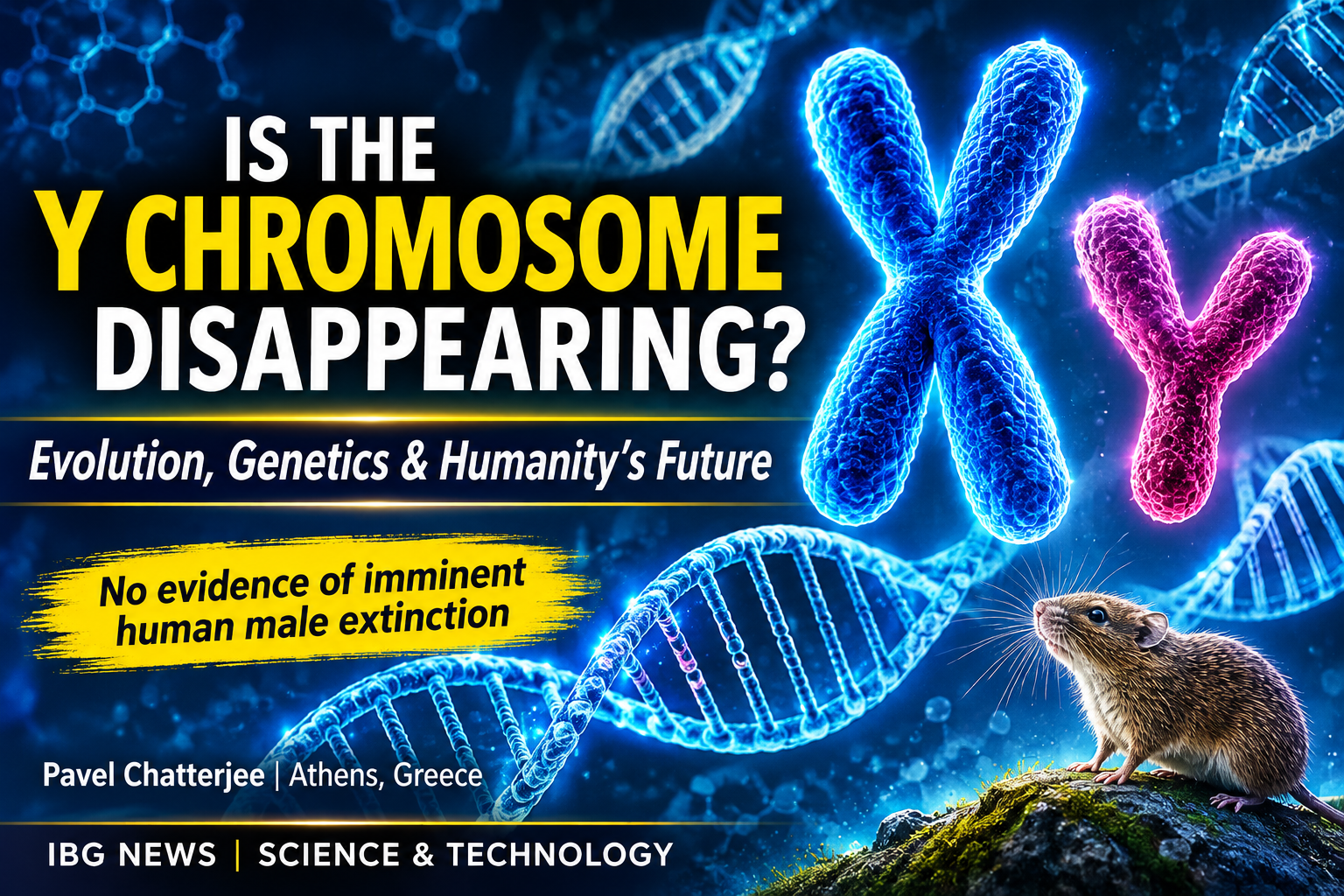
However, an important scientific distinction must be made at the outset: The evolutionary reduction of the Y chromosome does not mean that men are facing imminent extinction. There is currently no reliable scientific evidence establishing that the human male population will inevitably disappear in the foreseeable future.
1. X and Y Chromosomes: The Genetic Foundation of Human Sex Determination
The human body normally contains 46 chromosomes, arranged in 23 pairs. Of these, 22 pairs are autosomes, while the remaining pair consists of sex chromosomes.
In the conventional human chromosomal system, females generally have XX chromosomes, while males generally have XY chromosomes.
The mother’s egg typically carries an X chromosome, whereas the father’s sperm carries either an X or a Y chromosome. When an X-bearing sperm fertilises an egg, the resulting chromosomal combination is generally XX. When a Y-bearing sperm fertilises the egg, the combination is generally XY.
An important component of the Y chromosome is the SRY gene (Sex-determining Region Y), which plays a major role in initiating the development of the male reproductive system during embryonic development.
Although the Y chromosome has a significant role in conventional human sex determination, biological sex development is a complex process involving multiple genes, hormones and developmental mechanisms.
2. Why Has the Y Chromosome Become Smaller?
Evolutionary research indicates that the X and Y chromosomes originated from an ancient pair of ordinary chromosomes.
Over millions of years, the Y chromosome lost a considerable number of its original genes and became substantially smaller.
One important reason is the limited genetic recombination between the X and Y chromosomes.
Recombination is a biological process through which corresponding chromosomes exchange segments of DNA. This process contributes to genetic diversity and can help remove certain harmful genetic variations over evolutionary time.
However, most regions of the Y chromosome do not undergo ordinary recombination with the X chromosome. This limitation has contributed to the evolutionary loss of genes over long periods.
Nevertheless, historical gene loss does not establish that the human Y chromosome is currently shrinking rapidly with every generation.
Research has not established a reliable timeline for the complete disappearance of the human Y chromosome. It would therefore be scientifically inaccurate to interpret its evolutionary history as proof of imminent extinction.
3. Understanding DNA, Genes and Chromosomes
To understand this debate, it is useful to distinguish three fundamental elements of genetics.
DNA (Deoxyribonucleic Acid): DNA is the molecule that stores hereditary information in living organisms. Its structure is commonly described as a double helix, resembling a twisted ladder.
Gene: A gene is a specific segment of DNA containing instructions involved in producing proteins and regulating biological functions and characteristics.
Chromosome: A chromosome is an organised structure consisting of DNA and associated proteins. It stores genetic information within cells.
Together, DNA, genes and chromosomes form the foundation of heredity, influencing physical characteristics, inherited tendencies and numerous biological processes.
4. Genetic Recombination and Human Evolution
Human reproduction involves the contribution of 23 chromosomes from the mother’s egg and 23 chromosomes from the father’s sperm, producing the usual total of 46 chromosomes.
During the formation of reproductive cells, a specialised cell division process called meiosis takes place. During this process, genetic material can be exchanged between corresponding chromosomes through recombination.
This creates new combinations of inherited genetic information. Consequently, children inherit characteristics from both parents while possessing a distinct genetic combination of their own.
Genetic variation is fundamental to evolution. Environmental changes, natural selection and genetic mutations collectively influence how populations change over successive generations.
Although most of the Y chromosome has limited recombination with the X chromosome, it possesses its own mechanisms for maintaining and preserving important genetic sequences.
Therefore, the Y chromosome should not be considered biologically inactive or inevitably approaching extinction.
5. Can Male Mammals Exist Without a Y Chromosome?
One of the most fascinating discoveries in evolutionary biology is that certain mammalian species have developed alternative sex-determination systems without a conventional Y chromosome.
Two notable examples illustrate this phenomenon.
The Japanese Spiny Rat
The Amami spiny rat, scientifically known as Tokudaia osimensis, is found on Amami Ōshima Island in Japan.
Remarkably, both male and female members of this species lack the conventional Y chromosome. The species also does not possess the SRY gene commonly associated with male development in humans and many other mammals.
Research has identified alternative genetic mechanisms involved in determining sex in this species.
This demonstrates that the conventional Y chromosome is not the only possible genetic mechanism through which male development can occur in mammals.
Mole Voles
Certain species belonging to the genus Ellobius, commonly known as mole voles, also lack a Y chromosome.
In some species, both males and females possess an XO chromosomal arrangement. In other species, both sexes have an XX arrangement, with alternative genetic mechanisms determining sexual development.
These examples demonstrate an important principle of evolutionary biology: different species can develop alternative genetic systems for sex determination.
However, the existence of these mechanisms in other mammals does not establish that the same evolutionary pathway will occur in humans.
6. The Importance of the SRY Gene in Male Development
The SRY gene, located on the human Y chromosome, plays a critical role in the development of the male reproductive system.
During early embryonic development, the activation of SRY initiates a sequence of genetic signals that contributes to the formation of testes. Hormonal processes subsequently influence the development of male reproductive structures.
However, biological sex development is not controlled by a single gene alone.
Multiple genes, hormonal signals, cellular interactions and developmental processes work together to determine the characteristics of the reproductive system.
The SRY gene is therefore highly significant, but the entire process cannot be reduced to the function of one genetic component.
7. Inbreeding and the Importance of Genetic Diversity
Another important aspect of genetics is inbreeding, particularly marriage or reproduction between closely related individuals.
When closely related individuals reproduce, there is an increased probability that their children will inherit identical copies of harmful recessive genetic variants.
This can increase the risk of certain inherited disorders, congenital conditions and other genetic complications.
Historically, several royal families, including those of ancient Egypt, practised marriages between close relatives to preserve dynastic inheritance, political authority and family property.
Modern genetic investigations into the family history of Pharaoh Tutankhamun have provided important insights into the possible consequences of royal inbreeding and its association with certain health problems.
This illustrates why genetic diversity is important for population health and long-term evolutionary development.
8. Would the Disappearance of the Y Chromosome Mean the Extinction of Humanity?
This is perhaps the most significant and controversial question in the entire debate.
Evolutionary biology has established that different animal species can develop alternative systems of sex determination. The Japanese spiny rat and certain mole voles provide important examples.
Theoretically, if the present genetic role of the human Y chromosome were ever to change significantly in the distant future, alternative genetic mechanisms could become a subject of scientific investigation.
However, two separate issues must be distinguished.
First, the human Y chromosome has experienced gene loss throughout its evolutionary history.
Second, this historical process does not establish that men will inevitably disappear or that humanity itself will become extinct.
Current scientific research has not established a reliable timeline predicting the complete disappearance of the human Y chromosome.
Consequently, dramatic predictions about the extinction of men should not be confused with established scientific conclusions.
Understanding the actual mechanisms of genetic evolution is far more important than making unsupported predictions about humanity’s future.
9. The Future of Humanity: Could Nature Develop an Alternative Path?
Evolution does not operate according to a predetermined plan. It is influenced by environmental conditions, genetic variation, natural selection and reproductive success.
Future genetic changes in humans will depend on numerous biological and environmental factors.
Meanwhile, artificial intelligence, gene-editing technologies, genetic disease screening and advanced reproductive technologies are creating new possibilities in medicine and human biology.
However, technological progress and the natural evolution of the Y chromosome are separate scientific subjects. There is currently no established scientific evidence connecting the development of artificial intelligence with the genetic disappearance of men.
If human reproductive biology undergoes significant changes in the distant future, understanding their nature and consequences will require extensive research and long-term scientific observation.
Conclusion: The Mystery of Evolution Matters More Than Predictions of Extinction
The evolutionary history of humanity demonstrates that change is a natural feature of biological existence.
Research into the Y chromosome, genetic recombination and alternative sex-determination mechanisms is expanding our understanding of human biology and evolutionary possibilities.
However, the historical reduction in the genetic content of the Y chromosome cannot be interpreted as proof that men are destined to disappear.
The more important scientific question is whether nature can maintain reproduction and biological continuity through different genetic mechanisms.
Species such as the Japanese spiny rat and mole vole demonstrate that evolution can produce biological systems that differ considerably from conventional patterns.
Humanity’s genetic future remains an important field of scientific investigation. But definitive predictions about that future would be premature.
Is the extinction of the male species a genuine possibility, or is it an evolutionary question that requires much more scientific investigation? Current evidence provides no reason for alarm. Understanding humanity’s genetic future will require research, evidence and a careful appreciation of the extraordinary complexity of evolution.
Author: Pavel Chatterjee
Location: Athens, Greece
Publication: IBG NEWS | Science & Technology
Editorial note: This article presents the evolutionary and genetic discussion while distinguishing established scientific findings from theoretical possibilities. The loss of Y-chromosome genes over evolutionary time should not be interpreted as proof of imminent human male extinction.

