













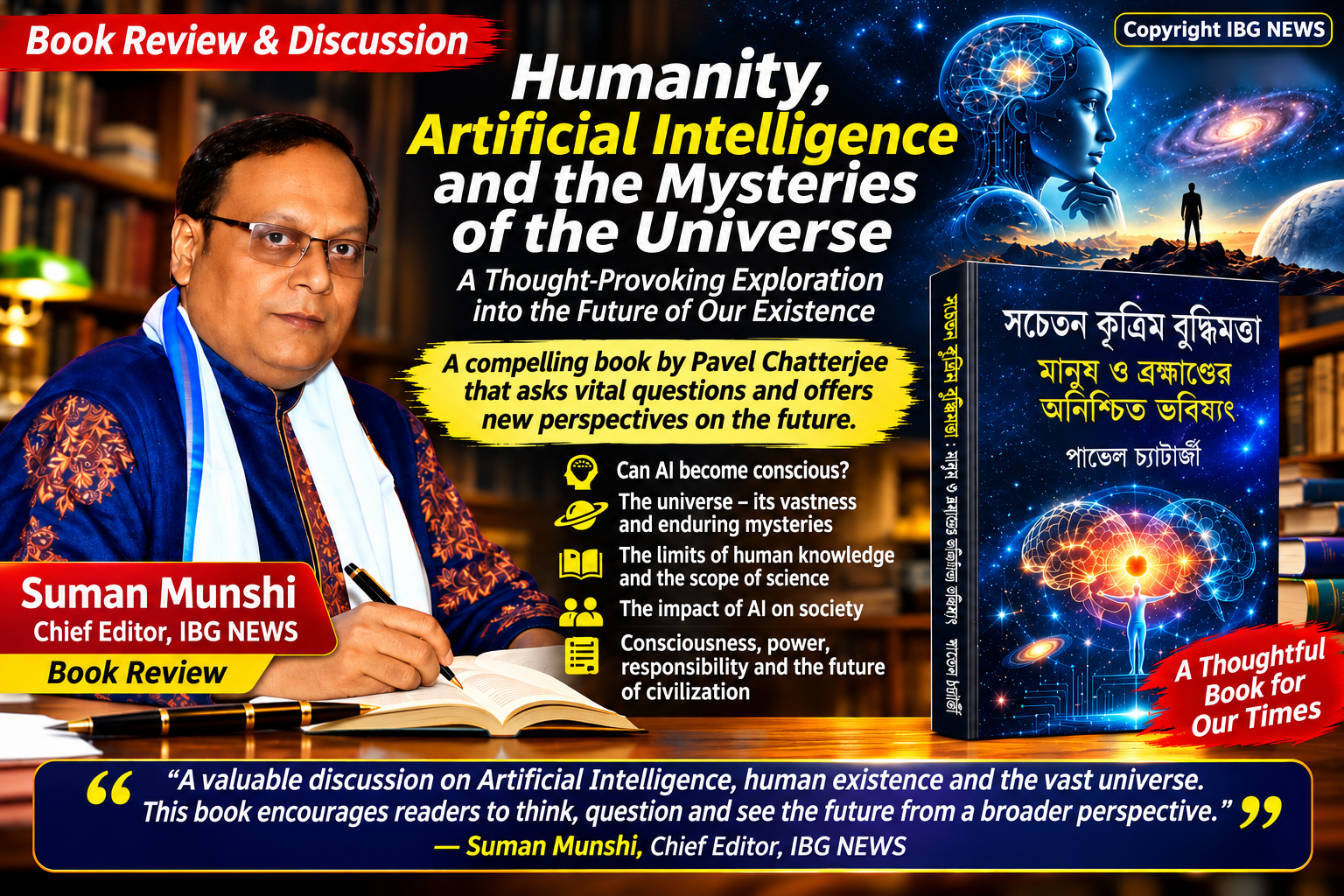

Humanity, Artificial Intelligence and the Mysteries of the Universe: A Different World of Thought as We Stand Before the Future
Pavel Chatterjee’s Book Encourages Us to Think, Question and Explore the Unknown
Book Reviewer: Suman Munshi
Chief Editor, IBG NEWS
Book: Conscious Artificial Intelligence: The Uncertain Future of Humanity and the Universe
Author: Pavel Chatterjee
Publisher: Lalmati Publication
Publication Date: 31 July 2026
Print Length: 100 pages
Language: Bengali
Country of Origin: India
ASIN: B0HDCDGVXD
Gratitude to the Author and the Responsibility of an Impartial Reviewer
First and foremost, I would like to express my sincere gratitude and respect to the author, Pavel Chatterjee. His recognition of the contribution made by IBG NEWS and Suman Munshi towards the initial publication and development of the ideas explored in his book is undoubtedly an honour and a source of great satisfaction.
When an idea initially published in one forum subsequently becomes part of a wider intellectual discussion, and the author himself acknowledges its origins with gratitude, it brings particular satisfaction to a journalist and editor. This recognition is not merely a personal honour for me; it is also a memorable moment in the publishing journey of IBG NEWS.
However, this recognition also increases my responsibility as a book reviewer. Since the author has directly associated my name and IBG NEWS with the inspiration behind his book, I must ensure that personal gratitude, mutual respect or emotional considerations do not influence the impartiality of my assessment.
I must admit that reviewing a book under such circumstances is not easy. On one hand, there is genuine gratitude for the author’s recognition; on the other, there is the responsibility to uphold journalistic integrity and the intellectual independence expected of a critic.
Therefore, while maintaining my respect for the author, I have attempted to examine the book’s content, intellectual scope, logical arguments and scientific perspective as objectively as possible.
I believe genuine respect is not limited to praise. It is also expressed through independent opinions, reasoned discussion and the courage to raise necessary questions.
Personal gratitude belongs to the heart, while impartiality in literary criticism belongs to one’s conscience and professional responsibility. A reviewer must give equal importance to both.
I once again extend my sincere thanks to Pavel Chatterjee for his recognition and graciousness.
As We Look Towards the Future, Has Humanity Begun to Reconsider Its Own Existence?
Human beings once learned to make fire, invented the wheel and dreamed of flying through the skies. Today, that same humanity has developed a technology capable of writing on our behalf, creating images, helping solve complex problems and engaging in conversations with us.
This technology is known as Artificial Intelligence (AI).
But is this where the story ends? Or are we witnessing the beginning of a much larger story?
If machines can understand human language, analyse enormous volumes of information, propose new solutions and imitate aspects of human thought, what makes human intelligence unique? In which direction will the relationship between humans and machines evolve? And what might ultimately emerge from this rapid technological transformation?
Pavel Chatterjee’s book, Conscious Artificial Intelligence: The Uncertain Future of Humanity and the Universe, places readers before precisely these kinds of questions.
Its intellectual scope is not confined to technology. It extends into deeper subjects, including human existence, consciousness, the limits of knowledge, the nature of the universe and the possible direction of future civilisation.
We live in an era when technological change is transforming much more than the way we work. It is reshaping our thinking, employment, social relationships and expectations about the future.
Against this background, the subject chosen by the author is undoubtedly timely.
Is AI Merely a Machine, or Does It Present a New Philosophical Question for Humanity?
Artificial Intelligence is being discussed across the world. Some see extraordinary opportunities for progress, while others fear employment disruptions, the devaluation of human creativity and excessive dependence on technology.
The reality is that AI is creating new possibilities in medicine, education and research. At the same time, its misuse can create risks involving the spread of misinformation, violations of personal privacy and interference with human freedom of decision-making.
Beyond these concerns lies a much deeper question: Is intelligence simply the ability to analyse information and solve problems, or does it also involve consciousness, subjective experience and an awareness of one’s own existence?
There is no simple answer to this question.
The fact that an AI system can communicate in human-like language does not establish that it possesses consciousness comparable to that of a human being. Intelligence, consciousness and self-awareness are distinct concepts, and their relationship remains an important subject of scientific and philosophical debate.
The title of this book reminds us of this very debate. One of its attractions is the opportunity it creates to consider technological progress and human identity together.
For me, this is where the importance of the discussion lies. As technology becomes increasingly sophisticated, humanity must think more deeply about what we are creating, why we are creating it and how prepared we are to accept responsibility for our creations.
How Much Does Humanity Really Know in the Vastness of the Universe?
One of humanity’s greatest characteristics is curiosity.
Looking towards the sky, people once began asking what lay beyond the stars. How did the Earth originate? How vast is the universe? Where did time begin?
Such questions have driven the advancement of knowledge and scientific exploration.
That journey has not yet ended.
We know considerably more about outer space today than our ancestors did. Yet countless mysteries of the universe remain unresolved. Every new discovery expands the boundaries of human knowledge while often giving rise to further questions that may require decades of research.
Considering the possibilities of Artificial Intelligence within the broader context of the universe can take readers beyond familiar technological discussions.
However, science explains the world through evidence, while philosophy often raises questions about meaning and significance. These two disciplines can enrich one another, but their methods are not identical.
Any proposition concerning the origin, destruction or future of the universe must be supported by reliable evidence before it can be accepted as scientific fact.
It is equally important to maintain a clear distinction between established scientific information, philosophical speculation and personal belief.
In my opinion, reflective works such as this book should be approached with precisely this awareness.
Not every question needs an immediate answer. Sometimes, discovering the right question is itself the most important step in the pursuit of knowledge.
The Intellectual Curiosity of Ancient Thinkers and the Journey of Modern Science
The history of human intellectual exploration stretches back thousands of years.
Ancient philosophers, sages and thinkers raised questions about nature, life, consciousness and the existence of the world. Modern scientists are investigating some of these questions through different methods, using observation, experimentation, mathematics and evidence.
There may be a shared desire to understand the unknown between these two eras. However, ancient philosophy and modern experimental science should not be treated as identical.
They differ significantly in their methods of verifying truth and the standards of evidence they employ.
Nevertheless, humanity’s curiosity has survived across generations. Some questions that once remained within the realm of philosophical discussion have now become subjects of scientific investigation. Others continue to require contributions from both science and philosophy.
In the age of Artificial Intelligence, this spirit of inquiry has become even more important.
We are no longer merely attempting to understand nature; we are also creating systems that can actively assist us in the pursuit of knowledge.
Yet, no matter how powerful machines become, the responsibility for verifying information, evaluating the validity of reasoning and ensuring the appropriate use of knowledge remains with human beings.
The Book Through Readers’ Eyes: Presenting Complex Ideas in Accessible Language
The value of a book is not limited to the author’s statements. What readers think after reading it, the questions they raise and the connections they discover with their own experiences are equally important.
The reader responses available about this book reveal several interesting aspects of its subject matter.
In his comments, Apu Swapna Bhattacharya described the subject matter as interesting. His observations also suggest that examining different sections of the discussion separately could help make certain ideas clearer.
On the other hand, Tapas Chakraborty appreciated the author’s effort to present complex subjects in an accessible and understandable language.
These responses are significant.
When books explore science, technology and philosophy, clarity of language plays a particularly important role in reaching ordinary readers. Explaining complex subjects in a way that allows readers to think independently is no easy task.
Of course, a handful of reader comments cannot establish the quality of every argument or scientific proposition in a book. Such an assessment requires examining the complete text, its references and the consistency of its reasoning.
Nevertheless, creating curiosity, encouraging readers to confront new questions and initiating meaningful discussion are also valuable contributions of an intellectually stimulating book.
Aspects of the Book That Particularly Encourage Reflection
Considering the subject matter and reader responses, several aspects of the book deserve particular attention.
First, the subject is highly relevant to our times.
Artificial Intelligence is no longer a distant vision of the future. It has already become part of everyday life. Discussion about its possibilities, limitations and impact on human society is therefore essential.
Second, the book draws attention to larger questions.
Discussions about AI are often restricted to technological benefits, employment or productivity. Connecting these discussions with human consciousness, existence and the future of the universe creates opportunities for a wider intellectual exploration.
Third, the book offers scope for active reader participation.
The accompanying comments suggest that readers have expressed their opinions about its subject matter. When a book encourages readers to question, disagree or begin thinking in new ways, it succeeds in creating a space for discussion.
However, a definitive assessment of the book’s scientific reliability, factual accuracy and depth of reasoning would require a complete reading and careful verification of its arguments.
This is particularly important when discussing AI consciousness and the future of the universe. Established scientific findings, philosophical speculation and the author’s personal interpretations must remain clearly distinguishable.
Such caution does not diminish the importance of the book. Rather, it makes the reading experience more meaningful.
Printing, Binding and Cover Design: A Beautiful Combination of Content and Presentation
The overall quality of a book is determined not only by its content but also by the clarity of printing, durability of binding, aesthetics of the cover and accuracy of editing.
In this respect, Lalmati Publication deserves appreciation for its commendable work in printing and binding this book.
There is a pleasing balance between the quality of the publication and the importance and scope of its subject matter. The printing presentation and binding give the book a well-organised and attractive appearance.
The cover artwork is particularly appealing.
Its thoughtful and serious visual atmosphere naturally creates curiosity about the book’s central themes: Artificial Intelligence, humanity and the uncertain future of the universe.
The cover is not merely attractive; it is also closely aligned with the subject matter. This connection between the visual presentation and the book’s intellectual content makes the publication more engaging for readers.
However, there is also room for improvement in producing an even more polished edition.
A few printing and proofreading errors are noticeable in the book. Such mistakes can occur unintentionally in any publication. But when a work revolves around science, philosophy and complex intellectual discussions, accuracy of language, clarity of sentences and appropriate use of terminology become particularly important.
More careful proofreading and final editorial checks in a future edition could correct these shortcomings. This would improve readability and allow readers to concentrate more closely on the subject matter.
Overall, Lalmati Publication has delivered an appealing presentation through commendable printing and binding, attractive cover artwork and a good balance between the publication’s presentation and intellectual content.
With a few printing and proofreading errors corrected, the next edition could become even more refined and approach a nearly flawless standard.
I congratulate Lalmati Publication for these positive aspects of the book. At the same time, I believe that closer attention to editing and proofreading in future editions would further enhance its overall quality.
Ultimately, the Question Is Not Just About AI, but About Humanity
There can be numerous predictions about how advanced Artificial Intelligence may become in the future.
But a more important question is how humanity will choose to direct this technology.
Will we use AI to expand human knowledge, improve medical treatment, broaden educational opportunities and find solutions to difficult problems?
Or, in the absence of appropriate regulation and responsibility, could this technology become another source of inequality, confusion and uncertainty?
The answers do not rest solely in the hands of technologists.
Scientists, philosophers, teachers, policymakers, journalists and ordinary citizens all have a role to play in this discussion.
I believe technological progress will truly advance human welfare only when it is accompanied by ethics, humanity and accountability.
Increasing the capabilities of machines is important, but ensuring the responsible use of those capabilities is equally essential.
Pavel Chatterjee’s Conscious Artificial Intelligence: The Uncertain Future of Humanity and the Universe can serve as an interesting starting point for this broader discussion.
The very title of the book reminds us that the time to reflect on technology and the future of human civilisation is now.
What conclusions readers reach after reading the book will ultimately depend on their own judgement.
However, if the book encourages readers to reconsider the capabilities of Artificial Intelligence, the distinctiveness of human existence and our position in the universe, then the value of that intellectual engagement is undeniable.
Because understanding the future requires us not only to look at technology, but also to look at ourselves.
Humanity’s true strength lies not merely in intelligence, but also in the ability to acknowledge its limitations, the courage to ask questions and the wisdom to use acquired knowledge for the welfare of all.
And that is precisely why human beings must remain at the centre of every discussion about the future of Artificial Intelligence.
Book Reviewer: Suman Munshi
Chief Editor, IBG NEWS
Original Bengali publication: 30 October 2026
Book: Conscious Artificial Intelligence: The Uncertain Future of Humanity and the Universe
Author: Pavel Chatterjee
Publisher: Lalmati Publication

