












Netanyahu Loses Parliamentary Majority: Gadi Eisenkot Gets Opportunity to Form Israel’s Next Government – A Geopolitical Turning Point
By Suman Munshi | IBG NEWS
8 November 2026
Israel’s Political Uncertainty Could Reshape Middle Eastern Diplomacy, Security Alliances and the Regional Balance of Power
Israel is entering a potentially transformative political phase after Prime Minister Benjamin Netanyahu’s governing bloc failed to secure a parliamentary majority in the October 27 general election. President Isaac Herzog has selected opposition leader and former Israel Defense Forces (IDF) Chief of Staff Gadi Eisenkot to attempt to form the next government.
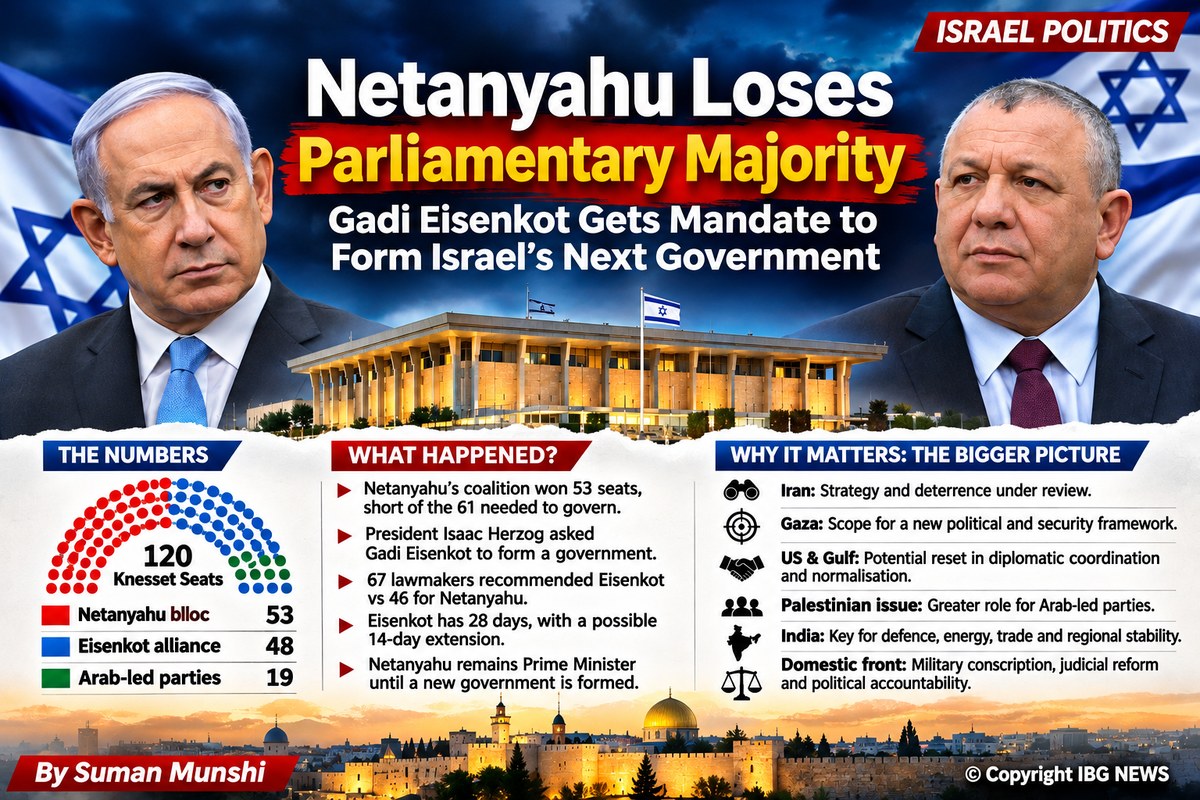
The election has produced a fragmented 120-member Knesset. Netanyahu’s political bloc secured 53 seats, while Eisenkot’s opposition alliance won 48. Arab-led political parties captured the remaining 19 seats, emerging as potentially decisive participants in the government formation process.
During presidential consultations, 67 lawmakers recommended Eisenkot, compared with 46 who backed Netanyahu. Eisenkot has 28 days to negotiate a government, with a possible 14-day extension.
However, Netanyahu has not yet been removed from office. He remains Prime Minister until a successor successfully forms a government and obtains parliamentary confidence.
This is more than an ordinary leadership contest. Israel’s political transition comes amid continuing regional conflicts, tensions with Iran, uncertainty over Gaza, security challenges along the Lebanese border and growing international scrutiny of Israeli policy.
The consequences could extend well beyond Jerusalem.
1. Netanyahu’s Political Setback: The Arithmetic of Power
Netanyahu’s Likud remains the largest individual party, but the combined strength of his right-wing and religious allies is insufficient to command a parliamentary majority.
Eisenkot has received broader support during the presidential consultations, but his own political alliance also falls short of the 61 seats required to govern.
The 19 Arab-led lawmakers have consequently acquired considerable negotiating influence.
Yet their recommendations should not be mistaken for a confirmed coalition agreement. Deep political disagreements remain, particularly over Palestinian policy, national security and the participation of Arab parties in government.
The immediate challenge for Eisenkot is converting parliamentary support into a functioning administration.
2. Gadi Eisenkot: A Military Commander Facing a Political Test
Eisenkot brings substantial military experience to the political contest. His background as a former IDF chief of staff gives him an established understanding of Israel’s defence establishment and regional security environment.
His political approach could place greater emphasis on institutional accountability, military preparedness and diplomatic coordination.
Three issues will define his leadership challenge:
- Gaza: Developing a sustainable political and security framework beyond military operations.
- National security: Maintaining deterrence against Iran and regional armed groups while managing international relationships.
- Domestic reform: Addressing judicial reform, military conscription and the accountability questions arising from the October 7, 2023 attacks.
However, military experience does not automatically translate into coalition-building ability. Eisenkot must reconcile political groups with sharply different ideological priorities.
3. Iran: Will Israel’s Strategic Approach Change?
Iran remains one of Israel’s principal security concerns because of its nuclear programme, missile capabilities and relationships with regional armed groups.
A change of government could alter the diplomatic management and political presentation of Israel’s Iran policy, but a fundamental abandonment of Israeli security concerns is unlikely to follow simply from a change in leadership.
An Eisenkot administration could seek closer coordination with Washington, particularly over military escalation and regional deterrence.
For Tehran, Israel’s political uncertainty may create an opportunity to reassess regional diplomatic calculations. However, Israel’s military and intelligence institutions retain considerable continuity regardless of the governing coalition.
The central question is whether Israel will prioritise a more coordinated deterrence strategy or continue relying heavily on military pressure.
4. Gaza and Lebanon: The Limits of Military Solutions
The Gaza conflict remains a defining challenge for Israel.
The October 7 attacks fundamentally changed Israeli security perceptions. The subsequent war has generated enormous humanitarian consequences and international pressure, while leaving unresolved questions about Gaza’s future governance.
A new administration could reconsider the balance between military objectives, hostage negotiations, humanitarian access and a sustainable post-war political arrangement.
However, meaningful progress would require difficult negotiations involving Palestinian political representatives, regional governments and international partners.
Lebanon presents another challenge. Hezbollah’s military capabilities and its relationship with Iran remain important factors in Israel’s northern security calculations.
A new government may reassess the balance between military deterrence and diplomatic arrangements to prevent another devastating confrontation.
Neither challenge can be resolved simply by replacing the Prime Minister.
5. Washington’s Role: Strategic Partnership Beyond Political Personalities
The United States remains Israel’s most important strategic partner, with extensive defence, intelligence and diplomatic cooperation.
Netanyahu’s departure, if it occurs, would not automatically dismantle this relationship.
Nevertheless, an Eisenkot government could create opportunities for a different diplomatic relationship with Washington, especially concerning Iran, Gaza and regional security.
American policymakers will remain concerned about escalation that could draw the United States into another major Middle Eastern conflict.
The new Israeli leadership’s ability to coordinate military decisions with Washington could therefore become an important determinant of regional stability.
6. Saudi Arabia and the Gulf: The Future of Normalisation
The possibility of wider Arab-Israeli normalisation remains strategically important.
The UAE has already established diplomatic relations with Israel through the Abraham Accords. Saudi Arabia’s potential normalisation, however, involves considerably broader questions, including Palestinian statehood, regional security guarantees and American defence commitments.
An Israeli administration willing to pursue meaningful diplomatic engagement on the Palestinian question could potentially create additional opportunities.
But Saudi Arabia’s decisions will also reflect its independent strategic, economic and security priorities.
For Israel, the challenge is to convert its technological and military advantages into lasting regional diplomatic relationships.
7. The Palestinian Question: A New Parliamentary Reality
The combined 19 seats held by Arab-led political parties represent a significant development in Israeli parliamentary politics.
Their recommendations helped Eisenkot secure the largest number of endorsements during presidential consultations.
This creates an unusual political situation: parties representing Arab citizens of Israel have acquired substantial influence over the formation of a potentially new government, despite considerable ideological disagreements with several opposition partners.
Their priorities include public safety, housing, equality and the treatment of Arab communities within Israel.
However, parliamentary cooperation should not be confused with agreement over Gaza, Palestinian statehood or Israeli military policy.
Whether Eisenkot can accommodate their support without fracturing his political alliance will be one of the defining tests of his negotiations.
8. India: Strategic Interests Across a Changing Middle East
India has strong reasons to follow Israel’s political transition carefully.
India-Israel relations encompass defence technology, agriculture, water management, cybersecurity, intelligence cooperation and innovation.
But India’s West Asia strategy extends considerably further.
New Delhi also maintains important relationships with Iran, Saudi Arabia, the UAE and other Gulf countries.
Four major considerations are particularly relevant:
- Defence: Continuity in military technology and strategic cooperation with Israel.
- Energy: Protection of oil and gas supplies against regional instability.
- Trade: Safeguarding maritime connectivity and international commercial routes.
- Indian diaspora: Protecting the interests of millions of Indian citizens working across Gulf economies.
India’s diplomatic advantage lies in maintaining constructive relationships with competing regional powers rather than depending on a single political partnership.
A stable Israeli administration would serve India’s broader interest in regional predictability.
9. The Domestic Battle: Military Conscription and Judicial Reform
Two domestic issues could determine whether Eisenkot can establish a sustainable coalition.
The first is military conscription. The long-standing exemptions enjoyed by sections of the ultra-Orthodox community have become increasingly controversial as Israel faces continuing military manpower demands.
Eisenkot’s support for broader military or national service could attract secular and nationalist political groups but create resistance among religious parties.
The second issue is judicial reform. Israel’s dispute over the balance of power between the judiciary and elected government has divided society and political institutions.
An Eisenkot-led administration could seek to reverse or revise important elements of Netanyahu’s judicial overhaul programme.
Both issues have consequences beyond domestic politics because institutional stability and military preparedness are essential to Israel’s long-term strategic position.
10. What Happens Next? Three Political Possibilities
Israel now faces three broad possibilities.
First: Eisenkot successfully forms a government.
A coalition agreement could produce a change in domestic policy, greater institutional accountability and a reassessment of Israel’s diplomatic approach. Its stability would depend on difficult compromises.
Second: A broad national unity arrangement emerges.
A government involving Likud and opposition parties could provide wider parliamentary support, but disagreements over Netanyahu’s leadership, judicial reform, military service and the October 7 security failures would remain significant.
Third: Coalition negotiations collapse.
If Eisenkot cannot establish a viable government, another candidate could be given an opportunity. Continued deadlock could ultimately result in another election.
Netanyahu would remain caretaker Prime Minister until a successor is installed.
11. The Larger Geopolitical Picture: Leadership Change or Strategic Reset?
The most important question is not simply whether Netanyahu will leave office.
Israel must confront a broader set of interconnected challenges:
- Preventing a wider confrontation with Iran.
- Establishing a sustainable framework for Gaza.
- Managing security along the Lebanese border.
- Preserving strategic relations with the United States.
- Rebuilding diplomatic confidence with European and Arab partners.
- Addressing domestic political divisions and institutional accountability.
- Maintaining military preparedness without indefinitely expanding the burden on Israeli society.
A new government could change the priorities and methods through which these challenges are addressed. It cannot automatically eliminate the underlying conflicts.
For Iran, the Gulf states, Washington, Europe and India, the leadership transition is therefore an important strategic development to monitor.
Conclusion: Netanyahu’s Political Dominance Is Under Pressure, but the Final Outcome Remains Uncertain
Benjamin Netanyahu has suffered a major parliamentary setback, and Gadi Eisenkot has received the opportunity to attempt to form Israel’s next government.
However, the opposition’s parliamentary advantage does not guarantee a stable governing coalition. Ideological differences, the role of Arab-led parties and disagreements over religious exemptions and judicial reform could complicate the negotiations.
The coming weeks will determine whether Israel experiences a genuine political transition or another period of prolonged governmental uncertainty.
The consequences will extend beyond Israeli domestic politics. They could influence regional security, Iran policy, Arab-Israeli diplomacy, American strategic calculations and India’s interests across West Asia.
The real test for Israel is whether a change in political leadership can produce a more sustainable balance between national security, democratic accountability and regional diplomacy.
By Suman Munshi
Chief Editor, IBG NEWS
Editorial note: This article distinguishes established election developments from geopolitical interpretation. Possible policy changes and political scenarios are analytical assessments, not confirmed decisions.

