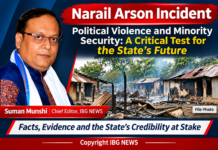











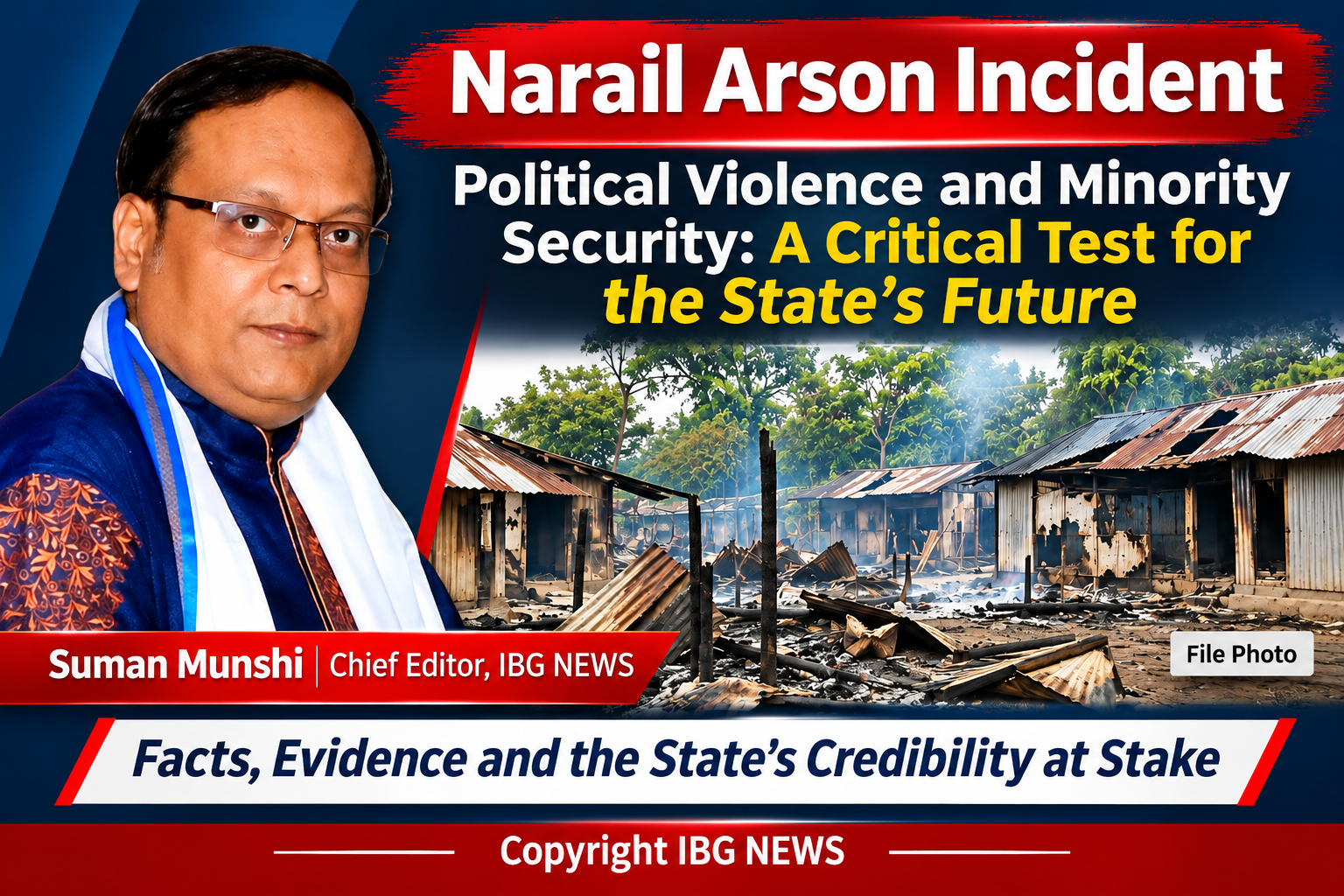

Narail Arson, Minority Security and Bangladesh’s Political Future: A New Test of Public Trust for the State?
Political violence, minority security, the rule of law and regional diplomacy: The Narail incident poses a fresh challenge to Bangladesh’s institutional credibility
Special Analysis | Suman Munshi | Chief Editor, IBG NEWS
The recent incidents of arson and violence in Narail have brought an important question to the forefront of Bangladesh’s political landscape: Following a political transition, is the state capable of ensuring the safety of every citizen and their property, or is the politics of retaliation gaining renewed strength?
The attacks, vandalism, looting and arson reported in Bendar Char village in the Kalia upazila of Narail have triggered various claims across social media, political circles and news platforms. Some have described the incidents as political retaliation, while others have raised concerns about minority security. Police and local administration, meanwhile, have characterised the violence as a consequence of a specific political conflict.
In this situation, the most important requirement is evidence-based analysis rather than conclusions driven by emotion, political positions or social media campaigns.
What Happened in Narail?
According to published news reports, on 18 November 2026, two leaders associated with the Bangladesh Nationalist Party (BNP) were killed in an attack on a motorcycle procession in the Kalia area of Narail. The deceased were Shaheen Molla, a local leader of the Jatiyatabadi Krishak Dal, and Sohel Molla, a leader of the Jatiyatabadi Samajik Sanskritik Sangstha (JASAS).
The BNP and local sources blamed individuals associated with the Awami League for the attack. Police also acknowledged allegations of involvement by activists of the banned Awami League.
Two days later, on 20 November, houses and business establishments belonging to individuals associated with the Awami League in Bendar Char and neighbouring areas were attacked, vandalised, looted and set on fire. Media reports stated that the properties targeted included the residences of former Member of Parliament B.M. Kabirul Haque Mukti and former Kalia Municipality Mayor Fakir Mushfiqur Rahman Liton.
There are discrepancies among different sources regarding the extent of the damage. According to the upazila administration and police, approximately 15–20 houses were attacked. Fire service officials reported that more than 50 residential structures across 20–25 homesteads were damaged by fire. A report published by The Daily Star on 22 November mentioned that at least 40 houses had been damaged.
The final number of affected properties therefore requires verification through official administrative records and an independent investigation.
Claims of Hindu Families Being Targeted: What Does the Evidence Say?
Following the Narail incidents, claims circulated widely on social media that the houses of Hindu families had been attacked and set on fire. However, there are significant differences between these claims, accounts published by news organisations and statements made by the police.
Narail Police have stated that no Hindu family or business establishment was attacked in the Bendar Char area. Police have also alleged that some photographs and videos circulating on social media were old or artificially generated using artificial intelligence.
On the other hand, a report published by Dhaka Tribune on 21 November quoted representatives of the local Hindu community. According to them, there was no Hindu settlement in Bendar Char, and the claim of a mass attack on Hindu families was inaccurate.
However, local Hindu representatives confirmed that the house of Krishna Pada Ghosh, a Hindu political leader associated with the Awami League and a former upazila chairman, had been attacked. They denied reports of attacks on the houses of other ordinary Hindu families in Ghoshpara.
These accounts require two separate considerations:
- The social media claim that hundreds of Hindu homes were attacked has not been reliably established.
- Reports of an attack on the residence of a Hindu political leader have been published and deserve serious investigation.
Therefore, it would be irresponsible journalism to describe the Narail incident as a mass attack on Hindu families without supporting evidence. Equally, it would be unacceptable to ignore allegations concerning the attack on the residence of a Hindu political leader.
Why Has the Incident Become a Matter of National Importance?
Political violence is not new to Bangladesh’s history. However, three factors make the Narail incident particularly significant.
1. The Culture of Political Retaliation
If, following the killing of two political leaders, the houses and properties of numerous individuals associated with a particular political group are targeted instead of pursuing legal action against the accused, it raises serious concerns about the rule of law.
In a democratic state, criminal responsibility rests with individuals. Membership of, support for or family association with a political party does not give anyone the right to impose extrajudicial punishment.
If this cycle of political retaliation continues, a change in political power will not necessarily guarantee the security of citizens.
2. Wider Concerns About Minority Security
Although claims that Hindu families were targeted in the specific Narail incident remain disputed, the question of minority security in Bangladesh is a wider national concern.
In June 2026, the Bangladesh Hindu Buddhist Christian Unity Council (BHBCUC) expressed concern about communal violence and minority security and called upon the government to take effective measures.
In July 2026, the organisation stated that, according to its own documentation and analysis of media reports, 257 incidents of communal violence had occurred during the first six months of the year, resulting in 44 deaths. These figures represent the organisation’s own compilation and should not be treated as numbers established through official government investigations.
Before Durga Puja in October 2026, the organisation also expressed concern about the circumstances in which celebrations were being held under stringent security arrangements involving police, drones and political volunteers.
These statements reflect the organisation’s broader concerns about the security of minority communities in Bangladesh. However, they cannot be used as evidence of what specifically happened in Narail. Every incident requires its own investigation and verification.
3. Bangladesh’s International Image
International human rights organisations, diplomatic circles and foreign investors generally look beyond official statements. They monitor whether investigations are impartial, whether the judicial process is transparent and whether the security of minorities and political opponents is being protected.
When conflicting claims emerge around an incident, it is the government’s responsibility to publish the findings of a prompt and credible investigation. Otherwise, rumours, political propaganda and a crisis of international confidence may intensify.
The Biggest Test Facing the Government
Regardless of which political party is in power, citizens expect three fundamental outcomes in incidents of this nature.
Will Justice Be Delivered?
The investigation into the killing of the two BNP leaders is essential. Equally, those responsible for arson, looting and destruction of property must be brought under the law.
Justice cannot be established by pursuing one crime while ignoring another.
Will the Administration Remain Neutral?
Public confidence will increase if the police, administration and judiciary function independently of political influence. If investigations or judicial proceedings are conducted according to political affiliation, the credibility of state institutions will suffer.
Will the Victims Be Protected?
Ensuring the security, rehabilitation and lawful compensation of affected families, irrespective of their religious identity or political ideology, is the responsibility of the state.
Publishing a list of affected families, conducting an impartial assessment of property damage and providing updates on rehabilitation are equally important.
Minority Security: More Than a Human Rights Issue—An Indicator of State Capacity
Hindus, Buddhists, Christians and other minority communities are integral to Bangladesh’s social, cultural and economic life. Ensuring their security is not a favour granted by any political party; it is a fundamental responsibility of the state.
Whenever allegations of communal attacks emerge in an area, the government’s responsibility is not simply to deny them. It must ensure an impartial investigation, verify the accounts of local residents, protect affected people and bring those responsible to justice.
At the same time, circulating photographs and videos on social media without verifying their authenticity is dangerous. Old or artificially generated visuals can create fresh communal tensions.
Transparent investigations and the publication of verified information remain the most effective ways to counter rumours and political misinformation.
India–Bangladesh Relations in Context
The security of minorities in Bangladesh receives considerable attention in India’s political and public discourse. As a result, incidents of internal violence in Bangladesh can quickly influence public opinion in both countries.
India–Bangladesh relations are not dependent solely on political leadership. Cooperation between the two countries is important in several areas, including trade, border management, energy, connectivity, river-water sharing, the security of Northeast India and strategic interests in the Bay of Bengal.
The spread of misleading information about incidents such as the one in Narail could deepen mistrust between the two countries’ populations. The Bangladeshi administration should therefore publish investigation findings in a timely manner and maintain necessary diplomatic communication with India.
Predicting a border crisis or a major regional conflict on the basis of a single local incident would not be responsible analysis. Evidence-based diplomacy, minority security and the rule of law are instead the foundations on which long-term trust between the two countries can be strengthened.
Why Does This Matter for the Economy?
When political violence becomes prolonged, its consequences extend beyond politics. It can create uncertainty for the country’s investment climate, industrial production, transportation, export supply chains and small businesses.
Potential risks include:
- Reduced confidence among domestic and foreign investors;
- Concerns about the security of industrial zones and business establishments;
- Disruptions to transportation and supply chains;
- Negative effects on tourism and local businesses;
- Greater caution among international development partners when evaluating projects.
There is no basis for concluding that a single incident in Narail will, by itself, create a major crisis for the national economy. However, if similar violence recurs in different regions and the administration fails to control it effectively, pressure on economic confidence could increase.
The Real Questions Facing Bangladesh
Viewing the Narail incident merely as a criminal case or a political confrontation between the BNP and the Awami League would fail to capture the full picture.
The more important questions are:
- Is the culture of political retaliation declining?
- Is the law being applied equally, regardless of political affiliation?
- Do minority communities feel safe?
- Is the state able to distinguish rumours from verified facts?
- How quickly are justice, protection and rehabilitation being provided to those affected?
- Are political parties capable of restraining their activists and supporters from engaging in violence?
The answers to these questions will provide a clearer understanding of Bangladesh’s democratic future, social stability and international standing.
Conclusion: The Time to Rebuild Public Trust Is Now
The large volume of conflicting claims and counterclaims circulating on social media following the Narail arson incident has also exposed weaknesses in Bangladesh’s information environment.
On one side are the actual incidents of arson, vandalism and looting. On the other are conflicting statements about the identities of those affected and whether the violence had a communal character. Together, these circumstances make an independent and transparent investigation even more necessary.
The information currently available identifies the Narail incident as a serious case of political violence. However, reliable evidence has not been established to substantiate the claim that Hindu families were attacked on a large scale. At the same time, published reports concerning the attack on Krishna Pada Ghosh’s residence cannot be ignored.
The state has a responsibility to ensure justice for the killings, identify those responsible for the arson, rehabilitate affected families, address the concerns of minority communities and ensure equal application of the law irrespective of political affiliation.
Bangladesh’s future will not be determined by political slogans or displays of party strength. It will depend on how fairly, impartially and effectively the state protects the lives, property and dignity of its citizens.
The Narail incident is therefore not merely a test of law and order in one district. It is also a test of Bangladesh’s institutional neutrality, democratic maturity and ability to rebuild public trust.
References
- Dhaka Tribune, 21 November 2026 — “Dozens of homes torched in Narail after killing of two BNP leaders”.
- Dhaka Tribune, 21 November 2026 — “Police, Hindu leaders reject communal attack claims in Narail”.
- The Daily Star, 18 November 2026 — “2 killed after AL men swoop in on BNP bike procession in Narail”.
- The Daily Star, 21–22 November 2026 — Reports concerning arson and property damage at homes associated with the Awami League in Narail.
- Bangladesh Hindu Buddhist Christian Unity Council (BHBCUC), 13 June 2026 — Statement concerning communal violence and minority security.
- BHBCUC, 27 July 2026 — The organisation’s documented statistics on communal violence during the first six months of 2026 and its eight-point demands.
- BHBCUC, 15 October 2026 — Statement concerning security arrangements for Durga Puja.
Editorial Note: Claims of widespread attacks on Hindu families in the Narail incident have not been independently established. Statements by local Hindu representatives, police statements and media reports concerning property damage have been considered separately. The BHBCUC statistics have been attributed to the organisation as its own claims and compilation, not presented as officially verified government figures.