










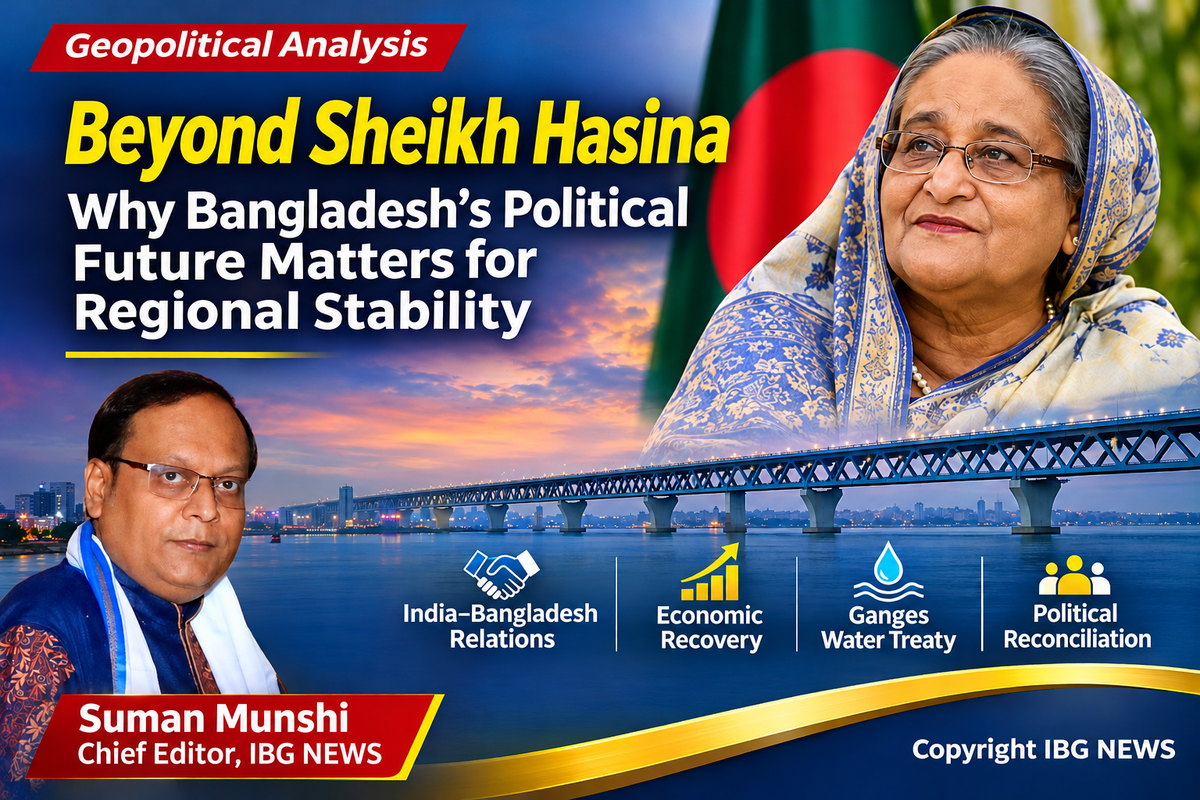

Beyond Sheikh Hasina: Why Bangladesh’s Political Future Matters for Regional Stability
By Suman Munshi | Chief Editor, IBG NEWS
KOLKATA, November 24, 2026: Bangladesh stands at a politically consequential moment. Reports regarding former Prime Minister Sheikh Hasina’s proposed return to Bangladesh on December 16, coinciding with the country’s Victory Day, have reignited debate over accountability, democratic participation, national reconciliation and regional stability. Yet the broader significance of this development extends beyond the political future of one leader. It raises critical questions about Bangladesh’s democratic trajectory, India-Bangladesh relations, Bay of Bengal security and the future balance of power in South Asia.
According to statements attributed to representatives of Sheikh Hasina, the former prime minister intends to return to Bangladesh after more than two years in India following her departure from power in August 2024. Reports indicate that her representatives have requested arrangements for travel from New Delhi to Dhaka using Bangladesh’s national carrier, Biman Bangladesh Airlines. At the time of writing, no official travel arrangements have been publicly confirmed.
Bangladesh’s current government has reportedly rejected proposals for any special arrangement and maintains that any return would need to comply with existing legal processes. Government officials have also indicated that she could face arrest upon arrival based on ongoing and previous legal proceedings.
Authorities in Bangladesh have stated that a court sentenced Hasina to death in absentia in November 2025 in connection with cases arising from the 2024 unrest. Sheikh Hasina and her supporters reject both the charges and the legitimacy of the proceedings, arguing that the cases are politically motivated. The contrasting positions reflect the deep divisions that continue to shape Bangladesh’s political landscape.
The central question is therefore not merely whether Sheikh Hasina returns, but whether Bangladesh can move toward a political framework that balances accountability, democratic participation and institutional stability.
A Political Transition Still Seeking Resolution
Sheikh Hasina’s departure in August 2024 brought an end to approximately fifteen years of uninterrupted Awami League-led government. The mass protests and student-led movement that contributed to the transition reflected grievances related to governance, political freedoms, economic opportunities and public accountability.
Following the interim administration led by Nobel laureate Muhammad Yunus, Bangladesh held parliamentary elections in February 2026. The Bangladesh Nationalist Party (BNP), led by Tarique Rahman, secured a parliamentary majority and formed the government.
The Awami League, however, was excluded from participation under the prevailing legal and political framework. Supporters of this approach argue that accountability for alleged abuses during the previous administration must take precedence before any political normalization can occur. Critics, meanwhile, contend that the long-term exclusion of a major political force risks deepening political polarization and narrowing democratic participation.
This unresolved tension remains one of Bangladesh’s most significant political challenges. The concerns of those who participated in the 2024 movement deserve recognition and respect. Equally, the political rights of citizens who identify with the Awami League cannot simply be disregarded in a pluralistic democratic system.
Bangladesh’s long-term stability will depend on whether institutions can address differences through lawful, peaceful and democratic means rather than prolonged political exclusion.
Why Bangladesh Matters to India
Bangladesh occupies a strategically vital position for India. Sharing one of India’s longest international borders, the country plays an important role in regional trade, connectivity and security cooperation.
During Sheikh Hasina’s tenure, India and Bangladesh expanded cooperation in areas including cross-border security, intelligence sharing, railway connectivity, inland waterways, energy trade, trade facilitation and infrastructure development.
These initiatives were particularly significant for India’s northeastern states, many of which benefit from transit and connectivity arrangements through Bangladesh.
For New Delhi, the challenge today is maintaining productive relations with Bangladesh regardless of changes in political leadership. While Sheikh Hasina’s government cultivated especially close ties with India, policymakers increasingly recognize that long-term bilateral relations should be grounded in institutions, shared interests and people-to-people engagement rather than dependence on any single political figure.
A stable and economically successful Bangladesh remains in India’s strategic interest regardless of which party governs in Dhaka.
Strategic Competition and Bangladesh’s Growing Importance
Bangladesh’s significance has increased alongside growing international interest in the Bay of Bengal and the wider Indo-Pacific region.
China has emerged as a major investor in infrastructure, energy and industrial development projects. India, Japan, the United States and European partners also maintain significant economic, diplomatic and strategic interests in the country.
Bangladesh’s location makes it important for maritime trade routes, logistics corridors and regional security considerations.
The country’s future prosperity may ultimately depend on maintaining balanced relationships with multiple partners while preserving policy independence. Whether under the current government or a future administration, Bangladesh’s foreign policy choices are likely to be guided by national interests rather than alignment with any single external power.
The proposed return of Sheikh Hasina may influence political discourse, but it is unlikely by itself to determine the broader direction of Bangladesh’s relations with Beijing, New Delhi, Washington, Tokyo or Brussels.
Security Challenges in the Bay of Bengal
Bangladesh’s internal stability is closely linked to wider regional security challenges, particularly developments in neighboring Myanmar.
The continuing conflict in Myanmar’s Rakhine State and the unresolved Rohingya refugee crisis continue to impose significant humanitarian, economic and security pressures on Bangladesh.
The country hosts approximately 1.2 million Rohingya refugees. The prolonged absence of safe, voluntary and sustainable repatriation has generated challenges for host communities while creating concerns regarding trafficking networks, organized crime and regional security.
Addressing the crisis requires sustained cooperation among Bangladesh, Myanmar, India, China, ASEAN member states and international organizations.
Political stability and effective governance in Bangladesh would strengthen its ability to advance diplomatic initiatives and protect national interests in an increasingly complex regional environment.
What Matters Most to Ordinary Citizens
For most Bangladeshis, political developments ultimately matter because of their impact on daily life.
The country faces ongoing economic challenges that include inflationary pressures, investment uncertainty, banking-sector concerns and employment needs.
According to the World Bank’s October 2026 Bangladesh Development Update, economic growth is projected at 3.4 percent for FY2026 and FY2027, while structural challenges continue to affect investment, exports and household purchasing power.
A less confrontational political environment could potentially contribute to:
- Greater institutional stability and policy predictability.
- Improved investor confidence.
- Expanded employment opportunities.
- Stronger trade relationships.
- Improved conditions for long-term economic planning.
- Better protection of civil liberties and minority rights.
However, such outcomes are not automatic. They would depend on policy decisions, institutional reforms, economic management and the willingness of political actors to engage constructively.
Some analysts argue that a return by Sheikh Hasina could create opportunities for dialogue if managed through a transparent legal framework. Others contend that it could intensify polarization and political tensions if underlying grievances remain unresolved. Both possibilities deserve consideration.
The Ganges Water Treaty and an Important Deadline
Coinciding with the political developments is another issue of considerable importance: the future of the Ganges Water Sharing Treaty.
Signed on December 12, 1996, during Sheikh Hasina’s first term as prime minister, the agreement is scheduled to expire in December 2026.
The treaty remains critically important for agriculture, irrigation, fisheries, drinking water supplies and livelihoods in both India and Bangladesh.
Discussions surrounding renewal have attracted growing attention from policymakers, particularly in Bangladesh and the Indian state of West Bengal, both of which depend heavily on the Ganges river system.
Sheikh Hasina’s historical role in negotiating the original agreement gives her political legacy continuing relevance. Nevertheless, responsibility for any future arrangement belongs to the current governments of India and Bangladesh, whose decisions will directly affect millions of people.
Justice, Accountability and Reconciliation
No discussion about Bangladesh’s future can overlook the events of July and August 2024.
In February 2025, the United Nations Human Rights Office published findings that it said documented serious human rights violations during the unrest and estimated that up to 1,400 people may have been killed. The report called for accountability and further investigation.
The experiences of victims and their families deserve recognition, transparency and justice.
At the same time, legal proceedings involving former political leaders must adhere to internationally recognized standards of due process, transparency and fairness.
Supporters of accountability argue that justice is essential for healing and institutional credibility. Others warn that accountability efforts must not evolve into collective political punishment or undermine democratic participation.
The challenge for Bangladesh is to pursue accountability while preserving public confidence that legal institutions operate independently and fairly.
A durable national reconciliation process would require both justice for victims and safeguards against future cycles of political retaliation.
Voices Beyond the Major Parties
Any meaningful national conversation must include perspectives beyond the country’s largest political organizations.
Student leaders associated with the 2024 movement have repeatedly emphasized demands for accountability, institutional reform and greater political transparency.
Human rights organizations continue to call for independent investigations into alleged abuses by all actors involved in the crisis.
Minority rights advocates have highlighted concerns regarding communal harmony, equal protection under the law and the need for stronger safeguards for vulnerable communities.
These voices form an important part of Bangladesh’s democratic discourse and should not be overlooked in discussions focused primarily on political leaders and parties.
Three Possible Scenarios
Several outcomes remain possible in the coming weeks.
Peaceful legal return: A mutually agreed legal process could reduce immediate tensions and contribute to a more structured political debate.
Delayed or blocked return: Diplomatic and legal disagreements could postpone or prevent any return, leaving existing disputes unresolved.
Heightened political confrontation: Competing mobilizations, protests or political escalation could increase pressure on governance, economic activity and security.
The ultimate outcome will depend upon decisions made by Bangladesh’s authorities, Indian policymakers, Sheikh Hasina and a range of political stakeholders.
What Should India and the International Community Do?
India’s primary objective should be a stable, sovereign and prosperous Bangladesh.
A constructive approach should emphasize:
- Respect for Bangladesh’s sovereignty and constitutional processes.
- Support for human rights and due process.
- Peaceful management of legal and diplomatic disputes.
- Continued economic cooperation.
- Expanded trade and connectivity initiatives.
- Strengthened border security coordination.
- Renewed efforts to reach a sustainable water-sharing arrangement.
- Cooperation in addressing the Rohingya refugee crisis.
Similarly, China, Japan, the United States and European partners should support Bangladesh’s economic stability, institutional resilience and independent development.
Bangladesh’s future should be shaped primarily by its citizens and institutions rather than becoming an arena for geopolitical competition.
Can Bangladesh Move Beyond Polarization?
The proposed return of Sheikh Hasina has become an important political symbol. Yet the deeper challenge facing Bangladesh extends far beyond the future of one leader.
A healthy democratic system requires mechanisms that allow governments to change peacefully, investigations to proceed independently and citizens to participate in public life without fear or discrimination.
The aspirations of young people who energized the 2024 movement deserve recognition. Likewise, ordinary supporters of the Awami League should not face discrimination solely because of political affiliation.
Bangladesh’s future will depend less on individual personalities and more on the strength of its institutions: an independent judiciary, accountable law enforcement, credible elections, economic opportunity and equal protection under the law.
Conclusion: Bangladesh’s Future Is Larger Than Any One Leader
December 16, 2026, may become an important date in Bangladesh’s political history. Reports of Sheikh Hasina’s proposed return have renewed debate about justice, accountability, democratic participation and regional stability.
A peaceful and legally credible resolution could reduce uncertainty and encourage dialogue. Conversely, a confrontational outcome could deepen divisions and create additional political, diplomatic and economic challenges.
The future of Bangladesh should not be determined solely by the fate of one political leader or one political party. It should be shaped by the aspirations, rights and welfare of its citizens.
Peace requires dialogue. Democracy requires participation. Accountability requires fairness. And sustainable development requires strong and trusted institutions.
The true significance of the Sheikh Hasina question lies not in the future of one individual, but in what it reveals about Bangladesh’s continuing search for political stability, democratic legitimacy and national reconciliation.
Editorial Note: This article distinguishes between verified developments, publicly reported claims and analytical assessments. References to possible political, economic or diplomatic outcomes represent scenarios and analysis rather than predictions. Allegations and legal findings mentioned herein remain subjects of ongoing political, judicial or public debate.