













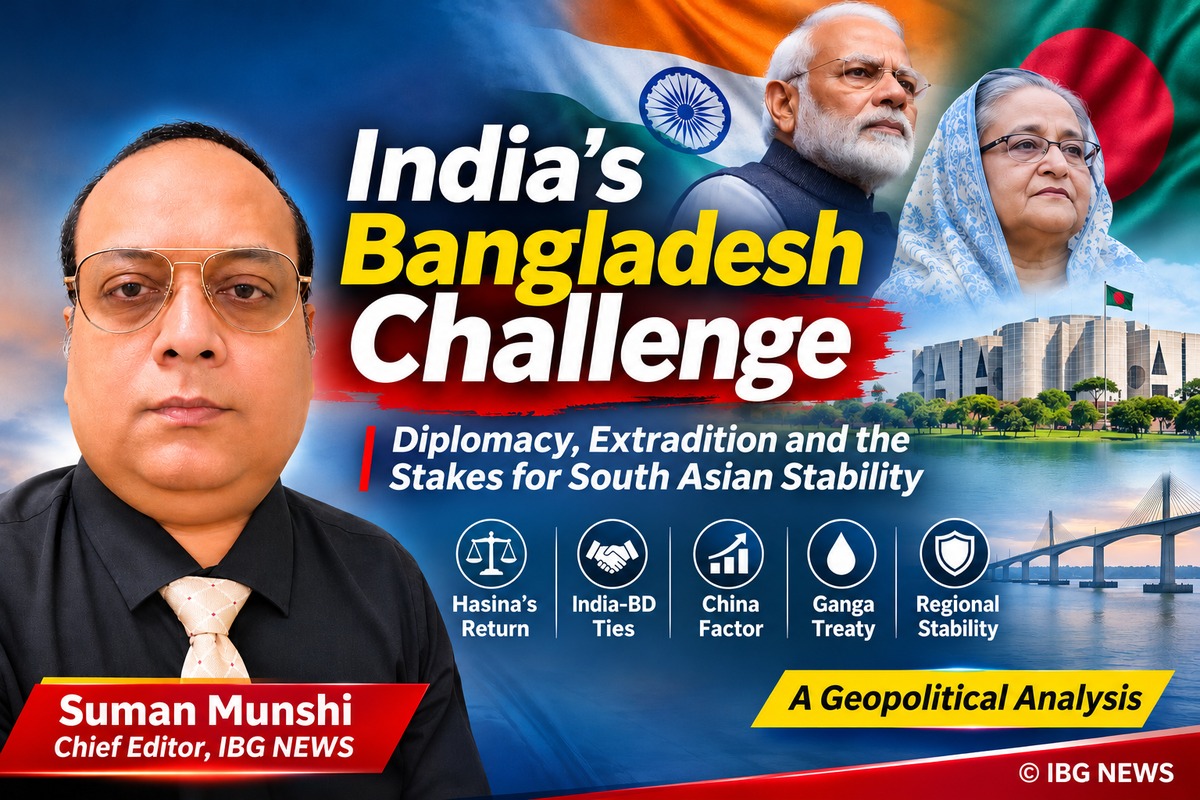

Bangladesh at a Geopolitical Crossroads: Why Narendra Modi’s December Decisions Could Shape South Asia’s Future
Sheikh Hasina’s proposed return, Tarique Rahman’s political challenges, the China factor and the Ganga water treaty place India at the centre of a critical regional moment
By Suman Munshi | Chief Editor, IBG NEWS
Special Geopolitical Analysis | 22 November 2026
December 2026 could become an unusually consequential month for Bangladesh and its relationship with India. A combination of political uncertainty, unresolved legal questions and strategic competition is bringing New Delhi and Dhaka to an important diplomatic crossroads.
Former Bangladeshi Prime Minister Sheikh Hasina has announced her intention to return to Bangladesh in December, after more than two years in India. Her proposed return has become a major political issue for Prime Minister Tarique Rahman’s government, which insists that any such development must follow the legal process and the existing extradition arrangements between the two countries.
At the same time, India faces a wider strategic challenge. Its relationship with Bangladesh affects the security of the northeastern states, regional connectivity, cross-border trade, energy cooperation and the balance of influence in the Bay of Bengal. China’s expanding economic and strategic engagement with Bangladesh adds another dimension.
There is also an important diplomatic deadline approaching: the 30-year Ganga Water Sharing Treaty between India and Bangladesh is due to reach the end of its term in December 2026.
These developments create a larger question: Can Prime Minister Narendra Modi’s government protect India’s strategic interests while building a workable relationship with a politically transformed Bangladesh?
The answer may influence not only bilateral relations but also the future of regional cooperation in South Asia.
1. Sheikh Hasina’s proposed return: A political announcement with international consequences
Sheikh Hasina left Bangladesh in August 2024 following the mass uprising that brought her long tenure as prime minister to an end. She subsequently remained in India.
In November 2026, she reiterated her intention to return to Bangladesh during December. Her representatives also took a significant step by requesting a new Bangladeshi passport and national identity card through the Bangladesh High Commission in New Delhi.
Reuters reported on 9 November that the request was rejected by the Bangladeshi authorities. The report also stated that Hasina’s aides expected to announce a specific return date after completing the necessary formalities. Reuters
The distinction is important: December is her publicly stated target, but 11 December 2026 has not been established as an officially confirmed return date.
Bangladesh’s position is that her return must be dealt with through the extradition framework rather than by issuing fresh travel documents that bypass the legal process.
The controversy is intensified by the judgment against Hasina. Bangladesh’s International Crimes Tribunal sentenced her to death in absentia in November 2025 in connection with the 2024 crackdown. Hasina has rejected the proceedings and disputed the allegations against her. The Guardian+1
Her return, if it takes place, could therefore trigger immediate legal action and a fresh period of political uncertainty.
For India, this is no longer simply a question of providing residence to a former head of government. It is a matter involving treaty obligations, diplomatic relations, legal safeguards and regional stability.
2. Narendra Modi’s diplomatic dilemma
India’s position is particularly sensitive because its relationship with Bangladesh has historically been shaped by geographical proximity, economic interdependence and political cooperation.
New Delhi must now deal with a government in Dhaka whose political priorities and approach to India may differ from those of the previous administration.
Three considerations are likely to shape Modi’s calculations.
The legal dimension: India must examine the extradition request under the applicable treaty and domestic legal procedures. The matter cannot be resolved simply through political statements.
The diplomatic dimension: India’s decision could influence whether the Tarique Rahman government regards New Delhi as a constructive partner or an obstacle to its domestic political objectives.
The strategic dimension: Any deterioration in relations could affect border security, trade, electricity supply, transport connectivity and India’s wider regional position.
India has publicly maintained that it wants a positive, constructive and forward-looking relationship with Bangladesh. On 13 November, the Ministry of External Affairs reiterated that extradition was a legal matter to be dealt with accordingly, while declining to comment on reports about specific conditions for Hasina’s possible return. Dhaka Tribune
This indicates that New Delhi is attempting to keep the legal question separate from its wider diplomatic relationship with Dhaka.
That separation will be difficult, but it is strategically important.
3. The extradition treaty: Where law meets geopolitics
The India–Bangladesh extradition treaty, signed in 2013, provides the legal framework for dealing with requests for the surrender of individuals wanted for prosecution or enforcement of judicial penalties.
However, extradition is not an automatic administrative process.
The treaty contains provisions concerning political offences and circumstances in which a request may be refused. The precise application of those provisions depends on the facts, the offences involved and the relevant legal procedures.
The Hasina case is particularly sensitive because it involves a death sentence imposed in absentia and allegations arising from the violent suppression of protests.
The central questions include:
- What legal obligations arise from Bangladesh’s extradition request?
- What treaty provisions are relevant to the offences and proceedings?
- What safeguards are available to the individual concerned?
- How would India assess the fairness and legal validity of the proceedings?
- What would be the diplomatic consequences of accepting or refusing the request?
The outcome will be closely watched by political actors in Bangladesh and by other countries in the region.
A decision based on transparent legal reasoning would be easier to defend internationally than one perceived as being driven exclusively by political calculations.
India must therefore protect both its legal credibility and its diplomatic interests.
4. Tarique Rahman’s government: Sovereignty, justice and political stability
For Prime Minister Tarique Rahman, the Hasina question is also a test of political authority.
His government faces expectations that the allegations of abuses during the previous administration will be addressed. At the same time, it must prevent the political transition from becoming an extended cycle of retaliation.
Bangladesh’s Home Minister Salahuddin Ahmed has stated that the government would proceed under the existing India–Bangladesh extradition treaty if Hasina sought to return. Prothomalo
That position reflects Dhaka’s insistence that the issue is a matter of national sovereignty and judicial accountability.
However, the government must also consider the wider consequences of a prolonged confrontation with India.
Bangladesh needs stable external relations to address domestic priorities, including:
- Employment generation and industrial recovery.
- Export competitiveness and foreign investment.
- Energy security.
- Infrastructure development.
- Political reconciliation.
- Law and order.
- Protection of religious minorities.
A government that demonstrates institutional fairness and economic competence will be better placed to consolidate public confidence than one whose political agenda is dominated by confrontation with its predecessor.
The real test for Tarique Rahman is whether his government can pursue accountability without allowing political revenge to undermine national stability.
5. China’s growing importance: Bangladesh’s strategic diversification
One of the most consequential changes in the regional equation is Bangladesh’s increasing emphasis on diversifying its international partnerships.
China is a major economic and infrastructure partner for Bangladesh. Its role includes trade, industrial investment, development financing and defence cooperation.
For Dhaka, expanding relations with Beijing provides additional options for economic development and foreign policy. For New Delhi, these developments require careful strategic attention.
The issue is not whether Bangladesh should cooperate with China. As a sovereign country, Bangladesh has every right to maintain relations with multiple international partners.
The more important question is how regional competition will affect projects and infrastructure with strategic implications for India.
Three areas deserve particular attention.
Infrastructure and ports: Investment in ports, industrial zones, transport corridors and logistics networks can influence commercial routes and regional access.
Defence cooperation: Bangladesh’s defence procurement and military partnerships are important to the strategic balance in the Bay of Bengal.
Diplomatic influence: If political distrust between India and Bangladesh becomes entrenched, China may find additional opportunities to expand its engagement.
A recent analysis by the National University of Singapore’s Institute of South Asian Studies argues that Bangladesh’s efforts to diversify its international relationships must coexist with its continuing economic and geographical interdependence with India. NUS Institute of South Asian Studies
That observation captures the central strategic reality: Bangladesh can expand its relationship with China without being able to eliminate the importance of India.
India’s response should therefore be based on competitive cooperation, reliable investment and mutual respect—not pressure on Bangladesh to choose between two neighbours.
6. The Ganga Water Treaty: A second major December challenge
The proposed return of Sheikh Hasina is not the only issue that makes December 2026 important.
The 1996 Ganga Water Sharing Treaty between India and Bangladesh is approaching the end of its 30-year term in December.
This is a critical diplomatic matter because water-sharing arrangements affect agriculture, river-dependent livelihoods, irrigation, navigation and regional environmental management.
A failure to establish a mutually acceptable arrangement could create another source of tension between the two governments.
A paper published on 1 October 2026 by the National University of Singapore’s Institute of South Asian Studies identifies the approaching treaty deadline as one of the important reasons for India and Bangladesh to maintain diplomatic engagement. It also highlights trade, energy and border issues as areas of continuing interdependence. NUS Institute of South Asian Studies
For Narendra Modi, this presents both a challenge and an opportunity.
If the two governments can move beyond political disagreements and negotiate the future of the Ganga water arrangement, they could demonstrate that practical cooperation remains possible despite differences over Sheikh Hasina.
Water diplomacy may therefore become one of the most important tests of bilateral maturity in December.
7. India’s Northeast: The geographical factor Bangladesh cannot be separated from
Bangladesh occupies a unique geographical position in India’s regional strategy.
India shares a border of approximately 4,096 kilometres with Bangladesh. The country’s location is particularly important for connectivity between mainland India and its northeastern states.
The Siliguri Corridor, often called the Chicken’s Neck, connects the Northeast to the rest of India. Bangladesh’s geographical position creates opportunities for alternative transport routes, regional trade and access to ports.
Constructive relations with Dhaka can help India improve:
- Road and railway connectivity.
- Inland waterway transport.
- Access to regional markets.
- Movement of goods between the Northeast and other Indian states.
- Energy cooperation.
- Border security and intelligence exchange.
A prolonged deterioration in relations could complicate these opportunities and increase logistical challenges.
For Bangladesh, cooperation with India also offers economic benefits through transit, trade, transport infrastructure and regional connectivity.
This is why India’s Bangladesh policy must be viewed as part of a broader national strategy for the development and security of the Northeast.
8. Minority security: A test of Bangladesh’s international credibility
The protection of religious minorities remains an important element of Bangladesh’s political and international standing.
Reports of attacks, intimidation, property damage and communal tension have raised concerns among minority communities and in neighbouring India.
The Bangladeshi state has a responsibility to ensure equal protection for all citizens, irrespective of religion or political affiliation.
For New Delhi, minority security is a sensitive diplomatic issue because public concern in India can influence political debate and bilateral relations.
However, responsible diplomacy requires verified information. Allegations should be investigated, and responsibility should be established through evidence rather than assumptions.
Bangladesh’s credibility will depend on whether it can demonstrate that religious minorities enjoy effective protection under the law.
India’s credibility will similarly depend on whether it raises these concerns consistently, responsibly and through appropriate diplomatic channels.
Minority protection should not become a bargaining instrument. It is a fundamental responsibility of every democratic state.
9. The Bay of Bengal and the wider Indo-Pacific equation
The strategic importance of Bangladesh extends beyond its land borders.
Its coastline, ports and location near major maritime routes make it an important participant in the Bay of Bengal’s evolving security and economic environment.
The region is becoming increasingly important for:
- International shipping and commercial logistics.
- Energy transportation.
- Maritime security.
- Port development.
- Regional disaster response.
- Strategic competition among major powers.
India has a clear interest in a stable and cooperative maritime neighbourhood.
Bangladesh, meanwhile, has an interest in developing its ports, attracting investment and strengthening its international trade connections.
A relationship based on maritime cooperation, disaster management and commercial connectivity could benefit both countries.
The challenge for New Delhi is to recognise Bangladesh as a sovereign regional partner rather than merely a country whose foreign policy must align with India’s strategic preferences.
10. Five possible geopolitical scenarios for December 2026
The following are analytical possibilities, not predictions.
| Scenario | Likely development | Strategic implications |
|---|---|---|
| 1. Legal and diplomatic agreement | The two countries find a mutually acceptable route for resolving the Hasina issue | Could reduce immediate bilateral tension, subject to domestic political reactions |
| 2. Continued extradition disagreement | India and Bangladesh maintain different positions | Diplomatic mistrust could continue to affect other negotiations |
| 3. Political escalation in Bangladesh | Hasina’s proposed return becomes a catalyst for unrest | Domestic instability could damage economic confidence and regional cooperation |
| 4. Diplomatic reset | Both governments separate the legal dispute from other bilateral matters | Progress becomes possible on water, energy, trade and connectivity |
| 5. Strategic divergence | Bangladesh expands alternative partnerships while India recalibrates its approach | Competition over regional influence could become more pronounced |
The fourth scenario would probably offer the greatest immediate benefit to both countries.
It would not require either government to abandon its legal or political position. Instead, it would require agreement that disagreements over one issue should not prevent cooperation on matters affecting millions of people.
11. What should Narendra Modi’s government do?
India’s long-term interests would be best served by a balanced strategy based on five priorities.
First: Maintain legal credibility. The extradition issue must be handled through applicable law, treaty provisions and due process. Political convenience should not replace legal examination.
Second: Build a working relationship with Tarique Rahman’s government. India’s Bangladesh policy must be based on the present political reality, not on the expectation that an earlier political arrangement will return.
Third: Protect economic interdependence. Trade, electricity, transport and connectivity should remain areas of practical cooperation even when political disagreements persist.
Fourth: Strengthen regional security cooperation. Border management, intelligence exchange, maritime security and the safety of India’s Northeast require sustained engagement.
Fifth: Treat Bangladesh as an independent strategic partner. India should recognise Dhaka’s right to maintain relations with China and other countries while making its own partnerships more attractive through reliability and mutual benefit.
This approach would help India protect its interests without creating the impression that it seeks to control Bangladesh’s political choices.
12. The most important question: Can India separate Hasina’s future from Bangladesh’s future?
This may ultimately be the defining test of India’s Bangladesh policy.
India’s relationship with Bangladesh has benefited from close political engagement with Sheikh Hasina’s administration. But a sustainable bilateral relationship cannot depend on the political fortunes of one leader or one party.
Bangladesh is a country of more than 170 million people, with its own institutions, political traditions, economic ambitions and foreign policy interests.
New Delhi must therefore develop relationships that extend beyond individual political personalities.
That means maintaining constructive engagement with the government in Dhaka, strengthening business and institutional links, cooperating with security agencies and supporting regional development.
The success of India’s diplomacy should not be measured simply by whether Sheikh Hasina returns or remains in India.
It should be measured by whether India and Bangladesh can maintain a stable, mutually beneficial relationship despite changes in political leadership.
Conclusion: December may test India’s diplomacy, but Bangladesh will determine its own future
December 2026 could become an important turning point in the relationship between India and Bangladesh.
Sheikh Hasina’s proposed return has brought legal questions and political tensions to the forefront. The extradition dispute has created a direct diplomatic challenge for Narendra Modi’s government, while Tarique Rahman’s administration must balance sovereignty, accountability and economic stability.
At the same time, the approaching Ganga water treaty deadline, China’s expanding engagement and the security of the Bay of Bengal make the relationship far more consequential than a single political controversy.
For Narendra Modi, the challenge is to protect India’s national interests without allowing political differences to undermine the long-term relationship with Bangladesh.
For Tarique Rahman, the challenge is to establish confidence in Bangladesh’s institutions while maintaining constructive relations with its largest neighbour.
For Sheikh Hasina, the question is whether her stated intention to return can be translated into a lawful and politically workable process.
But the ultimate decision belongs neither to New Delhi nor Beijing.
Bangladesh’s future must be determined by the people of Bangladesh through credible institutions, lawful political processes and respect for national sovereignty.
India will remain a decisive regional stakeholder because of geography, economics and security. The choices made by Narendra Modi’s government could significantly influence the environment in which Bangladesh navigates its next political chapter.
The real measure of India’s regional leadership will be whether it can turn a period of uncertainty into an opportunity for a more mature, stable and mutually respectful partnership.
In South Asia, lasting influence will belong not to the country that seeks to control its neighbours, but to the country that can build trust, deliver cooperation and respect their sovereignty.
Sources and references
- Reuters, 9 November 2026 — Sheikh Hasina’s passport request and her stated plan to return to Bangladesh in December. Read the Reuters report.
- Reuters, 10 November 2026 — Explainer on why Hasina’s proposed return is contentious. Read the explainer.
- Al Jazeera, 9 November 2026 — Hasina’s passport request and the Bangladeshi government’s response. Read the report.
- The Daily Star / UNB, 13 November 2026 — India’s position on the extradition issue and reported conditions surrounding a possible return. Read the report.
- Prothom Alo, 10 November 2026 — Bangladesh government’s position on proceeding under the extradition treaty. Read the report.
- Institute of South Asian Studies, National University of Singapore, 1 October 2026 — Analysis of political strain and continuing economic interdependence between India and Bangladesh. Read the research paper.
- The Guardian, 10 November 2026 — Reporting on Hasina’s proposed return and the political implications in Bangladesh. Read the report.
Editorial and verification note: This article distinguishes reported developments from geopolitical analysis and possible future scenarios. Sheikh Hasina’s intention to return in December has been reported by multiple outlets. The specific date of 11 December 2026 has not been independently confirmed as an official return date. The article does not predict that India will determine Bangladesh’s government or political outcome. Legal and political developments should be rechecked immediately before publication.