











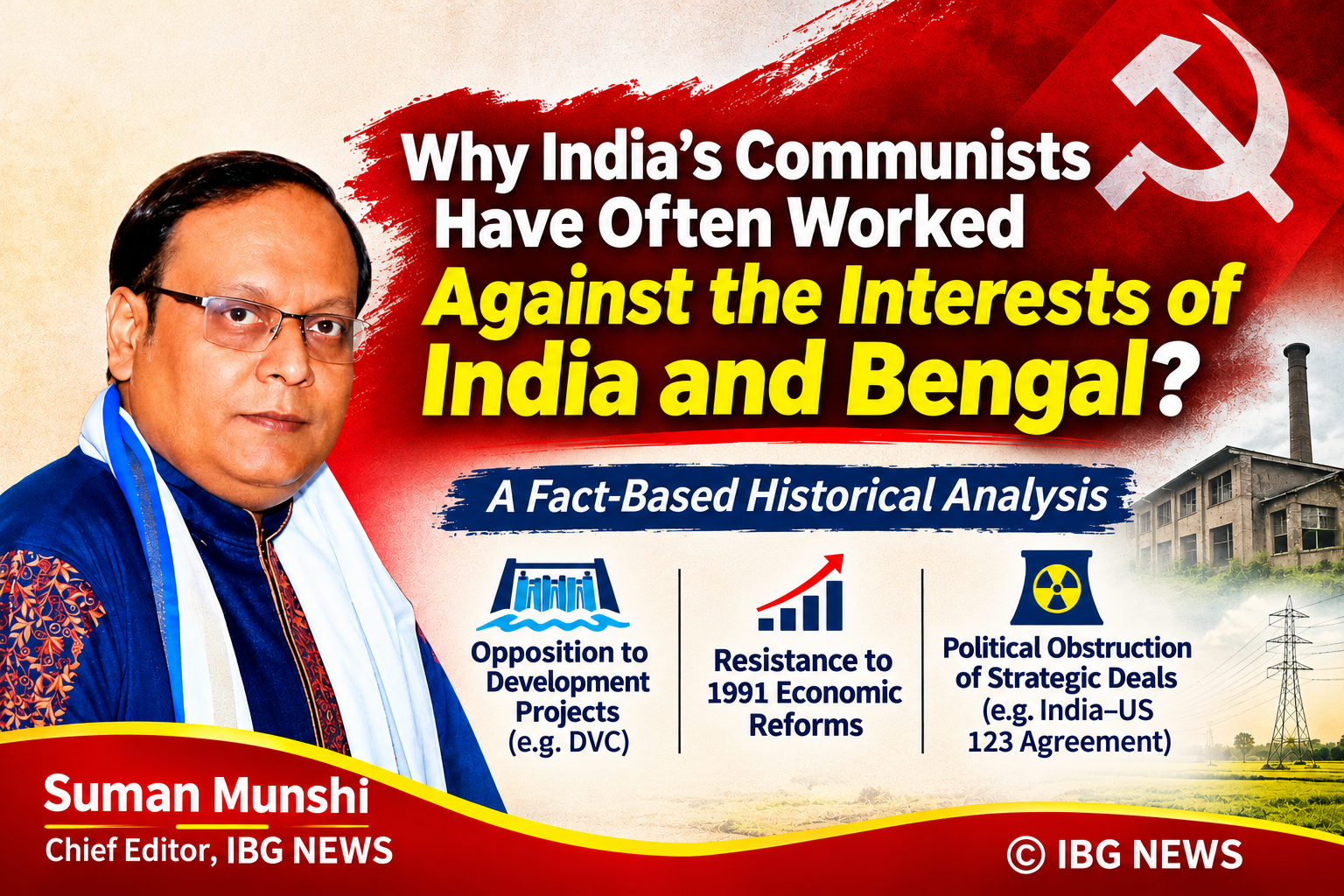

Communism in India: Ideals, Contradictions and Bengal’s Industrial Decline
A Historical Examination of Ideology, National Interest and Economic Transformation
By Suman Munshi
Chief Editor, IBG NEWS
Introduction: When Ideology Meets Reality
Few political movements have influenced modern India as profoundly as communism.
For decades, communist parties shaped debates on land reforms, workers’ rights, social justice and democratic participation. Their role in mobilising farmers, labourers and marginalised communities helped redefine India’s political landscape after Independence.
Yet history also presents uncomfortable questions.
Why did West Bengal, once India’s leading industrial powerhouse, lose its economic dominance? Why did the Left oppose economic liberalisation nationally while later seeking private investment within West Bengal? Why did issues such as the 1962 Sino-Indian War, the 1991 reforms, the India-US Nuclear Agreement and the Singur-Nandigram controversies create lasting political divisions?
The answers are neither simple nor ideological.
The story of Indian communism is not one of complete failure or unquestioned success. It is a story of achievements, contradictions, missed opportunities and lessons that remain relevant to India’s future.
The 1962 Sino-Indian War: A Defining Political Test
The Chinese attack on India in October 1962 exposed deep ideological fault lines within the Communist Party of India (CPI).
At a time when the nation was confronting external aggression, sections of the communist movement disagreed sharply over how to interpret the conflict. While many leaders unequivocally supported India’s position, others viewed the dispute through the broader lens of international communist politics and Sino-Soviet ideological tensions.
The divisions became so serious that they ultimately contributed to the split of the Communist Party and the emergence of the CPI(M) in 1964.
The central lesson from 1962 remains relevant today:
Political disagreement is legitimate, but national sovereignty must remain paramount during external aggression.
The episode highlighted a challenge faced by ideological movements worldwide: balancing international ideological commitments with national responsibilities.
Development Versus Political Narrative
Independent India embarked on ambitious nation-building projects after 1947.
Among the most significant was the Damodar Valley Corporation (DVC), envisioned as a multi-purpose development initiative involving electricity generation, irrigation, flood control and industrial growth.
The project became a symbol of India’s modernisation efforts.
While various allegations have circulated over the decades regarding political opposition to such infrastructure projects, many specific claims remain unverified and should be treated cautiously.
What is beyond dispute, however, is a broader principle:
Development debates must be grounded in scientific evidence rather than political rhetoric.
Whether the issue involves hydropower, electrification or industrial expansion, public concerns deserve respect. Yet policy decisions ultimately require facts, technical expertise and long-term planning.
The lesson is simple: informed criticism strengthens democracy, misinformation weakens it.
1991: The Economic Revolution the Left Resisted
By 1991, India faced one of the gravest economic crises in its history.
Foreign exchange reserves had fallen to alarming levels. Economic growth had stagnated. Radical reform became unavoidable.
Prime Minister P.V. Narasimha Rao and Finance Minister Dr. Manmohan Singh introduced sweeping liberalisation measures, opening India’s economy to competition, investment and global integration.
The Left strongly opposed these reforms.
Communist parties and affiliated trade unions argued that liberalisation would increase inequality, weaken worker protections and expose India to foreign economic influence.
Many of these concerns were genuine and remain relevant even today.
However, history produced an interesting contradiction.
The Bengal Contradiction
Only a few years after opposing liberalisation at the national level, the Left Front government in West Bengal introduced its own industrial policy aimed at attracting private investment.
Under Chief Minister Jyoti Basu, the government actively sought domestic and foreign investment, private enterprises and industrial growth.
The shift was driven by necessity.
West Bengal’s economy had slowed. Traditional industries were struggling. Employment opportunities were shrinking. The government recognised that reviving industrial growth required capital and investment beyond what the state alone could provide.
The contradiction was impossible to ignore:
If private investment was necessary for Bengal’s development, why had similar policies been criticised so strongly when implemented nationally?
The answer illustrates a broader reality of governance:
Practical economic realities often force ideological movements to adapt.
West Bengal’s Industrial Fall
In the decades immediately after Independence, West Bengal stood among India’s foremost industrial centres.
Kolkata was a major hub for engineering, manufacturing, shipping, banking and trade. The state possessed skilled labour, strategic geography and established infrastructure.
Yet as other states accelerated industrialisation, Bengal gradually lost momentum.
The reasons were numerous:
- The economic consequences of Partition.
- Freight equalisation policies.
- Competition from emerging industrial states.
- Ageing industries.
- Infrastructure constraints.
- Labour disputes and production disruptions.
- Policy uncertainty.
It would be historically inaccurate to place full responsibility on communist governments.
The decline had begun before the Left Front assumed power in 1977.
Nevertheless, after governing for 34 years, the Left Front inevitably became part of the story.
Many investors came to see Bengal as a difficult destination for business. Labour militancy, frequent industrial disputes and prolonged political intervention created concerns about predictability and operational stability.
As Maharashtra, Gujarat, Karnataka and Tamil Nadu expanded aggressively, Bengal increasingly struggled to keep pace.
The result was a gradual erosion of industrial competitiveness.
The Nuclear Deal That Tested Ideology
The India-US Civil Nuclear Agreement became another defining ideological battle.
The Left opposed the agreement, arguing that it could compromise India’s strategic autonomy and draw the country closer to Washington’s geopolitical orbit.
The Congress-led UPA government viewed the deal differently.
Supporters saw it as a historic opportunity to integrate India into the global nuclear framework, secure access to civilian nuclear technology and strengthen energy security.
The disagreement became so severe that Left parties withdrew support from the government in 2008.
Ultimately, the government survived, the agreement moved forward, and India gained broader access to international nuclear cooperation.
The episode demonstrated that strategic decisions are often contested not because of patriotism versus anti-patriotism, but because of competing visions of national interest.
Singur and Nandigram: The Turning Point
No issue damaged the Left Front more than its handling of industrialisation during its final years in power.
Ironically, after decades of opposing large private corporations, the government under Buddhadeb Bhattacharjee sought rapid industrial growth.
The objective itself was widely recognised as necessary.
The implementation proved disastrous.
Singur
The proposed Tata Nano project promised jobs, investment and the creation of an automobile manufacturing ecosystem.
However, concerns over land acquisition, compensation and consultation triggered widespread protests.
Eventually, Tata Motors relocated the project to Gujarat.
For many observers, Singur became a symbol of Bengal’s inability to convert opportunity into growth.
Nandigram
The proposed chemical hub generated even greater controversy.
Violence, political confrontation and fatalities transformed the issue into a national crisis.
The project was abandoned, and public trust in the government suffered significant damage.
Together, Singur and Nandigram exposed a critical reality:
Industrialisation cannot succeed without transparency, public participation and democratic consent.
The Left had once mobilised farmers against perceived injustice. It now found itself accused of ignoring those same concerns.
The Continuing Debate Over Development
Since 2014, communist parties have continued to oppose or question several government initiatives involving privatisation, disinvestment and foreign investment.
Some criticisms are valid.
A modern economy requires strong safeguards against monopolies, exploitation and excessive concentration of wealth.
However, today’s India also faces immense developmental challenges.
The country seeks leadership in:
- Semiconductor manufacturing
- Artificial intelligence
- Defence production
- Renewable energy
- Advanced engineering
- Electric vehicles
- Digital infrastructure
- Global supply chains
Such ambitions require private capital, technology partnerships and large-scale investment.
The debate therefore should not be framed as public versus private.
The real issue is whether policies serve India’s long-term interests while ensuring accountability and social protection.
Recognising the Left’s Real Achievements
Any balanced assessment must also acknowledge what the Left achieved.
Among its most significant contributions were:
- Operation Barga and tenancy reforms.
- Strengthening the rights of sharecroppers.
- Decentralisation through Panchayati Raj institutions.
- Expansion of rural political participation.
- Agricultural growth during key periods of Left rule.
- Strengthening labour rights and collective bargaining.
These accomplishments changed the lives of millions and remain an important part of West Bengal’s political history.
They deserve recognition alongside criticism.
A mature historical assessment must consider both.
Bengal’s Future: Learning from Success and Failure
West Bengal still possesses extraordinary advantages:
- Strategic location in eastern India.
- Access to Bangladesh, Nepal and Bhutan.
- Major port infrastructure.
- Strong educational institutions.
- A large skilled workforce.
- Historical commercial networks.
Its future depends less on political ideology and more on policy execution.
To regain economic leadership, Bengal needs:
- Investment-friendly governance.
- Transparent land acquisition.
- Reliable infrastructure.
- Stable labour relations.
- Technology-driven manufacturing.
- Logistics and export expansion.
- Research and innovation ecosystems.
The state’s next chapter will be written not by slogans but by outcomes.
Conclusion: The Limits of Ideology
The history of Indian communism offers an important lesson for every political party, regardless of ideology.
The Left contributed significantly to land reforms, labour rights and democratic decentralisation.
At the same time, several moments in its history reveal the risks of allowing ideological commitments to overshadow changing economic and strategic realities.
The debate is not about whether communism was entirely right or entirely wrong.
The more important question is whether political movements can adapt when circumstances change.
History suggests that societies thrive when governments combine principles with pragmatism.
For India, that means placing national interest, economic development, employment and public welfare above ideological rigidity.
For West Bengal, it means moving beyond old political battles and rebuilding confidence in investment, industry and innovation.
Because in the end, voters judge governments not by their ideological purity, but by their ability to create opportunities, prosperity and a better future.
IBG NEWS Special Analysis