









ZSI Director Dr. Dhriti Banerjee Honoured with Lifetime Achievement Award at 11th International TSAB–IRF-2026 Conference in Kolkata
International Conference Brings Together 424 Participants from 23 Indian States and Five Countries to Discuss Biodiversity Conservation, Sustainable Agriculture and Environmental Resilience
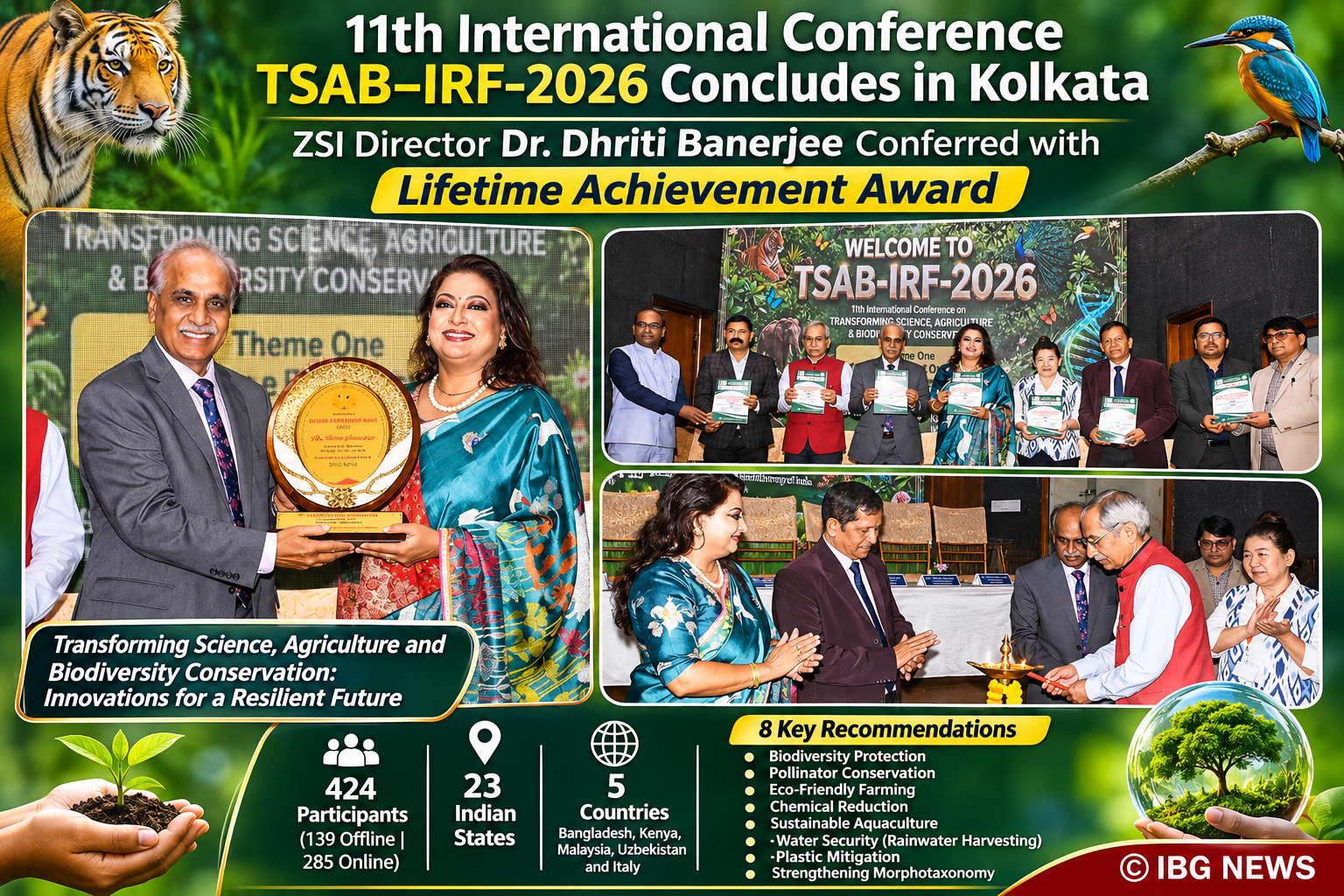
KOLKATA | 24 November 2026: The 11th International Conference on Transforming Science, Agriculture and Biodiversity Conservation: Innovations for a Resilient Future (TSAB–IRF-2026) concluded successfully at the National Library of India, Kolkata, on 23 November, bringing together scientists, researchers, academicians and students from India and abroad to deliberate on critical environmental and agricultural challenges.
The two-day international conference, held on 22–23 November 2026, was jointly organised by the Zoological Survey of India (ZSI), Kolkata, and the Agricultural Technology Development Society (ATDS), Ghaziabad.
A major highlight of the conference was the presentation of the prestigious Lifetime Achievement Award to Dr. Dhriti Banerjee, Director of the Zoological Survey of India, in recognition of her significant contributions to zoological research, faunal taxonomy and biodiversity science, along with her leadership in strengthening India’s scientific research community.
Eminent Scientists and Academicians Attend the Conference
The inaugural programme was attended by Dr. Dhriti Banerjee as Chief Guest, Prof. Amar P. Garg, former Vice-Chancellor of SIET, Meerut, as Distinguished Guest, and Prof. Dilfuza Jabborova as Special Guest.
Other prominent participants included Prof. H. Shivananda Murthy, Dr. Jitendra Kumar, Dr. P. R. More, Convenor of the conference, Dr. Anant Kumar, President of ATDS, and Dr. T. S. Pathan, Conference Director.
The conference was coordinated by Dr. Devanshu Gupta, Scientist-D, ZSI, Kolkata, and Dr. Joginder Singh, Secretary, ATDS, who served as the Organising Secretaries.
The gathering provided an interdisciplinary platform for exchanging scientific knowledge, presenting research findings and exploring innovative approaches to biodiversity conservation, sustainable agriculture and environmental protection.
Lifetime Achievement Award Recognises Dr. Dhriti Banerjee’s Scientific Contributions
One of the most significant moments of TSAB–IRF-2026 was the recognition of Dr. Dhriti Banerjee with the Lifetime Achievement Award.
The honour acknowledged her contributions to zoological science, particularly faunal taxonomy, biodiversity research and scientific leadership.
As Director of the Zoological Survey of India, she has been associated with the advancement of zoological research and the strengthening of institutional efforts towards documenting and understanding India’s rich faunal diversity.
The conference dignitaries also released the official conference souvenir, containing information on the scientific themes, research abstracts and scholarly contributions presented during the event.
Participation from 23 Indian States and Five Countries
TSAB–IRF-2026 recorded a total of 424 participation entries, comprising 139 offline and 285 online participants.
The conference attracted representation from 23 Indian states and five foreign countries:
- Bangladesh
- Kenya
- Malaysia
- Uzbekistan
- Italy
The international participation highlighted the growing importance of scientific collaboration across geographical and institutional boundaries.
The programme featured 15 keynote addresses delivered by experts from different scientific disciplines.
Researchers and academicians from several prominent institutions participated, including:
- Zoological Survey of India (ZSI)
- CSIR–National Environmental Engineering Research Institute (CSIR-NEERI)
- CSIR–Institute of Minerals and Materials Technology (CSIR-IMMT)
- ICAR–Central Institute of Freshwater Aquaculture (ICAR-CIFA)
- ICAR–Indian Agricultural Research Institute (ICAR-IARI)
- Banaras Hindu University (BHU)
- TERI School of Advanced Studies
Eight Key Recommendations for Sustainable Agriculture and Biodiversity Conservation
The scientific deliberations concluded with eight major recommendations aimed at balancing agricultural productivity with environmental protection and ecological sustainability.
1. Strengthening Morphotaxonomy
Promoting classical and integrative morphotaxonomic research to improve the identification, classification and documentation of diverse life forms.
2. Protection of Biodiversity
Strengthening habitat protection and developing targeted conservation strategies for native flora and fauna.
3. Conservation of Pollinators
Introducing dedicated conservation measures for pollinators, which play an essential role in maintaining ecological balance and supporting agricultural productivity.
4. Encouraging Environment-Friendly Agriculture
Promoting natural farming, biofertilisers, biopesticides and biochar as sustainable alternatives that can support soil health and agricultural resilience.
5. Reducing Dependence on Synthetic Chemicals
Gradually reducing the excessive use of synthetic agrochemicals and encouraging Integrated Pest Management (IPM) practices.
6. Promoting Sustainable Aquaculture
Encouraging environmentally responsible aquaculture practices to protect aquatic ecosystems while supporting food production.
7. Strengthening Water Security
Making rainwater harvesting an essential component of water-management strategies to improve groundwater recharge and water availability.
8. Reducing Plastic Pollution
Phasing down the use of polythene and single-use plastics to minimise environmental contamination and protect terrestrial and aquatic ecosystems.
Biodiversity Conservation Essential for a Sustainable Future
During the conference, speakers emphasised that biodiversity conservation is fundamental to ecological stability, food security and sustainable development.
The discussions highlighted the need to integrate scientific research, agricultural innovation and environmental management to address emerging global challenges, including biodiversity loss, ecosystem degradation, climate-related pressures and unsustainable agricultural practices.
The successful conclusion of TSAB–IRF-2026 reaffirmed the commitment of the Zoological Survey of India and the Agricultural Technology Development Society to promoting interdisciplinary scientific research, taxonomic excellence and international cooperation.
The conference also underlined the importance of connecting scientific knowledge with practical policy recommendations and sustainable development initiatives.
As environmental challenges become increasingly interconnected, collaboration among research institutions, policymakers, agricultural experts and conservation organisations will remain essential for building a more resilient future.
The Kolkata conference concluded with a clear message: protecting biodiversity and strengthening sustainable agricultural practices are not competing objectives; they are essential foundations of long-term human and ecological well-being.
Suman Munshi
Chief Editor, IBG NEWS
Science | Environment | Agriculture | Biodiversity Conservation | Kolkata
Source: Conference information provided by the organisers of TSAB–IRF-2026.