












Netaji Subhas Chandra Bose’s Azad Hind Government: The Forgotten Sovereign of India’s Freedom Struggle
Introduction
On 21 October 1943, the world witnessed a bold declaration — Netaji Subhas Chandra Bose announced the establishment of the Azad Hind Government (Arzi Hukumat-e-Azad Hind) in Singapore.
This provisional government, born in exile, was a sovereign declaration of India’s independence from British rule — even before 1947. Led by one of India’s most charismatic revolutionaries, the Azad Hind Government united the global Indian diaspora and transformed the freedom struggle into an international political and military campaign.
Formation and Leadership
The Azad Hind Government emerged from the framework of the Indian Independence League and was officially proclaimed under the leadership of Netaji Subhas Chandra Bose, who assumed multiple roles — Head of State, Prime Minister, and Minister for War and Foreign Affairs.
The key members of the cabinet included:
- Netaji Subhas Chandra Bose – Head of State and Supreme Commander
- Captain Lakshmi Sahgal – Minister for Women’s Affairs (Rani of Jhansi Regiment)
- Rash Behari Bose – Senior Advisor
- A.C.N. Nambiar – European Representative
The government adopted:
- National Greeting: Jai Hind
- National Flag: Tricolor with the Springing Tiger emblem
- National Anthem: Subh Sukh Chain
This marked the first organized Indian government-in-exile, declaring war against the British Empire.
International Recognition
The Azad Hind Government gained diplomatic recognition from several Axis-aligned and Asian countries, including:
Japan, Germany, Italy, Croatia, Burma (Myanmar), Philippines, Thailand, and Manchukuo (Manchuria).
This recognition gave it a legitimate international presence, allowing it to function diplomatically and coordinate military efforts through the Indian National Army (INA).
Area of Operation and Territorial Control
The government’s administrative and military operations extended across Southeast Asia and parts of Indian territory during World War II.
1. Andaman and Nicobar Islands
- Officially handed over to the Azad Hind Government by Japan on 30 December 1943.
- Renamed Shaheed (Martyr) Island and Swaraj (Self-Rule) Island by Bose.
- Bose raised the Indian Tricolor in Port Blair, symbolizing India’s reclaimed sovereignty.
2. Southeast Asian Bases
- Singapore, Rangoon (Burma), and Malaya served as administrative and military centers.
- Recruitment, training, and supply for the Indian National Army were coordinated from these regions.
3. Indian Frontline Campaigns
The Indian National Army (INA), the armed wing of the Azad Hind Government, launched military campaigns alongside Japanese forces:
- Imphal and Kohima (1944): Attempted to enter Indian territory through the Northeast.
- Arakan (Myanmar–Bangladesh border): Strategic base for Indian operations.
- Moirang, Manipur: On 14 April 1944, the INA hoisted the Tricolor — the first time India’s flag flew on Indian soil under a nationalist army.












Government Structure and Army
The Azad Hind Government operated like a sovereign entity with departments for War, Finance, Foreign Affairs, and Publicity.
Its military strength was embodied in the Indian National Army (INA), which grew to nearly 45,000 soldiers, composed mainly of Indian POWs and volunteers from Southeast Asia.
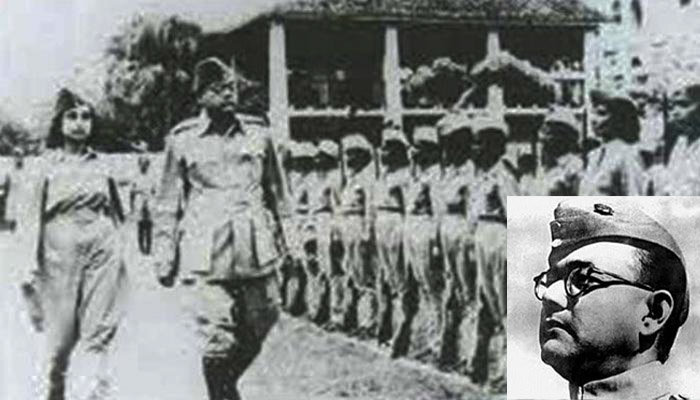
A unique feature was the Rani of Jhansi Regiment, an all-women combat unit led by Captain Lakshmi Sahgal, symbolizing women’s empowerment in the freedom struggle.
Ideology and Vision
Netaji’s political philosophy blended nationalism, socialism, and secularism. His rallying cry,
“Give me blood, and I will give you freedom,”
captured the spirit of self-sacrifice and unity across all religions and classes.
He envisioned an India that was:
- Free from colonial and capitalist exploitation,
- Based on social justice and equality,
- And capable of standing proudly among global powers.
Fall of the Azad Hind Government
With Japan’s defeat in 1945, the Azad Hind Government and INA lost their operational base. Bose’s reported death in a plane crash on 18 August 1945 in Taipei marked the tragic end of this bold venture.
Many INA officers were captured and tried by the British in the infamous Red Fort Trials (1945–46), which triggered nationwide protests and mutinies in the Royal Indian Navy — key events that hastened India’s independence.
Legacy and Historical Significance
While the Azad Hind Government did not achieve military victory, its psychological and political impact was immense:
- It shattered the myth of Indian subservience to British authority.
- It ignited a wave of patriotism among Indians both at home and abroad.
- It inspired subsequent generations to view independence as a right, not a gift.
Historians often credit Netaji and the INA with accelerating the British exit from India, by eroding loyalty within the colonial armed forces.
Key Historical Dates
| Event | Date | Location |
|---|---|---|
| Proclamation of Azad Hind Government | 21 October 1943 | Singapore |
| Handover of Andaman & Nicobar Islands | 30 December 1943 | Port Blair |
| INA Flag Hoisted at Moirang | 14 April 1944 | Manipur, India |
| INA Surrenders | 1945 | Rangoon (Yangon) |
| Disappearance of Netaji | 18 August 1945 | Taipei (reported) |
Conclusion
The Azad Hind Government was not merely a symbolic gesture — it was a revolutionary declaration of India’s self-determination. Through it, Netaji Subhas Chandra Bose demonstrated that India could organize, govern, and fight for freedom on its own terms.
Today, its legacy stands as a reminder of courage, unity, and patriotism, urging future generations to preserve and honor the sacrifices made for the nation’s liberty.
Suggested Byline
Written by: Suman Munshi, Grandson of the Late Khitish Chandra Munshi, Ex-INA Official in the Intelligence Department and co-inmate of Netaji Subash Chandra Bose in Mandalay(Burma) Jail during the freedom struggle.
Special Feature for IBG NEWS in tribute to Netaji and his forgotten Army.
#NetajiSubhasChandraBose #AzadHindGovernment #IndianNationalArmy #WWIIIndia #FreedomMovement