

















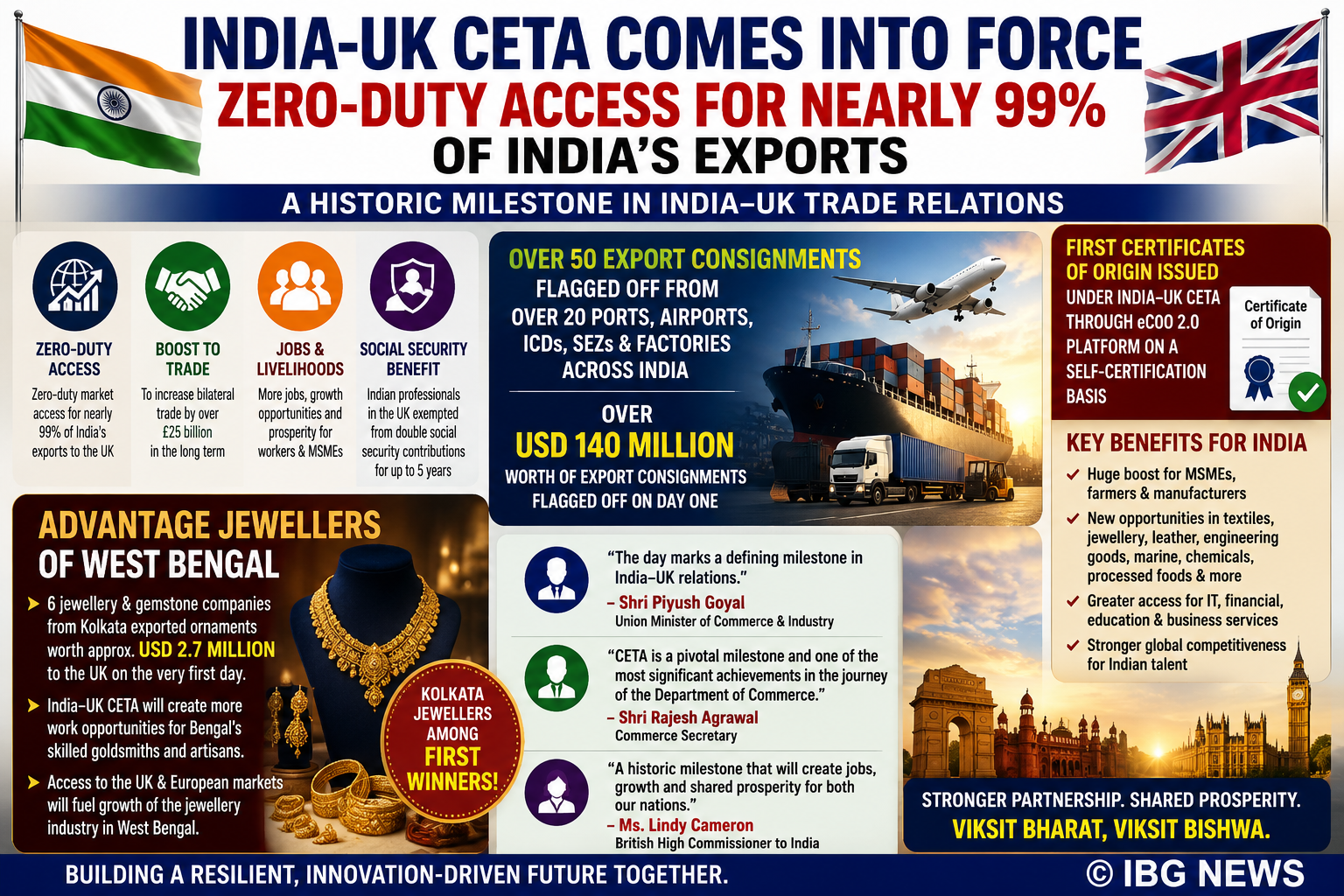
India–UK CETA Comes Into Force, Opening Zero-Duty Access for Nearly 99% of Indian Exports
By Suman Munshi | IBG NEWS
New Delhi, July 15: India and the United Kingdom have entered a new era of economic cooperation with the formal implementation of the India–United Kingdom Comprehensive Economic and Trade Agreement (CETA) and the Agreement on Social Security (Double Contribution Convention – DCC). The landmark agreements came into force on Wednesday, promising to significantly expand bilateral trade, investment, services, and employment opportunities between the two nations.
To mark the historic occasion, the Government of India flagged off more than 50 export consignments worth over USD 140 million from over 20 ports, airports, Inland Container Depots (ICDs), Special Economic Zones (SEZs), and manufacturing facilities across the country under the new preferential tariff regime. The consignments included electronics, pharmaceuticals, gems and jewellery, engineering products, and other high-value exports destined for the United Kingdom.
Zero-Duty Access for Indian Exports
Union Commerce and Industry Minister Shri Piyush Goyal described the implementation of the agreement as a defining milestone in India–UK relations. He noted that the agreement grants zero-duty market access to nearly 99% of India’s exports, covering almost the entire value of bilateral merchandise trade.
According to the Minister, labour-intensive sectors such as textiles, leather, gems and jewellery, engineering goods, marine products, chemicals, and processed food are expected to benefit substantially. The agreement is also expected to create new opportunities for India’s IT, professional, financial, education, and business services sectors while improving global mobility for skilled Indian professionals.
Major Relief for Indian Professionals
A key feature of the accompanying Agreement on Social Security is the exemption of Indian professionals working temporarily in the United Kingdom from making double social security contributions for up to five years. This provision is expected to enhance the competitiveness of Indian professionals and reduce employment costs for Indian companies operating in the UK.
A New Chapter in Bilateral Trade
Commerce Secretary Shri Rajesh Agrawal described the CETA as one of the most significant achievements of India’s Department of Commerce. He highlighted that negotiations involved over 800 technical sessions across 14 formal rounds, making it one of India’s most comprehensive trade agreements to date.
He emphasized that the agreement extends beyond merchandise trade by providing extensive commitments in services, an area that contributes more than half of India’s GDP and over 70% of the UK’s economy. The agreement is expected to provide long-term certainty for businesses and investors in both countries.
Digital Trade Facilitation
The first Certificates of Origin under the India–UK CETA were issued through India’s eCoO 2.0 digital platform using a self-certification mechanism. Officials believe this digital system will reduce compliance costs, simplify export procedures, and particularly benefit India’s Micro, Small and Medium Enterprises (MSMEs).
UK Calls Agreement Historic
British High Commissioner to India Ms. Lindy Cameron termed the agreement a “historic milestone” in UK–India relations. She noted that bilateral trade had already reached nearly £48 billion annually, while investments between the two countries support more than 700,000 jobs.
According to the British Government, the agreement is expected to increase bilateral trade by more than £25 billion annually over the long term while contributing approximately £5 billion each year to both the UK and Indian economies.
Industry Welcomes the Agreement
Export Promotion Councils, industry bodies, and exporters welcomed the implementation of the agreement, stating that duty-free access, simplified Rules of Origin, and easier certification procedures would significantly enhance the competitiveness of Indian products in one of the world’s largest consumer markets.
Industry representatives also expressed confidence that the agreement would generate fresh employment opportunities, particularly in labour-intensive sectors, while benefiting women entrepreneurs, MSMEs, youth, and students, thereby contributing to India’s vision of Viksit Bharat.
IBG NEWS Analysis
The India–UK CETA represents one of India’s most ambitious trade agreements in recent years. By providing almost complete duty-free access for Indian exports and strengthening cooperation in services, digital trade, intellectual property, and investment, the agreement has the potential to reshape bilateral economic ties.
For Indian exporters, especially MSMEs, the pact offers a significant opportunity to improve competitiveness in the UK market. The social security provisions also provide meaningful financial relief to Indian professionals working overseas, reinforcing India’s position as a global talent hub.
As implementation gathers pace, the success of the agreement will depend on how effectively businesses, exporters, and government agencies leverage the new market access to expand trade, create jobs, and deepen economic integration between the world’s fifth and sixth largest economies.