











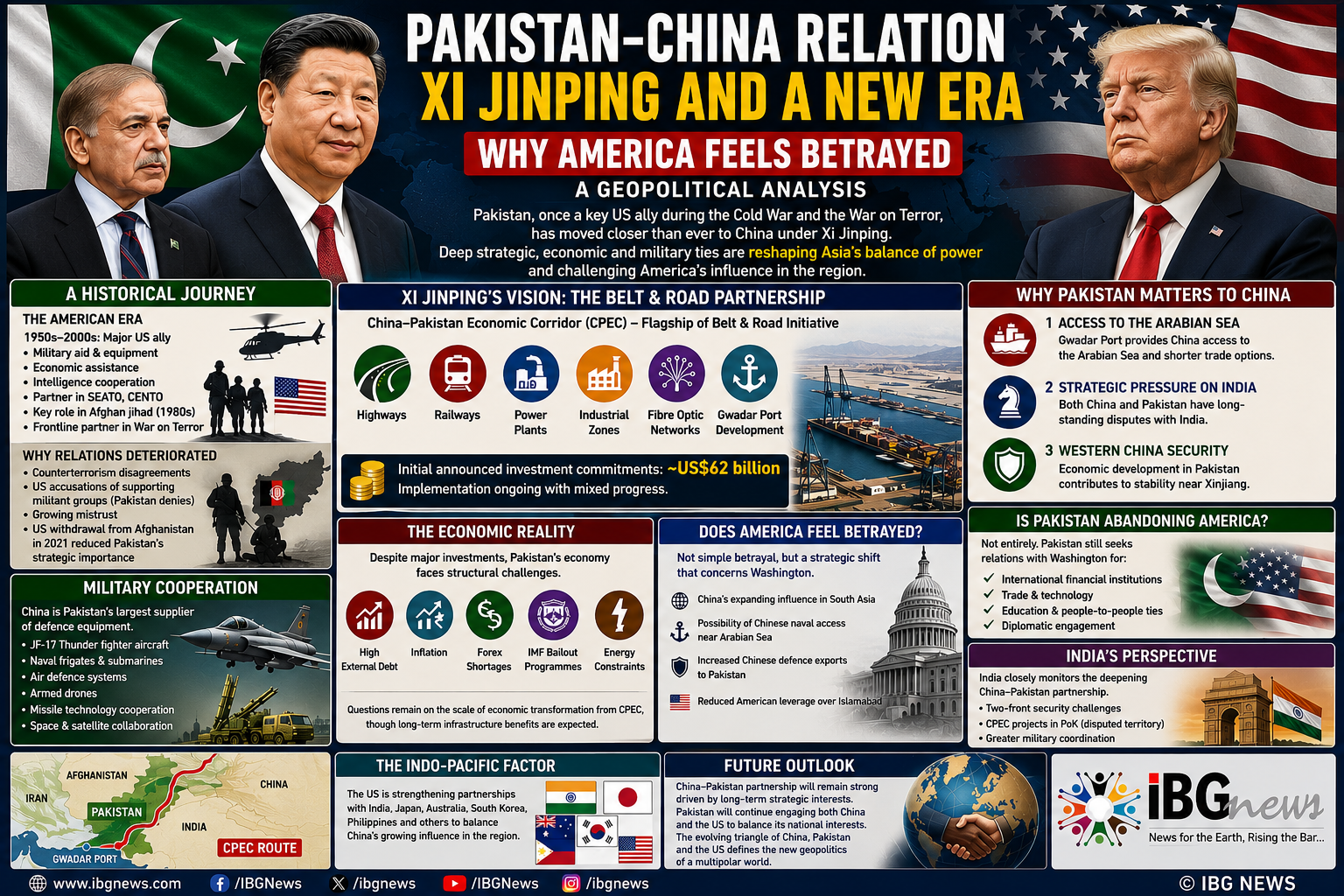
Pakistan, China and the Shifting Balance of Power: Why Washington Is Watching Islamabad’s New Strategic Alignment Closely
An Analysis of China–Pakistan Relations Under Xi Jinping and Their Impact on US Strategy
By Suman Munshi | IBG NEWS
Introduction
For more than seven decades, Pakistan has occupied a unique place in global geopolitics. During the Cold War, it was a key American ally against Soviet influence. After the September 11 attacks, Pakistan again became a frontline partner in the United States’ war on terrorism.
Today, however, the geopolitical landscape has changed dramatically. While Pakistan continues to maintain diplomatic relations with Washington, its strategic, economic and military partnership with China has reached unprecedented levels under Chinese President Xi Jinping. This transformation has become one of the defining strategic developments in Asia.
The perception in some American strategic circles is that Pakistan—once considered a major US security partner—has moved significantly closer to Beijing. Whether this amounts to “betrayal” is debated, but there is broad agreement that the relationship has fundamentally shifted.
The Historical Triangle
The American Era
Between the 1950s and early 2000s, Pakistan benefited enormously from American assistance.
The United States supplied:
- Military equipment
- Economic aid
- Intelligence cooperation
- Diplomatic support
Pakistan joined Western security arrangements such as SEATO and CENTO and later became a major non-NATO ally.
During the Afghan jihad against the Soviet Union in the 1980s, Pakistan served as America’s principal regional partner.
After 9/11, Washington again relied heavily on Islamabad in Afghanistan.
Why Relations Began to Deteriorate
Several issues gradually eroded trust.
Counterterrorism Disagreements
American officials repeatedly accused Pakistan of allowing militant networks to operate from its territory while simultaneously receiving US assistance.
Pakistan rejected many of these accusations, arguing that it had itself suffered heavily from terrorism and incurred significant military and civilian losses.
Afghanistan Withdrawal
The US withdrawal from Afghanistan in 2021 further altered regional dynamics.
With America’s military presence reduced, Pakistan’s strategic importance to Washington declined considerably.
Xi Jinping’s Vision
Chinese President Xi Jinping transformed China’s foreign policy through the Belt and Road Initiative (BRI).
Among all BRI projects, none became more important than the China-Pakistan Economic Corridor (CPEC).
Announced in 2015, CPEC includes:
- Highways
- Railways
- Power plants
- Industrial zones
- Fibre optic networks
- Gwadar Port development
Initial announced investment commitments were valued at around US$62 billion, although implementation has progressed unevenly and not all proposed projects have been completed.
For Beijing, Pakistan became the flagship partner of the Belt and Road Initiative.
Why Pakistan Matters to China
Pakistan provides several strategic advantages.
1. Access to the Arabian Sea
Gwadar Port offers China access to the Arabian Sea.
Although China’s trade still overwhelmingly moves through eastern seaports, Gwadar could eventually complement existing routes and reduce dependence on longer maritime paths.
2. Strategic Pressure on India
China and Pakistan both have longstanding territorial disputes with India.
Although each pursues its own national interests, closer defence cooperation between Beijing and Islamabad has strategic implications for New Delhi.
3. Western China Security
China believes economic development in Pakistan contributes to stability near Xinjiang.
Beijing has consistently emphasised counterterrorism cooperation with Islamabad as part of its broader regional security approach.
Military Cooperation
China has become Pakistan’s largest supplier of defence equipment.
Joint projects include:
- JF-17 Thunder fighter aircraft
- Naval frigates
- Air defence systems
- Armed drones
- Missile technology cooperation
- Space and satellite collaboration
Pakistan increasingly relies on Chinese military technology rather than Western platforms.
The Economic Reality
Despite major investments, Pakistan’s economy continues to face structural challenges.
These include:
- High external debt
- Inflation
- Foreign exchange shortages
- IMF bailout programmes
- Energy constraints
Some analysts question whether CPEC has delivered the scale of economic transformation originally envisioned, while others argue that its long-term infrastructure benefits have yet to be fully realised.
Does America Feel Betrayed?
The answer depends on perspective.
It is more accurate to say that many American policymakers see Pakistan as having shifted its strategic priorities rather than simply “betraying” the United States.
US concerns include:
- China’s expanding influence in South Asia.
- The possibility of Chinese naval access near the Arabian Sea.
- Increased Chinese defence exports to Pakistan.
- Reduced American leverage over Islamabad.
At the same time, the United States continues to engage Pakistan on counterterrorism, regional stability and economic issues.
Is Pakistan Abandoning America?
Not entirely.
Pakistan still seeks constructive relations with Washington because the United States remains important for:
- International financial institutions
- Trade
- Technology
- Education
- Diplomatic engagement
Pakistan has repeatedly stated that it does not wish to choose between China and the United States, but instead aims to maintain productive relations with both.
India’s Perspective
India closely monitors the deepening China–Pakistan partnership.
Indian strategic concerns include:
- Potential two-front security challenges.
- Chinese infrastructure projects in Pakistan-administered Kashmir, which India claims as its own territory.
- Greater military coordination between Beijing and Islamabad.
These issues continue to shape India’s defence planning and diplomatic engagement.
The Indo-Pacific Factor
The United States has increasingly focused its Asia strategy on the Indo-Pacific.
Key elements include strengthening partnerships with:
- India
- Japan
- Australia
- South Korea
- The Philippines
This strategic shift reflects Washington’s broader objective of balancing China’s growing regional influence.
Future Outlook
The China–Pakistan partnership is likely to remain strong because it is driven by long-term strategic interests rather than short-term political developments. However, Pakistan’s economic needs and desire for diversified international relationships mean it is also likely to continue engaging with the United States and other partners.
For Washington, the challenge is to manage competition with China while maintaining selective cooperation with Pakistan where interests overlap. For Beijing, sustaining its investments and ensuring security for Chinese personnel and projects in Pakistan will remain priorities.
The evolving triangle among China, Pakistan and the United States is therefore best understood not as a simple story of alliance or betrayal, but as an example of how states adapt to changing geopolitical realities. In today’s multipolar world, countries increasingly seek multiple partnerships to advance their own national interests, and Pakistan’s balancing act reflects that broader global trend.