














India Mobile Congress 2026: PM Modi Highlights India’s Rise from Digital Consumer to Technology Creator
Prime Minister Says Mobile Connectivity Has Become a Foundation for Governance, Inclusion, Innovation and Economic Opportunity; Calls for Stronger Cybersecurity and Global Action Against Deepfakes
By Suman Munshi, Chief Editor, IBG NEWS
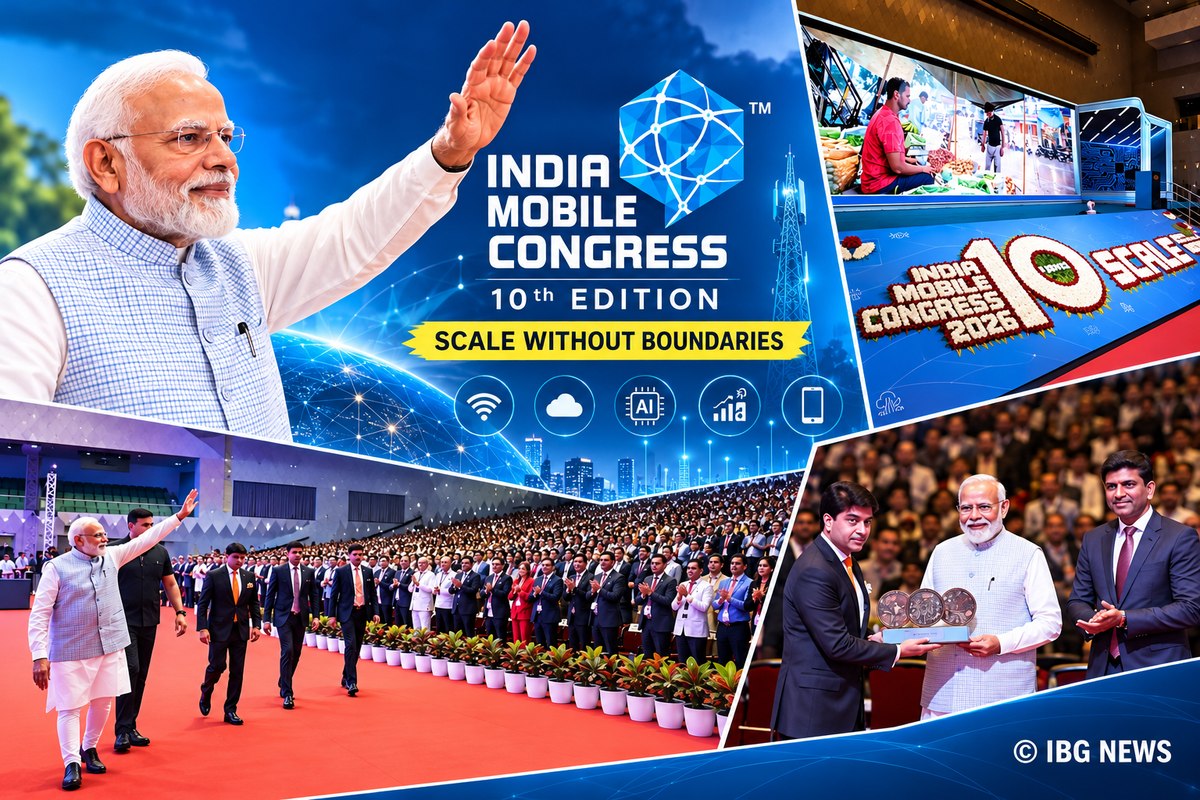
NEW DELHI, October 8, 2026: Prime Minister Narendra Modi inaugurated the 10th edition of the India Mobile Congress (IMC) 2026 at Yashobhoomi in New Delhi, using the occasion to outline India’s transformation from a major technology consumer into an increasingly self-reliant creator of digital products, technology and intellectual property.
The 2026 edition of IMC is being held from October 7 to 10 under the theme “Scale Without Boundaries.” The event brings together the global telecom and technology ecosystem, with participation expected from more than 100 countries. Press Information Bureau
According to the PIB release forming the basis of this report, the Prime Minister placed mobile connectivity at the centre of India’s Digital India transformation, arguing that the mobile phone has evolved from a communication device into an important instrument for governance, education, financial inclusion, entrepreneurship and everyday convenience. Pasted markdown
Mobile Technology as an Instrument of Governance
Reflecting on India’s digital transformation over the past decade, Modi said the mobile phone had become much more than a tool for communication.
Hundreds of government services can now be accessed through mobile devices, while digital systems have enabled government benefits to reach beneficiaries directly. The Prime Minister presented this reduction in travel, waiting time and transaction costs as one of the most significant benefits of technology for ordinary citizens. Pasted markdown
The government’s Digital India programme, he said, was conceived partly as an effort to address the digital divide. At a time when modern technology risked becoming concentrated among people with greater financial means, India sought to expand access and make digital technology more widely available.
The mobile phone became a central instrument in that effort. Pasted markdown
From Digital Divide to Wider Access
The Prime Minister highlighted the role of connectivity in improving access to education and essential services, particularly during the COVID-19 pandemic.
According to the figures cited in his address, the DIKSHA digital education platform recorded more than 5 billion learning sessions and around 60 billion learning minutes through July 2022 during the peak period of pandemic-driven digital learning.
The government is now seeking to connect approximately 25 crore students with digital and online education platforms, according to the address. Pasted markdown
The broader message was that digital infrastructure can reduce geographical barriers and enable citizens in remote areas to access services that previously required travel to urban centres.
Direct Benefit Transfers and Digital Inclusion
Financial inclusion was another major element of the Prime Minister’s address.
He highlighted the role of mobile-based digital systems in transferring government assistance directly to beneficiaries. According to figures cited in the speech, more than ₹50 lakh crore has been transferred directly through such mechanisms, with an estimated ₹5 lakh crore in leakages prevented.
The Prime Minister also referred to PM-KISAN Samman Nidhi, saying that more than ₹4 lakh crore had reached small and marginal farmers directly. Pasted markdown
The larger significance, he argued, lies in technology’s ability to make government delivery more transparent and accessible.
5G Expansion Reaches Every District
Looking at India’s telecom infrastructure, Modi pointed to the country’s rapid 5G rollout.
He recalled launching 5G at India Mobile Congress in 2022 and said the technology has subsequently expanded to more than 5.5 lakh base stations, reaching every district of the country.
According to the Prime Minister, the expansion has contributed to substantially faster internet connectivity nationwide. Pasted markdown
The development also illustrates the wider evolution of India Mobile Congress. What began primarily as a platform showcasing India’s domestic telecom capabilities has increasingly developed into an international forum for technology standards, innovation and industry collaboration.
The 2026 event’s official theme, “Scale Without Boundaries,” reflects this broader ambition. Press Information Bureau
Mobile Phones Become Creation Platforms
One of the most significant changes identified by the Prime Minister was the transformation of the smartphone from a consumption device into a creation platform.
India’s large youth population has increasingly adopted mobile technology for gaming, digital entertainment, content production and entrepreneurship.
Modi cited an ecosystem involving more than 50 crore gaming users, particularly among young people and users in Tier-2 and Tier-3 cities. He noted that many participants are moving beyond gaming itself into e-sports, content creation and related businesses. Pasted markdown
The growth of affordable data and wider connectivity has similarly expanded video creation, regional OTT content and other forms of digital entertainment.
This has opened opportunities for creators outside India’s traditional metropolitan media centres.
Cybersecurity and Digital Trust Become Critical
With greater dependence on digital technology comes greater exposure to cyber threats.
The Prime Minister stressed that strengthening the security of mobile phones, networks and digital infrastructure must remain a national priority.
For ordinary users, digital trust is ultimately about practical questions: whether a caller can be identified, whether a message is genuine, whether an online transaction is secure and whether personal information remains protected.
The Prime Minister argued that citizens must have confidence that their data is safe when they use digital services. Pasted markdown
Global Framework Needed to Combat Deepfakes and Cyber Fraud
Modi also highlighted two increasingly borderless threats: cyber fraud and deepfakes.
Because such threats can cross national and technological boundaries, he called for greater international cooperation involving governments, technology companies, telecom operators and financial institutions.
The Prime Minister also urged the global telecom ecosystem, including the GSMA, to explore mechanisms that could identify and disrupt fraudulent activity before it reaches individual users. Pasted markdown
The call comes at a time when manipulated audio, video and synthetic media are becoming increasingly sophisticated, creating challenges for public trust, financial security and information integrity.
India Moves Toward Technology Sovereignty
A central theme of the Prime Minister’s speech was India’s transition from being primarily a technology consumer to becoming a technology creator.
The next stage, he said, should involve products and designs being developed domestically, supported by technologies and intellectual property owned within India.
The government is pursuing this objective through regulatory reforms, incentives and new technology-focused initiatives. The Prime Minister referred to the Telecommunications Act and the GatiShakti platform as part of the broader reform process. Pasted markdown
This approach represents a shift from simply expanding access to technology toward developing greater control over the technologies that underpin India’s digital economy.
Semiconductor Manufacturing Emerges as a Strategic Priority
The Prime Minister also highlighted progress under the India Semiconductor Mission.
According to the address, commercial semiconductor production is already operational at five locations, while the next phase is expected to focus more strongly on building and localising the wider semiconductor supply chain. Pasted markdown
For the telecom sector, domestic semiconductor capabilities could have significance well beyond mobile phones, extending into networking equipment, electronics, automotive technology, industrial systems and other strategic sectors.
IMC as a Global Platform for Innovation
The Prime Minister called on India Mobile Congress to evolve beyond an exhibition of products and technologies and become a major platform for research, innovation and partnerships aimed at solving real-world challenges.
The event’s official programme reflects this expanding scope. IMC 2026 is focusing on emerging areas including smart mobility, stadium experiences, industrial robotics and transport technology, alongside next-generation connectivity. Press Information Bureau
The 2026 edition is expected to bring together more than 1.5 lakh attendees, over 500 exhibitors and partners, more than 600 startups and around 900 thought leaders, according to preparations announced by the Ministry of Communications. Press Information Bureau
PM Pays Tribute to Nana Patekar
At the beginning of his address, Prime Minister Modi also paid tribute to veteran actor Nana Patekar, whose death was reported on October 8.
The Prime Minister described Patekar as an exceptionally talented performer whose intensity, individuality and versatility enabled him to create memorable characters. He also recalled the actor’s outspoken personality and contribution to Hindi and Marathi cinema. Press Information Bureau
Multiple reports, including Reuters and the Associated Press, confirmed that Patekar died at the age of 75 after being found unconscious at his home in Goa; cardiac arrest was reported as the cause. Reuters
India’s Next Digital Phase
The message emerging from the Prime Minister’s IMC 2026 address is that India’s telecom story is entering a new phase.
The first stage was largely about connectivity and access. The next phase is increasingly about innovation, domestic manufacturing, intellectual property, cybersecurity, digital trust and global technology leadership.
India’s challenge now is not merely to connect more people, but to ensure that the digital ecosystem remains secure, inclusive and capable of generating high-value technologies and businesses.
The Prime Minister’s vision places the mobile ecosystem at the intersection of governance, economic growth, education, entertainment, entrepreneurship and technological sovereignty.
As India moves deeper into the second half of the decade, the success of that vision will depend on whether the country can convert its enormous digital user base into a stronger ecosystem of research, manufacturing, intellectual property, startups and globally competitive technology products.
By Suman Munshi
Chief Editor, IBG NEWS

