











West Bengal Investment Promotion Policy 2026 Wins Industry Support; Major Business Groups Welcome Push for Manufacturing, Green Energy and Employment
By Suman Munshi | IBG NEWS
KOLKATA: West Bengal’s New Investment Promotion Policy 2026 has received an encouraging response from leading industrialists and business groups, with prominent industry leaders welcoming the State Government’s initiatives to strengthen the investment climate, accelerate industrial development and generate employment.
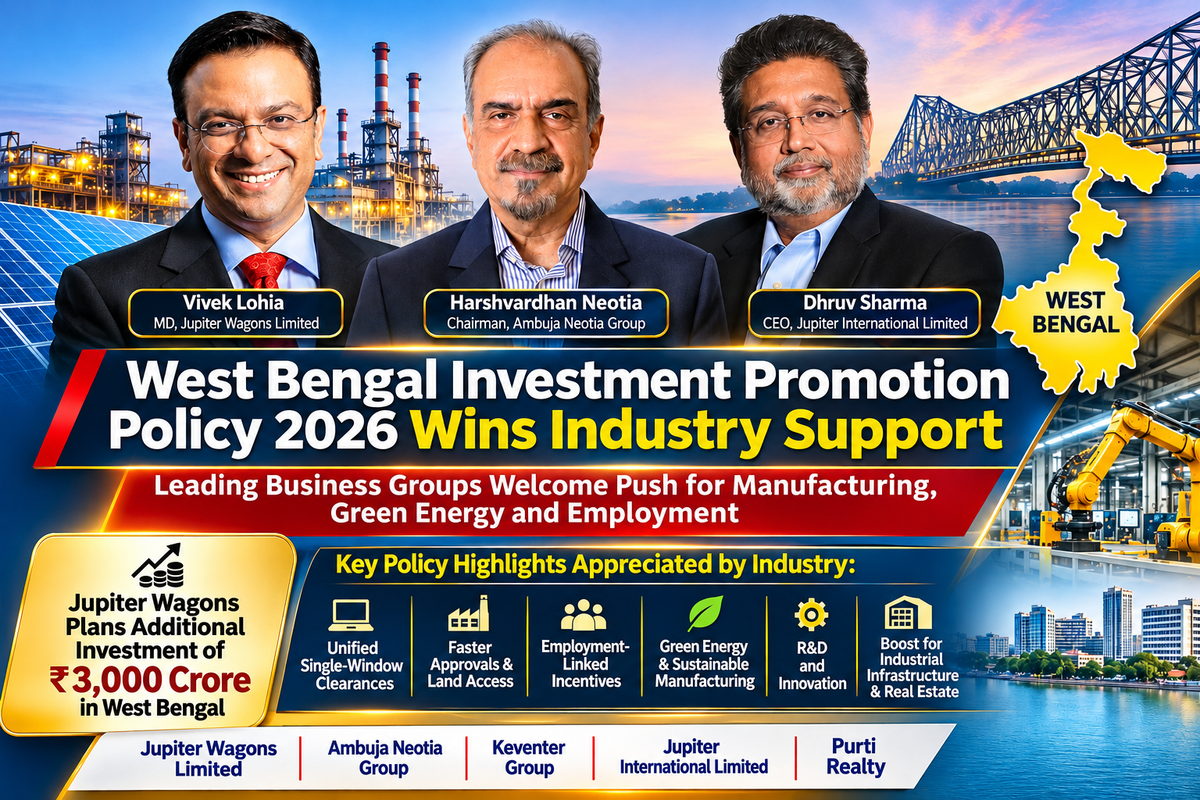
Representatives of Jupiter Wagons Limited, Ambuja Neotia Group, Keventer Group, Jupiter International Limited and Purti Realty have expressed confidence that the policy could position West Bengal as a more competitive destination for domestic and international investments.
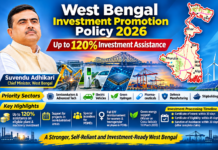
The policy places particular emphasis on improving ease of doing business through a unified digital single-window clearance mechanism, time-bound approvals, industrial land availability, financial incentives, research and development, green energy and employment generation.
Jupiter Wagons Plans Additional Investment of ₹3,000 Crore
Mr. Vivek Lohia, Managing Director of Jupiter Wagons Limited, described the policy as a decisive and forward-looking initiative that addresses three critical considerations for investors: availability of land, speed of approvals and employment-linked incentives.
Welcoming the Chief Minister and the State Government’s vision, Lohia said the policy aligns with the national objectives of Atmanirbhar Bharat and Make in India.
Highlighting the company’s longstanding association with Kolkata and West Bengal, he announced plans for an additional investment of ₹3,000 crore in the state.
Jupiter Wagons, which has expanded from its Kolkata roots into a comprehensive mobility and engineering enterprise, is also extending its presence in passenger rolling stock for India’s metro and high-speed rail networks.
He cited the company’s integrated defence manufacturing facility at Purulia as an example of how industrial investments can create economic opportunities and transform livelihoods in western West Bengal.
Lohia further emphasised that developing strong MSME supplier ecosystems around major industrial investments would generate a wider economic multiplier, helping Bengal emerge as a leading manufacturing destination in eastern India.
Ambuja Neotia Group Welcomes Investor-Friendly Reforms
Mr. Harshvardhan Neotia, Chairman of Ambuja Neotia Group, termed the 2026 policy an encouraging step towards converting West Bengal’s economic potential into investment, entrepreneurship and employment.
He particularly welcomed the proposed unified single-window clearance system and faster approvals, noting that predictable timelines and transparent procedures are essential for building investor confidence.
The policy’s provisions for industrial land pooling, utilisation of unoccupied industrial land and streamlined land allocation could make industrial expansion easier.
Neotia also highlighted several progressive features, including employment-linked incentives, EPF reimbursement support for women employees, working women’s hostels and encouragement for research and development.
He welcomed the proposed SGST-linked assistance, electricity duty concessions, interest subvention and stamp duty relief, alongside the focus on emerging industries, green technologies and modern manufacturing.
According to him, these initiatives could create new opportunities for Bengal’s skilled workforce, local suppliers and businesses while ensuring that economic growth benefits a wider section of society.
Keventer Group Highlights Execution and Innovation
Mr. Mayank Jalan, Chairman and Managing Director of Keventer Group, highlighted the policy’s emphasis on implementation, innovation and predictable project timelines.
He observed that uncertainty surrounding project approvals and execution schedules has traditionally been a significant concern for investors.
The proposed one-stop digital portal, clearly defined approval timelines and designated officers at different stages of the application and sanction process could substantially improve the investment experience.
Jalan also welcomed the government’s focus on employment-intensive industries such as food processing, identified as a THRUST sector, alongside support for research and development and incentives encouraging greater participation of women in the workforce.
He noted that tailor-made benefits for strategic and mega projects could encourage businesses to expand their operations and participate in West Bengal’s next phase of industrial development.
Jupiter International Emphasises Green Energy and Sustainable Manufacturing
Mr. Dhruv Sharma, CEO of Kolkata-based solar cell manufacturer Jupiter International Limited, welcomed the policy as an opportunity to provide fresh momentum to industrial growth and attract new manufacturing investments.
He pointed to land-related incentives, infrastructure assistance and streamlined single-window approvals as important measures for manufacturers planning to establish or expand operations in the state.
The policy’s focus on manufacturing, research and development and employment generation, particularly through enhanced incentives for hiring women and transgender employees, was also appreciated.
A particularly significant provision, according to Sharma, is the proposed waiver of cross-subsidy surcharge and additional surcharge on green power sourced within West Bengal until March 2030.
He described this measure as an important step towards accelerating the state’s green energy transition while making sustainable power more attractive for industrial consumers.
Sharma stressed that effective implementation of these provisions would be essential to strengthening investor confidence, attracting fresh capital and generating sustainable employment.
Purti Realty Sees Opportunities in Industrial Infrastructure and Urban Development
Mr. Mahesh Agarwal, Managing Director of Purti Realty, described the policy as a significant move towards establishing a more competitive and investment-friendly industrial environment.
He welcomed the financial incentives linked to SGST, electricity duty and stamp duty, along with enhanced EPF support for women and transgender employees.
The provisions supporting research and development, green energy and the revival of sick industrial units were also identified as important measures for strengthening the state’s industrial ecosystem.
Agarwal particularly highlighted the potential of enhanced assistance for THRUST sectors and less-industrialised priority areas to encourage investment beyond established economic centres.
From the real estate and infrastructure perspective, he said the policy could open up significant opportunities in industrial parks, warehousing, logistics facilities, commercial properties and residential development around emerging employment hubs.
He also emphasised that the digital single-window approval mechanism, backed by time-bound clearances, could improve investor confidence.
However, he noted that sustained infrastructure development and effective policy execution would be essential to translate the announced incentives into long-term investment, employment and balanced regional growth.
A New Opportunity for West Bengal’s Industrial Transformation
The positive response from these five industry leaders reflects growing expectations that West Bengal’s Investment Promotion Policy 2026 could help address long-standing concerns surrounding industrial investment, administrative processes and infrastructure development.
The policy’s approach combines financial incentives with institutional reforms, employment generation, sustainability and industrial diversification.
Several areas emerge as particularly important for the state’s economic future:
- Manufacturing expansion: Encouraging large-scale industrial investments and strengthening domestic production capabilities.
- MSME development: Building local supplier networks around major industrial projects.
- Green industrialisation: Promoting renewable energy adoption and sustainable manufacturing.
- Employment generation: Encouraging workforce participation, particularly among women and transgender employees.
- Regional development: Attracting investment into less-industrialised districts and emerging industrial locations.
- Research and innovation: Supporting R&D and technology-driven industries.
- Infrastructure growth: Creating demand for industrial parks, logistics, warehousing and supporting urban infrastructure.
The Road Ahead: Implementation Will Determine Success
While the industry’s initial response is encouraging, the long-term success of the West Bengal Investment Promotion Policy 2026 will ultimately depend on execution.
Timely land allocation, transparent clearances, reliable infrastructure, competitive power costs and consistent administrative coordination will be critical to converting investment announcements into operational projects.
The proposed additional ₹3,000 crore investment by Jupiter Wagons is a particularly significant indication of industrial confidence and could generate further opportunities for ancillary industries, MSMEs and skilled employment.
If the policy is implemented effectively, West Bengal could strengthen its position as an important manufacturing, renewable energy, food processing, engineering and logistics destination.
The challenge now is to translate policy commitments into investments on the ground, productive industrial capacity and sustainable employment across the state.
IBG NEWS | Business & Industry Desk
Source: Industry leaders’ statements shared regarding the West Bengal Investment Promotion Policy 2026.

