















Understanding Female Infidelity: 10 Research-Based Psychological Factors Associated with Unfaithfulness
A Research-Based Exploration of Attachment, Relationship Dynamics, Personal Values and the Psychology of Betrayal
By Suman Munshi | IBG NEWS
Introduction: Is There a Psychological Profile of a Woman Who Cheats?
Infidelity remains one of the most emotionally painful experiences that can occur within a romantic relationship. When a woman engages in an affair or forms a secret emotional or physical relationship outside an agreed partnership, questions naturally arise. Was she unhappy in the relationship? Was she seeking emotional connection, validation, excitement, or something else? Was the decision impulsive, situational, or part of a deeper psychological pattern?
Popular culture often attempts to identify “types” of women who cheat, describing them as attention seekers, commitment-phobic individuals, emotionally unavailable partners, or habitual cheaters. Psychological research, however, does not support such simplistic labels.
There is no scientifically validated personality profile, appearance, educational background, profession, social status, or lifestyle pattern that can reliably predict whether an individual woman will be unfaithful.
Instead, research suggests that infidelity may emerge from a complex interaction of psychological characteristics, relationship challenges, personal attitudes, opportunities, and situational influences. Importantly, these factors are not unique to women. Most are associated with infidelity across genders.
Possessing one or even several of these characteristics does not mean a person will cheat. Many individuals with these traits maintain deeply committed and faithful relationships throughout their lives.
This article examines ten psychological and behavioural factors that research has linked to a greater vulnerability to infidelity, while emphasizing that these are associations rather than predictions.
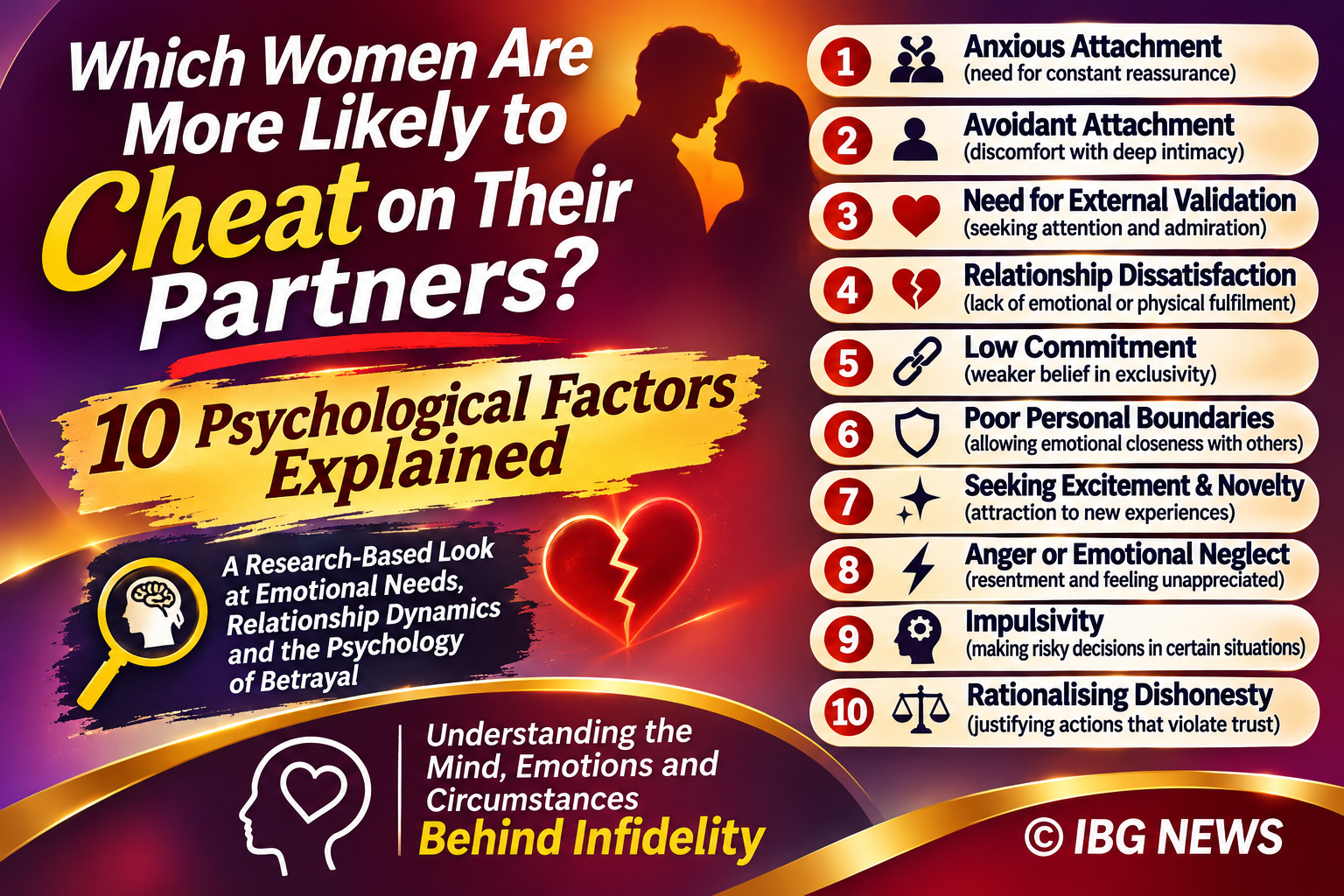
1. Attachment Anxiety and the Need for Reassurance
One of the most extensively studied factors associated with infidelity is insecure attachment.
According to attachment theory, people develop characteristic ways of responding to intimacy, trust, emotional closeness, rejection, and separation.
Individuals with anxious attachment patterns may:
- Frequently seek reassurance from their partner.
- Fear abandonment or rejection.
- Depend heavily on external validation.
- Feel distressed by emotional distance.
- Interpret minor changes in a relationship as signs of withdrawal.
A systematic review and meta-analysis published in Heliyon reviewed 17 studies involving 13,666 participants and found a statistically significant association between attachment anxiety and marital infidelity. However, the relationship was modest rather than deterministic. Many people with anxious attachment remain entirely faithful throughout their lives. [pmc.ncbi.nlm.nih.gov], [europepmc.org]
Psychological insight: When emotional reassurance is repeatedly sought outside the relationship rather than addressed through communication, vulnerabilities may emerge.
2. Attachment Avoidance and Discomfort with Intimacy
Another attachment-related pattern associated with infidelity is avoidant attachment.
People with avoidant tendencies may:
- Feel uncomfortable with emotional dependence.
- Struggle with vulnerability.
- Withdraw during relationship conflicts.
- Avoid discussions about emotions.
- Place a high value on personal autonomy.
The same Heliyon meta-analysis found an association between attachment avoidance and marital infidelity. However, valuing independence, privacy, or personal space should never be confused with a tendency to cheat. [pmc.ncbi.nlm.nih.gov], [europepmc.org]
Psychological insight: Difficulty managing intimacy can create relationship challenges, but personal responsibility ultimately determines behaviour.
3. Excessive Dependence on External Validation
Most people appreciate affection, compliments, and recognition. Problems can arise when self-worth becomes heavily dependent on external approval.
Examples may include:
- Constantly seeking reassurance about attractiveness.
- Relying on admiration from others for confidence.
- Becoming emotionally dependent on romantic attention.
- Feeling validated primarily through being desired.
- Pursuing attention as a source of self-esteem.
Research examining motivations for infidelity has identified self-esteem enhancement and the desire for affirmation among motivations reported by some participants. However, the evidence does not suggest that enjoying compliments, maintaining friendships, or participating in social media predicts infidelity by itself. [pubmed.ncb…lm.nih.gov], [europepmc.org], [researchgate.net]
Psychological insight: The difference lies between appreciating recognition and becoming emotionally dependent on it.
4. Significant Relationship Dissatisfaction
Relationship dissatisfaction is among the most consistently studied correlates of infidelity.
Common relationship difficulties may include:
- Persistent conflict.
- Lack of affection.
- Emotional disconnection.
- Feeling unappreciated.
- Sexual incompatibility.
- Communication breakdown.
A systematic review published in The Journal of Sexual Medicine found that interpersonal relationship factors play an important role in understanding infidelity. However, dissatisfaction alone neither causes nor excuses betrayal. Many dissatisfied partners remain faithful, while some people engage in affairs despite reporting relatively happy relationships. [pubmed.ncb…lm.nih.gov], [europepmc.org]
Psychological insight: Relationship dissatisfaction may increase vulnerability, but it does not eliminate personal accountability.
5. Weak Commitment to Relationship Exclusivity
Commitment involves more than maintaining a public relationship. It includes accepting the responsibilities and boundaries associated with exclusivity.
Individuals with lower commitment may:
- Keep alternative romantic options available.
- Avoid long-term discussions.
- Attach limited importance to exclusivity.
- Feel less obligated to protect relationship boundaries.
Research on motivations for extradyadic relationships has identified low commitment as a recurring theme among some individuals who reported infidelity. [fincham.info], [pubmed.ncb…lm.nih.gov]
Psychological insight: Being attracted to others is normal. Maintaining commitments depends on values, choices, and honesty.
6. Difficulty Maintaining Healthy Boundaries
Trust in relationships often depends on clear emotional and behavioural boundaries.
Potential warning signs may include:
- Secret romantic communication.
- Deliberately encouraging romantic attention.
- Concealing emotionally intimate interactions.
- Regularly crossing mutually agreed boundaries.
- Creating opportunities for inappropriate involvement.
It is important to note that healthy friendships, including friendships with members of the opposite sex, are not evidence of infidelity.
Psychological insight: Healthy boundaries protect trust while preserving personal freedom.
7. Strong Preference for Novelty and Sexual Variety
People differ significantly in their attitudes toward sexual exclusivity and novelty.
Relationship researchers often discuss sociosexual orientation, which refers to how comfortable an individual is with sexual relationships outside highly committed emotional bonds.
Studies investigating motivations for infidelity have identified novelty-seeking and sexual variety among reasons reported by some participants. However, a preference for novelty does not automatically translate into violating an existing commitment. [fincham.info], [pubmed.ncb…lm.nih.gov], [researchgate.net], [pubmed.ncb…lm.nih.gov]
Psychological insight: Desire and behaviour are not the same thing. Personal values determine whether attractions become actions.
8. Unresolved Anger, Hurt, or Resentment
Infidelity sometimes occurs in the context of emotional pain.
An individual may feel:
- Neglected.
- Rejected.
- Unappreciated.
- Humiliated.
- Resentful due to unresolved conflicts.
Research examining motivations for infidelity has identified anger and neglect among reasons reported by participants. However, emotional suffering does not make betrayal inevitable, nor does it justify it. [researchgate.net], [pubmed.ncb…lm.nih.gov]
Psychological insight: Attempting to cope with relationship pain through another relationship often creates additional harm rather than solving the original problem.
9. Impulsivity and Poor Decision-Making in High-Risk Situations
Not every affair results from long-term planning.
Some incidents occur during:
- Emotional crises.
- Periods of poor judgment.
- Intoxication.
- Highly charged social situations.
- Moments of reduced self-control.
Research on motivations for infidelity has identified situational influences, including intoxication and opportunity, among reported contributing factors. [researchgate.net], [pubmed.ncb…lm.nih.gov]
Psychological insight: Emotional regulation and awareness of high-risk situations are important elements of relationship responsibility.
10. Rationalising Dishonesty
One of the strongest behavioural predictors of repeated deception is the tendency to justify it.
Common rationalisations may include:
- “My partner does not understand me.”
- “I deserve this.”
- “It is only emotional, not physical.”
- “Nobody will get hurt.”
- “I can manage both relationships.”
Such rationalisations can reduce feelings of guilt and make dishonest behaviour easier to continue.
Psychological insight: Trust depends heavily on the willingness to take responsibility for one’s actions and choices.
Important Scientific Note
The ten factors discussed above are not a checklist, diagnostic tool, or method for identifying someone who will be unfaithful.
Some factors, such as attachment insecurity and relationship dissatisfaction, have stronger empirical support than others. Several themes arise from broader relationship research and clinical observations rather than serving as independently validated predictors.
Most importantly, no single factor predicts infidelity with certainty.
What Does Research Say About Women Compared with Men?
Despite common assumptions, current evidence does not support the idea that women are inherently more likely to cheat than men.
A review by researchers Frank D. Fincham and Ross W. May highlighted changing social patterns and a narrowing gender gap in infidelity research. [fincham.info], [pubmed.ncb…lm.nih.gov]
A separate study involving heterosexual couples reported that:
- 23.2% of men
- 19.2% of women
in that particular sample acknowledged sexual infidelity during their current relationship. Researchers also found that relationship happiness and compatibility of sexual values were relevant predictors for women in that study. [pubmed.ncb…lm.nih.gov]
These findings should not be treated as global prevalence estimates. They reflect specific research populations, definitions, and time periods.
The broader lesson is clear: infidelity cannot be adequately explained by gender alone.
Emotional, Physical and Digital Infidelity
Infidelity is not limited to physical sexual contact.
Emotional Infidelity
Developing a secret emotional or romantic attachment outside the relationship while concealing it from a partner.
Physical Infidelity
Sexual or physical intimacy that violates agreed relationship boundaries.
Digital Infidelity
Secret romantic messaging, online sexual interactions, concealed virtual relationships, or the use of dating applications while maintaining an exclusive partnership.
Different couples establish different expectations. What matters most is whether trust, honesty, and mutually agreed boundaries are violated.
Seven Things That Do Not Prove a Woman Is Cheating
The following behaviours are not evidence of infidelity:
- Having male friends or colleagues.
- Wearing attractive clothing.
- Maintaining an active social media presence.
- Travelling independently.
- Being financially successful.
- Wanting privacy and personal space.
- Being socially confident or outgoing.
Healthy relationships balance personal freedom with mutual trust and respect.
Can a Relationship Survive Infidelity?
Some relationships recover from infidelity, while others do not.
Recovery typically involves:
- Honest acknowledgement of what occurred.
- Ending the deceptive relationship or behaviour.
- Accepting responsibility.
- Allowing time for healing.
- Rebuilding transparency.
- Re-establishing boundaries.
- Seeking professional counselling where appropriate.
The betrayed partner also has the right to end the relationship. Reconciliation should never be considered an obligation.
Conclusion: Infidelity Is About Human Behaviour, Not Gender Stereotypes
A more useful question than “What kind of woman cheats?” is:
What psychological, emotional, and situational factors may increase the likelihood that a person violates a relationship commitment?
Research suggests that attachment insecurity, relationship dissatisfaction, low commitment, poor boundaries, anger, validation-seeking, novelty-seeking, situational influences, and attitudes toward honesty can all contribute to vulnerability.
However, none of these factors alone determines whether someone will be faithful or unfaithful.
A confident woman is not necessarily unfaithful. An independent woman is not necessarily emotionally avoidant. A socially active woman is not necessarily looking for another partner. Likewise, a quiet or seemingly devoted individual is not automatically immune to betrayal.
Ultimately, fidelity is not determined by appearance, social standing, education, income, gender, or personality labels alone.
It depends on honesty, emotional maturity, self-control, mutual respect, communication, and a genuine commitment to the promises made within a relationship.
The strongest foundation for a lasting relationship is not control, suspicion, or surveillance. It is a relationship in which both partners freely choose honesty, loyalty, trust, and responsibility every day.
IBG NEWS | Psychology, Relationships & Society

