














U.S., Japan, and South Korea Deepen Strategic Partnership at Trilateral Foreign Ministers’ Meeting
Civil Nuclear Cooperation, Indo-Pacific Security, and Supply Chain Resilience Take Centre Stage
By Suman Munshi | IBG NEWS
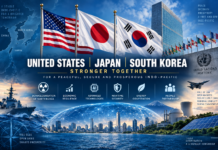
Ankara | July 9, 2026: The United States, Japan, and the Republic of Korea (ROK) have reaffirmed their commitment to strengthening trilateral cooperation across security, economic resilience, energy, and advanced technology during a high-level Foreign Ministers’ Meeting held on the sidelines of the NATO Summit in Ankara.
U.S. Secretary of State Marco Rubio met with Japanese Foreign Minister Toshimitsu Motegi and South Korean Foreign Minister Cho Hyun to reinforce their shared vision of a free, open, and secure Indo-Pacific. The leaders emphasized that enhanced trilateral cooperation is delivering tangible benefits for regional stability, economic prosperity, and international security.
Landmark Civil Nuclear Agreement
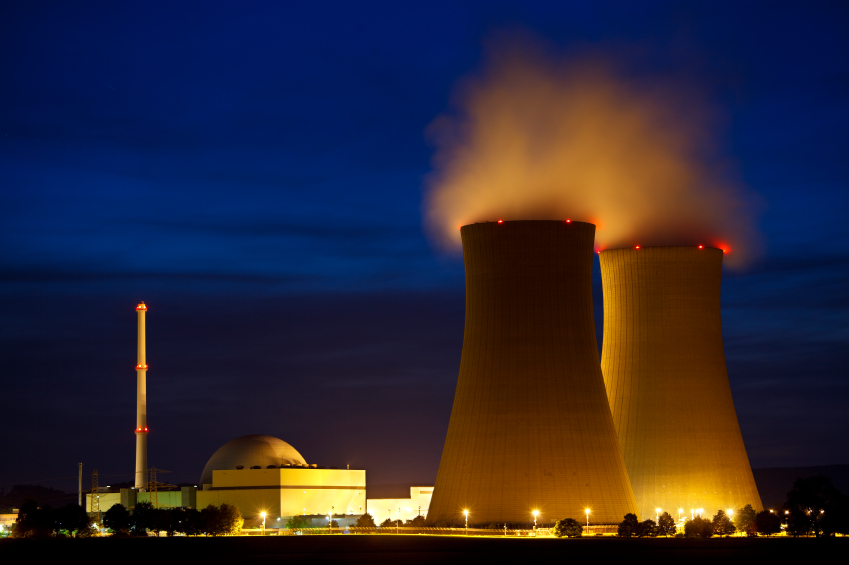
One of the meeting’s key outcomes was the signing of a Trilateral Memorandum of Cooperation on Civil Nuclear Energy. The agreement aims to accelerate the deployment of Small Modular Reactors (SMRs) in partner countries while promoting greater diversification toward U.S. energy imports.
The three nations described civil nuclear cooperation as an important step toward advancing clean energy solutions and strengthening long-term energy security.
Expanding Security and Defence Cooperation
The ministers highlighted the growing importance of NATO’s engagement with Indo-Pacific partners and pledged closer collaboration in several strategic areas, including:
- Defence spending and industrial production
- Energy security
- Countering cyber and hybrid threats
- Intelligence and security information sharing
- Emerging and critical technologies
- Regional and global security cooperation
They also reaffirmed their commitment to preserving freedom of navigation and maintaining a rules-based international order.
Standing Firm Against Economic Coercion
The three countries strongly opposed the use of economic coercion and the weaponization of global supply chains for political purposes. They pledged to continue diversifying and de-risking critical supply chains to improve resilience against future geopolitical disruptions.
Strong Message on North Korea
The ministers reiterated their shared commitment to the complete denuclearization of the Democratic People’s Republic of Korea (DPRK) and agreed to strengthen cooperation against North Korea’s malicious cyber activities and illicit information technology operations.
They also called for the immediate resolution of humanitarian issues involving abductees, detainees, unrepatriated prisoners of war, and separated families.
Taiwan Strait Stability Reaffirmed
The trilateral partners stressed the importance of maintaining peace and stability across the Taiwan Strait, expressing concern over increasingly frequent destabilizing activities in the region.
They encouraged the peaceful resolution of cross-Strait differences and firmly opposed any unilateral attempts to alter the status quo through force or coercion.
Looking Ahead
The meeting reaffirmed the commitments outlined in the U.S.-Japan-ROK Trilateral Joint Statement of September 22, 2025, as well as subsequent bilateral agreements reached between the United States and both Japan and South Korea.
The three foreign ministers also agreed to continue holding regular trilateral consultations at all levels and welcomed the expansion of cooperation into new areas, including international disaster relief and humanitarian assistance.
Defence & Strategic Analysis
The Ankara meeting reflects the rapid evolution of the U.S.-Japan-ROK partnership from a traditional security alliance into a comprehensive strategic framework covering energy security, civil nuclear technology, critical supply chains, cyber defence, and advanced technologies. The newly signed SMR cooperation agreement signals a coordinated effort to shape the future of clean energy infrastructure while reducing strategic vulnerabilities.
For the Indo-Pacific, this trilateral partnership is emerging as one of the region’s most influential strategic platforms, designed to strengthen deterrence, enhance economic resilience, and safeguard the rules-based international order amid evolving geopolitical challenges.
— By Suman Munshi, IBG NEWS