













IBG NEWS | DEEP ANALYSIS
Why IIT Bhubaneswar’s Spintronic Breakthrough Could Become a Strategic Technology for India’s AI, Semiconductor and Defence Future
Analysis by Suman Munshi | Chief Editor, IBG NEWS
The publication of the landmark research in Nature Nanotechnology is more than an academic achievement. It represents a technological milestone that aligns with India’s long-term ambitions in semiconductors, artificial intelligence, strategic electronics, and next-generation computing. Although the technology remains at the laboratory stage, its implications extend far beyond university research.
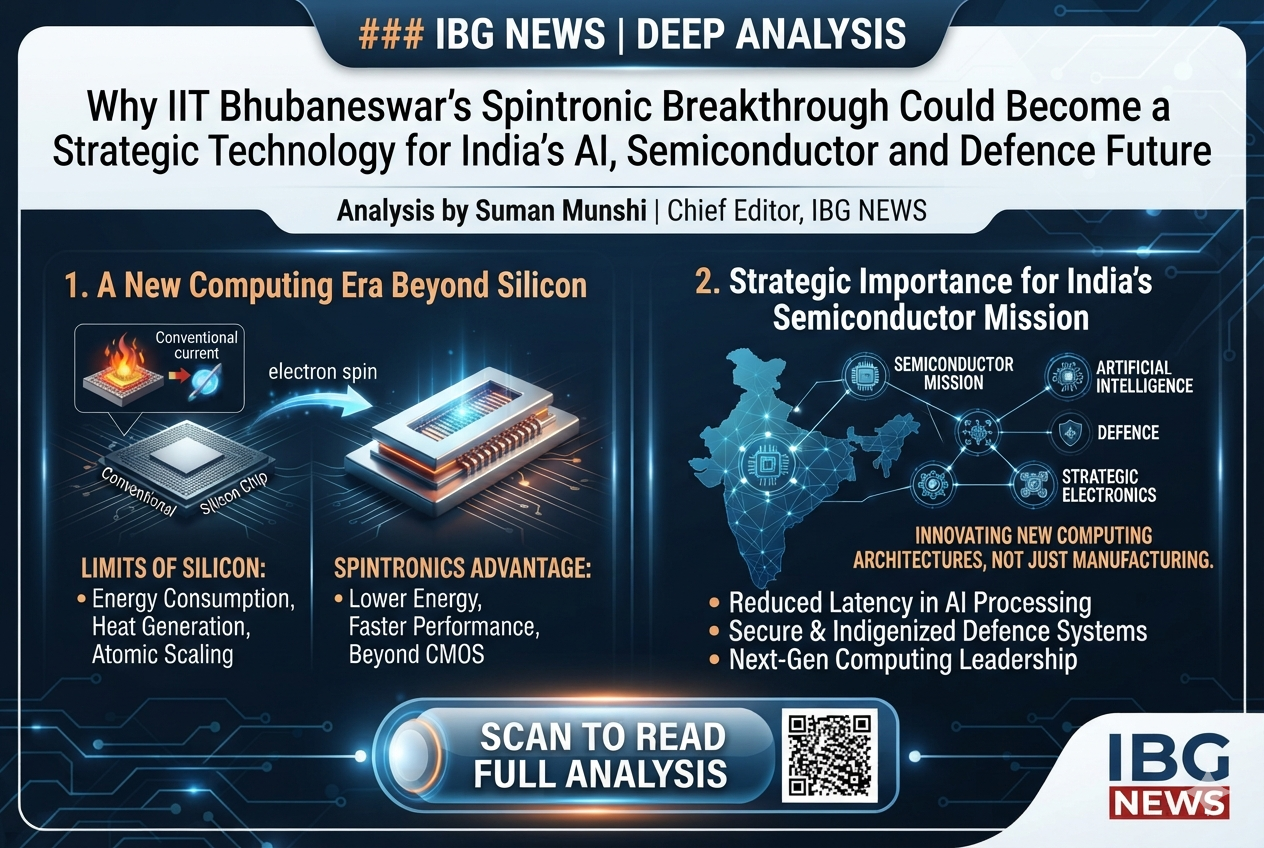
1. A New Computing Era Beyond Silicon
For over five decades, global computing has been driven by silicon transistor technology. However, as transistor dimensions approach atomic limits, further improvements in performance have become increasingly difficult and expensive.
The semiconductor industry now faces three fundamental challenges:
- Escalating energy consumption.
- Heat generation.
- Physical limits of transistor miniaturization.
Spintronics offers an alternative by exploiting the electron’s spin instead of relying solely on electrical charge.
Unlike conventional chips that move enormous amounts of electrical current, spintronic devices require significantly lower energy while potentially delivering much faster computational performance.
If successfully commercialized, this technology could become one of the major successors to traditional CMOS computing.
2. Strategic Importance for India’s Semiconductor Mission
India’s Semiconductor Mission has primarily focused on:
- Chip fabrication.
- Packaging and testing.
- Compound semiconductors.
- Display technologies.
- Electronics manufacturing.
However, the next phase of global competition will not merely be about manufacturing existing chips—it will involve inventing entirely new computing architectures.
Research such as IIT Bhubaneswar’s gives India an opportunity to participate in the design of future computing platforms rather than remaining only a manufacturing destination.
Countries that own breakthrough intellectual property in emerging technologies will command greater technological sovereignty.
3. Why AI Needs Spintronics
Artificial Intelligence is becoming increasingly computationally expensive.
Modern Large Language Models (LLMs), autonomous systems, robotics, weather prediction, drug discovery, and scientific simulations require enormous computing resources.
Training frontier AI models consumes:
- Massive GPU clusters.
- Gigawatts of electricity.
- Billions of dollars in infrastructure.
The largest AI data centres now consume electricity comparable to medium-sized cities.
Spintronic processors could dramatically reduce this energy burden because synchronized magnetic oscillators naturally perform certain computational tasks in parallel.
Potential AI applications include:
- Neural network acceleration
- Pattern recognition
- Image processing
- Speech recognition
- Optimization problems
- Edge AI
- Autonomous robotics
This makes spintronics particularly attractive for sustainable AI.
4. Brain-Inspired Computing
The human brain performs extraordinary computations while consuming only around 20 watts of power.
Modern supercomputers require megawatts.
This enormous efficiency gap has inspired scientists to develop neuromorphic computing—hardware that mimics biological neural networks.
Large synchronized spintronic oscillator networks resemble neuronal synchronization inside the brain.
The IIT Bhubaneswar research provides important experimental evidence that such synchronization remains possible even in extremely large systems.
This moves neuromorphic computing one step closer to practical reality.
5. Defence Applications
Strategically, this technology may prove valuable for defence systems requiring rapid decision-making under strict energy constraints.
Potential future applications include:
- Radar signal processing
- Electronic warfare
- Autonomous drones
- Missile guidance
- Battlefield AI
- Secure communications
- Space-based surveillance
- Satellite onboard processing
- Hypersonic tracking systems
Future military systems will increasingly depend on edge computing—performing AI directly inside equipment without relying on remote cloud infrastructure.
Energy-efficient spintronic hardware could become an important enabling technology.
6. Implications for India’s National Security
India currently imports a significant proportion of advanced semiconductor technologies.
Future technological sovereignty will depend not only upon manufacturing capacity but also upon indigenous innovation.
Breakthroughs in:
- Spintronics
- Quantum materials
- Photonics
- Advanced memory
- Neuromorphic computing
could provide India with strategic advantages similar to those achieved through indigenous space and missile technologies.
Research institutions like IITs therefore become important contributors to national technological security.
7. Relationship with Quantum Computing
Spintronics and quantum computing are often confused but serve different purposes.
Quantum computers use quantum bits (qubits) that exploit superposition and entanglement.
Spintronic systems remain classical devices but utilize magnetic spin to perform computation more efficiently.
Rather than competing technologies, they are likely to become complementary.
Future computing ecosystems may combine:
- Conventional CPUs
- GPUs
- AI accelerators
- Spintronic processors
- Quantum processors
- Photonic computing
Each platform would solve problems best suited to its architecture.
8. India’s Opportunity
India possesses one of the world’s largest engineering talent pools.
The country has already demonstrated global leadership in:
- Space technology
- Digital public infrastructure
- Software engineering
- Artificial Intelligence research
The next challenge is becoming a leader in hardware innovation.
This breakthrough illustrates that Indian researchers are capable of contributing not merely to incremental improvements but to technologies that may shape future global computing.
9. Commercial Challenges Ahead
Despite the scientific success, several hurdles remain before commercialization:
- Mass manufacturing techniques.
- Device reliability.
- Integration with existing semiconductor fabrication.
- Industrial-scale testing.
- Software ecosystems.
- Manufacturing costs.
Commercial deployment could still require several years of sustained research and industrial investment.
10. Why This Matters for India’s Economy
If India succeeds in translating such research into commercial technology, the long-term economic benefits could be transformative.
Potential outcomes include:
- Indigenous AI hardware.
- Reduced dependence on imported processors.
- Growth of deep-tech startups.
- Expansion of semiconductor manufacturing.
- High-value intellectual property generation.
- Export opportunities.
- Creation of highly skilled scientific employment.
- Strengthened digital sovereignty.
Such advances align closely with national initiatives including the India Semiconductor Mission, National Quantum Mission, Digital India, and the country’s ambition to become a global hub for advanced electronics and AI innovation.
IBG NEWS Strategic Outlook
The IIT Bhubaneswar-led breakthrough is more than an academic milestone—it is a glimpse into the architecture of tomorrow’s intelligent machines. While practical deployment will require years of engineering and industrial collaboration, the research demonstrates that India is not merely participating in the global technology race but contributing to its scientific foundations.
As the world moves beyond the limits of conventional silicon computing, innovations in spintronics, neuromorphic systems, quantum technologies, and advanced materials will define the next industrial revolution. Nations that invest today in frontier research, skilled talent, semiconductor ecosystems, and commercialization pathways will shape the future digital economy.
For India, this breakthrough is not simply a success for one institution—it is a strategic reminder that scientific excellence, when coupled with sustained policy support and industrial investment, can become a cornerstone of technological self-reliance and global competitiveness.