

















India’s Ornamental Fisheries Sector Gets a Boost as Union Secretary Visits Madurai Cluster
Dr. Abhilaksh Likhi reviews farming practices, production capacity and market opportunities; stresses scientific breeding, biosecurity and stronger market linkages
By Suman Munshi | IBG NEWS
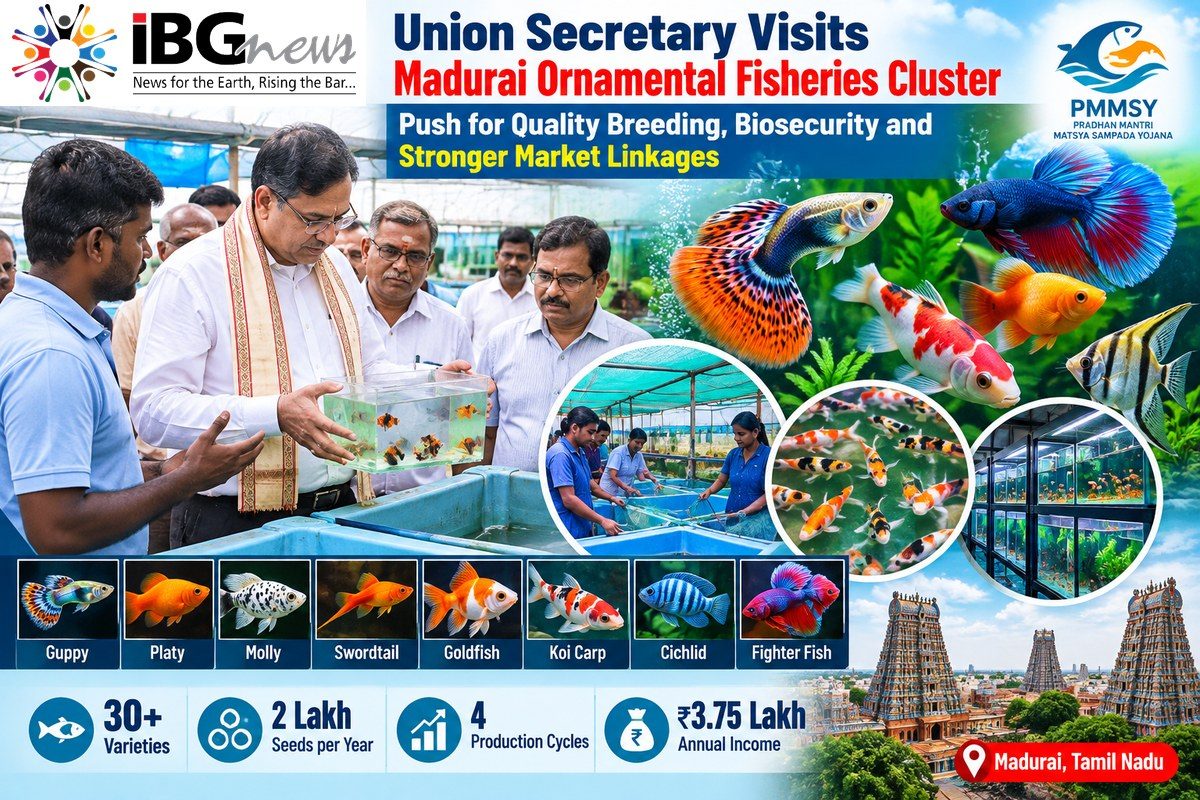
Madurai, Tamil Nadu | 12 October 2026: India’s ornamental fisheries sector received fresh attention on 12 October as Dr. Abhilaksh Likhi, Secretary of the Department of Fisheries, Ministry of Fisheries, Animal Husbandry and Dairying, visited the Padimuneeswarar Integrated Ornamental Fish Farm at Mukkampatti village in Melur, Madurai district, Tamil Nadu.
The visit focused on assessing the progress of ornamental fish farming, understanding the concerns of farmers and entrepreneurs, and identifying opportunities to strengthen Madurai’s development as an ornamental fisheries cluster under the Pradhan Mantri Matsya Sampada Yojana (PMMSY).
During discussions with fish farmers, Dr. Likhi reviewed issues relating to ornamental fish varieties, quality broodstock, seed availability, water quality management, aquatic animal health, transportation and marketing. He encouraged farmers to adopt scientific breeding and rearing methods, promote high-value indigenous species, strengthen biosecurity and improve access to technology, institutional finance and wider markets.
Cluster-based approach to strengthen the value chain
Highlighting the importance of coordinated development, the Union Secretary noted that 34 notified fisheries clusters are being developed across India. The initiative seeks to address gaps throughout the value chain, including production, input supply, infrastructure, skill development, processing, value addition, branding, logistics and market access.
The cluster-based approach is intended to improve competitiveness, strengthen commercial operations and enhance the incomes of fish farmers and other participants in the fisheries sector.
Madurai farm demonstrates the potential of small-scale enterprises
Established under PMMSY at a project cost of ₹25 lakh, the Padimuneeswarar Integrated Ornamental Fish Farm breeds and rears more than 30 varieties of ornamental fish. These include guppies, platies, mollies, swordtails, goldfish, koi carp, cichlids and fighter fish.
According to the information provided by the Department of Fisheries, the farm undertakes four production cycles annually and produces approximately two lakh ornamental fish seeds each year. Its estimated annual income is ₹3.75 lakh. The unit supplies ornamental fish to domestic markets in Tamil Nadu and Kerala.
The farm illustrates how specialised aquaculture can create livelihood opportunities and support entrepreneurship without requiring extensive land resources.
India’s ornamental fisheries industry has significant growth potential
India’s ornamental fisheries industry encompasses much more than fish breeding. Its value chain includes broodstock development, seed production, live feed, aquatic plants, aquarium equipment, specialised feed, fish-health products, retailing, transportation and exports.
The country’s rich aquatic biodiversity offers considerable opportunities for developing commercially viable indigenous species and expanding the domestic and international market for ornamental fish.
According to the figures cited in the Department’s background information, India has more than 374 indigenous freshwater ornamental fish species and over 700 indigenous marine ornamental fish species. This diversity provides a foundation for research, breeding programmes and the development of specialised aquaculture enterprises.
Under PMMSY, 2,672 ornamental fish rearing and integrated breeding-and-rearing units have been approved nationwide, comprising 2,465 rearing units and 207 integrated units. The programme has also supported five freshwater ornamental fish brood banks and 144 recreational fisheries units. The total approved investment cited for these initiatives up to 2024–25 was ₹230.45 crore.
The Indian ornamental fish industry, including breeding, rearing, trade, aquarium accessories, aquatic plants and decorative products, is estimated at approximately ₹3,000 crore, according to the background information supplied by the department.
Export growth will depend on quality and reliable logistics
India’s broader fisheries sector has continued to expand. Fish production reached 197.75 lakh tonnes in 2024–25, while marine product exports reportedly reached a record ₹73,890 crore in 2025–26.
Ornamental fish exports, however, represent a specialised segment with distinct requirements. According to the latest complete annual figures cited in the release, India exported approximately 59.73 tonnes of ornamental fish products valued at ₹16.94 crore during 2024–25.
Expanding this market will require consistent quality, commercial breeding of high-value species, improved certification and traceability, effective disease prevention, and efficient transport systems capable of maintaining the health of live fish throughout shipment.
Greater coordination among farmers, research institutions, financial organisations, exporters and logistics providers could help Indian producers reach more international buyers and build a stronger reputation for quality and reliability.
A pathway for rural entrepreneurship and employment
Ornamental fisheries can provide opportunities for rural youth, women’s Self-Help Groups, startups and small enterprises. With suitable technical training, access to finance, reliable inputs and market connections, small-scale producers can participate in a wider commercial ecosystem.
The Madurai cluster visit underlines the importance of combining scientific practices with enterprise development and market-oriented planning. Strengthening these elements will be essential if India is to translate its aquatic biodiversity into higher-value production, additional livelihoods and greater export competitiveness.
For India’s ornamental fisheries sector, the next stage of growth will depend on converting biological diversity and entrepreneurial potential into sustainable businesses capable of serving both domestic consumers and international markets.
Source: Press Information Bureau (PIB), Department of Fisheries, Government of India, 12 October 2026.
Make my news report more conciseStrengthen my opening with key findings

