

















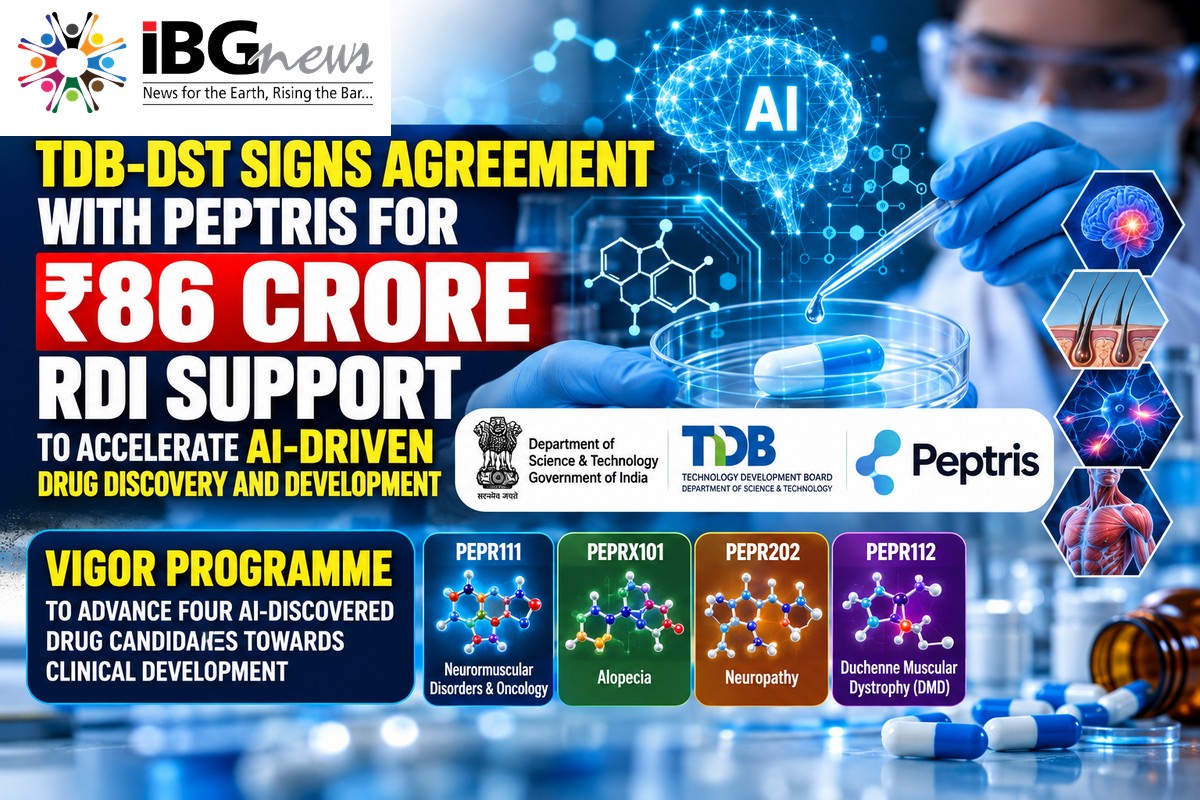

TDB-DST Commits ₹86 Crore to Peptris for AI-Powered Drug Discovery and Development
VIGOR programme to advance four AI-discovered drug candidates towards clinical development, strengthening India’s pharmaceutical innovation ecosystem
By Suman Munshi | IBG NEWS
New Delhi, October 12, 2026: In a major boost to India’s artificial intelligence-driven pharmaceutical research, the Technology Development Board (TDB), under the Department of Science and Technology (DST), Government of India, has signed an agreement with Bengaluru-based Peptris Technologies Private Limited to provide ₹86 crore in financial support under the Research Development and Innovation (RDI) Fund.
The initiative, titled VIGOR: Advancing AI-Discovered Molecules from Bench to Clinic, has a total project cost of ₹172 crore. It aims to move four promising drug candidates from Technology Readiness Level (TRL)-4 to TRL-6 through advanced preclinical research, scientific validation and preparations for clinical development. The funding will be provided through an Optionally Convertible Debt (OCD) arrangement.
Four AI-discovered drug candidates in focus
Peptris will use its proprietary artificial intelligence platform to advance four drug candidates targeting different medical conditions:
- PEPR111: Targeting neuromuscular disorders and oncology.
- PEPRX101: Focused on alopecia.
- PEPR202: Targeting neuropathy.
- PEPR112: Focused on Duchenne muscular dystrophy (DMD).
The three-year programme is expected to support advanced preclinical investigations, investigational new drug (IND)-enabling studies, formulation development and preparations for clinical trials. Progress will depend on scientific outcomes and the applicable regulatory requirements.
Bridging the gap between AI discovery and clinical development
Artificial intelligence is increasingly transforming pharmaceutical research by helping scientists identify potential drug molecules, explore disease mechanisms and evaluate promising therapeutic approaches. However, converting computer-generated discoveries into viable medicines requires extensive laboratory testing, preclinical evaluation and regulatory preparation.
The VIGOR programme seeks to address this critical challenge by combining AI-based drug discovery with experimental validation and established pharmaceutical development practices. Peptris also plans to leverage global contract research organisation (CRO) networks to support research and development activities.
By advancing multiple candidates through a coordinated development programme, the initiative aims to improve the translation of scientific discoveries into potential therapies, particularly in areas where unmet medical needs remain significant.
TDB highlights the importance of innovation funding
Rajesh Kumar Pathak, Secretary of the Technology Development Board, emphasised that artificial intelligence could significantly change the way new medicines are discovered and developed. He noted that promising research findings must be supported by sustained investment, rigorous scientific assessment and a structured pathway towards clinical development.
According to the TDB leadership, support through the RDI Fund is intended to help bridge the gap between technological innovation and clinical application while strengthening India’s capabilities in biotechnology, pharmaceuticals and AI-enabled healthcare.
A representative of Peptris Technologies said the financial assistance would help the company advance its VIGOR programme through crucial preclinical milestones. The company aims to combine computational drug discovery with experimental research and established development processes to pursue potential treatments for diseases with limited or inadequate therapeutic options.
Strengthening India’s pharmaceutical innovation ecosystem
The TDB–Peptris partnership highlights India’s growing efforts to connect artificial intelligence, biotechnology and pharmaceutical research. Supporting the transition from laboratory discoveries to clinically relevant drug candidates remains an important challenge for technology-driven healthcare innovation.
While the four candidates must undergo the necessary scientific and regulatory assessments before they can progress to clinical use, the VIGOR programme represents a significant investment in developing India’s domestic drug-discovery capabilities.
The initiative could contribute to the country’s ambition to build a stronger innovation ecosystem in which advanced technologies support the development of new therapeutic approaches and enhance the long-term competitiveness of India’s pharmaceutical sector.
IBG NEWS | Science, Technology & Innovation
By Suman Munshi, Chief Editor, IBG NEWS

