

















India’s Steel Industry Maintains Growth Momentum During April–July 2026
By Suman Munshi
Chief Editor, IBG NEWS
New Delhi, August 6, 2026: India’s steel sector continued to demonstrate steady growth during the first four months of the financial year 2026–27, with higher production, stronger domestic demand, expanding exports, and significant advances in indigenous technology and sustainability initiatives, according to the latest data released by the Ministry of Steel.
Production Registers Steady Growth
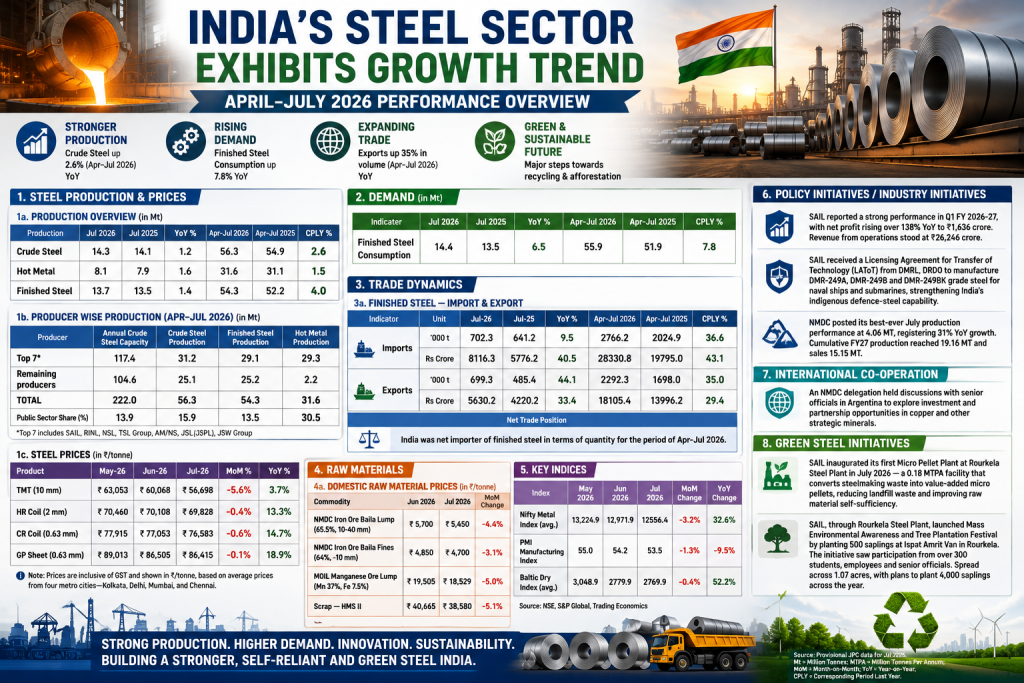
The country’s crude steel production reached 56.3 million tonnes (MT) during the April–July 2026 period, representing a 2.6% increase over the corresponding period last year. Finished steel production climbed to 54.3 MT, recording a 4.0% year-on-year growth, while hot metal output rose to 31.6 MT, an increase of 1.5%.
During July 2026 alone, crude steel production stood at 14.3 MT, reflecting a modest annual increase, while finished steel production reached 13.7 MT.
India’s seven largest steel producers—including SAIL, RINL, Tata Steel Group, JSW Group, AM/NS India, Jindal Steel, and NSL—accounted for more than half of the country’s total steel output during the review period.
Domestic Demand Continues to Strengthen
India’s domestic steel consumption maintained a healthy trajectory, supported by infrastructure development, manufacturing activity, housing projects, and industrial expansion.
Finished steel consumption reached 55.9 MT between April and July 2026, marking a robust 7.8% increase over the same period last year. Consumption during July alone increased by 6.5% year-on-year to 14.4 MT, highlighting sustained demand across key sectors of the economy.
Steel Prices Show Mixed Trend
Retail prices of major steel products moderated during July compared with June, largely reflecting changes in market conditions and raw material costs.
Despite the month-on-month decline, prices of products such as TMT bars, hot-rolled coils, cold-rolled coils, and galvanized sheets remained significantly higher than those recorded a year earlier, indicating continued market resilience.
Imports and Exports Expand
India witnessed growth in both imports and exports of finished steel during the April–July period.
Finished steel imports increased by 36.6% in volume to approximately 2.77 million tonnes, while exports grew by 35%, reaching nearly 2.29 million tonnes. In value terms, exports crossed ₹18,100 crore, reflecting strong international demand for Indian steel products.
However, import volumes continued to exceed exports during the period, leaving India a net importer of finished steel.
Raw Material Costs Ease
Prices of key raw materials used in steel production—including iron ore, manganese ore, and steel scrap—declined during July compared with the previous month.
The reduction in input costs could provide operational advantages for steel manufacturers by easing production expenses and improving overall cost efficiency.
Sector Indices Reflect Stable Manufacturing Activity
The Nifty Metal Index moderated during July after recording strong gains earlier in the year, while India’s Manufacturing Purchasing Managers’ Index (PMI) remained above the expansion threshold, indicating continued industrial growth.
International freight indicators, including the Baltic Dry Index, also remained at elevated levels compared with the previous year, reflecting sustained global trade activity.
SAIL, NMDC Strengthen Sector Performance
Public sector steel major Steel Authority of India Limited (SAIL) reported a strong first quarter of FY 2026–27, with net profit increasing by more than 138% year-on-year to ₹1,636 crore. Revenue from operations reached ₹26,246 crore, underlining improved operational and financial performance.
SAIL also secured a technology transfer licence from DRDO’s Defence Metallurgical Research Laboratory (DMRL) to manufacture specialised grades of defence steel for naval ships and submarines, reinforcing India’s efforts to enhance indigenous defence manufacturing capabilities.
Meanwhile, NMDC achieved its highest-ever July production, producing 4.06 million tonnes of iron ore, representing a 31% annual increase. Cumulative production for FY 2026–27 reached 19.16 MT, demonstrating continued operational strength.
International Mineral Partnerships Expand
In a move to diversify access to strategic minerals, an NMDC delegation held discussions with senior officials in Argentina to explore cooperation and investment opportunities in copper and other critical mineral resources.
The initiative forms part of India’s broader strategy to strengthen international resource partnerships and secure supplies essential for future industrial growth.
Sustainability and Green Steel Gain Momentum
The steel sector also recorded significant progress in environmental sustainability.
SAIL inaugurated its first Micro Pellet Plant at the Rourkela Steel Plant, a facility designed to recycle steelmaking waste into value-added micro pellets, reducing landfill disposal and improving raw material efficiency.
The company also launched an extensive environmental awareness and tree plantation campaign at Rourkela, beginning with the planting of 500 saplings and targeting 4,000 trees during the year as part of its long-term sustainability programme.
Positive Outlook
The latest performance indicators suggest that India’s steel industry continues to benefit from strong domestic demand, expanding manufacturing activity, technological innovation, and increasing emphasis on sustainable production. While higher imports remain a challenge, improved production, healthy consumption, expanding exports, and investments in advanced steel technologies are expected to support the sector’s long-term growth and reinforce India’s position as one of the world’s leading steel-producing nations.

