











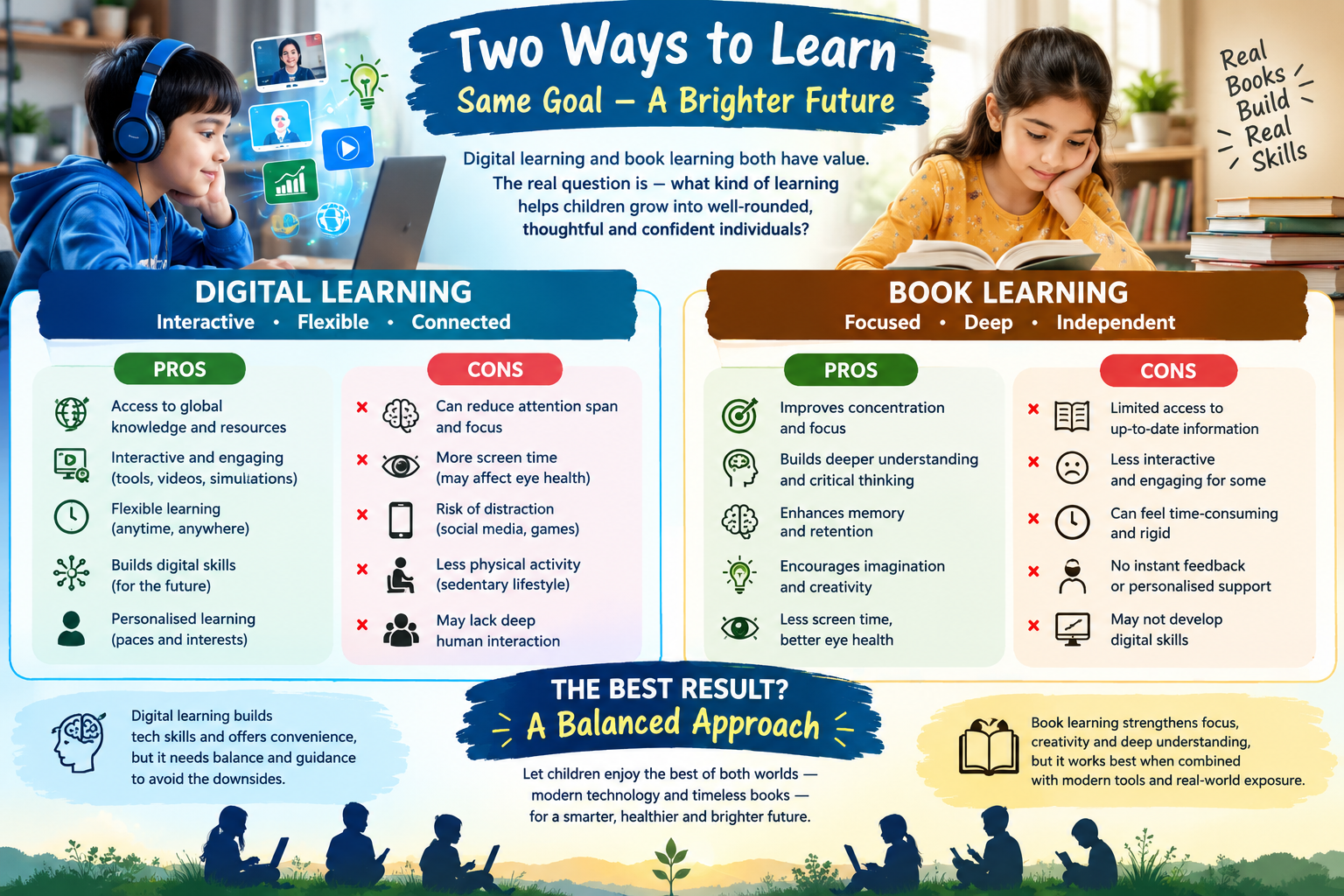

Are Screens Replacing Thinking? The Growing Debate Over Digital Learning and Children’s Cognitive Development
Special Research Report | IBG NEWS
By Suman Munshi, Chief Editor, IBG NEWS
Executive Summary & Key Research Takeaways
- OECD PISA 2022: 30% of students report digital distraction in math lessons; screen overuse correlates with reduced problem-solving retention.
- UNESCO 2023 GEM Report: Unguided EdTech distribution (e.g., Peru’s 1M laptop initiative) fails to improve educational outcomes without strong pedagogical integration.
- JAMA Pediatrics (2024): Solo screen consumption correlates with lower cognitive scores in early childhood, whereas co-use with adults enhances developmental outcomes.
- ASER 2024 (India): 89% of adolescents have household smartphone access, but 76% use them primarily for social media versus 57% for learning.
Introduction: The Digital Education Paradox
Digital classrooms promise personalized learning, instant information access, and a technology-ready future. Yet growing international research raises a fundamental question: Are children gaining access to more information while losing the concentration, independent reasoning, and intellectual discipline needed to process it?
A student today can find an answer to a complex equation in seconds, watch animated science models, and ask an artificial intelligence tool to write an essay—all without touching a physical textbook.
However, finding an answer is not the same as developing the mental architecture to arrive at one independently. As schools worldwide adopt smartboards, tablets, EdTech apps, and generative AI tools, distinguishing between access to facts and cognitive growth becomes critical.
The concern is not that technology inherently lowers intelligence. Rather, when digital convenience systematically replaces sustained mental effort, human interaction, and hands-on exploration, essential cognitive skills suffer.
1. What International Data Reveal About Digital Distraction
The Organisation for Economic Co-operation and Development (OECD), in its analysis of the 2022 Programme for International Student Assessment (PISA), revealed that roughly 30% of students were distracted by digital devices during mathematics lessons.
Mathematics requires working memory, pattern recognition, logical steps, and error testing. When a student repeatedly alternates between a math problem, notifications, browser tabs, and messaging apps, working memory experiences cognitive fragmentation.
The OECD’s 2024 policy analysis, Managing Screen Time, further noted that three-quarters of OECD students spend over one hour per weekday browsing social networks, and nearly 1 in 3 face classroom digital distractions. Distraction in learning environments is no longer a minor nuisance—it is a major structural challenge to deep processing.
2. The UNESCO Warning: Technology Is Not a Substitute for Teaching
UNESCO’s landmark 2023 Global Education Monitoring (GEM) Report, Technology in Education: A Tool on Whose Terms?, challenged the assumption that adding tech hardware automatically improves educational quality.
The report documented high-profile policy failures. In Peru, for example, distributing over one million laptops without adequate teacher training and curriculum alignment produced no measurable improvement in learning outcomes.
Key takeaway: A device is a delivery tool, not a teaching strategy. Watching a video passively differs fundamentally from explaining the experiment. Clicking a quiz differs from constructing, defending, and revising a logical argument.
3. Early Childhood & Neurodevelopment: Solo Viewing vs. Active Co-Use
The developmental risks of screen reliance are highest during early childhood (ages 0–6), when language processing, emotional regulation, and neural pathways build rapidly.
A August 2024 systematic review in JAMA Pediatrics analyzed early childhood screen environments:
- Solo viewing & background TV: Consistently associated with poorer cognitive and psychosocial outcomes.
- Active Co-use (Adult + Child): Positively associated with stronger cognitive development.
When an adult sits with a child and asks open-ended questions (“Why do you think the character did that?”), the interaction forces the child to retrieve memory, articulate language, and analyze cause-and-effect.
4. Cognitive Offloading: Are We Bypassing “Productive Struggle”?
Cognitive development relies on productive struggle—the process of confronting a problem, attempting solutions, failing, identifying errors, and adjusting methods.
Traditional Learning Process:
[Problem] ➔ [Attempt] ➔ [Error/Frustration] ➔ [Analysis] ➔ [Correction] ➔ [Mastery]

Digital "Short-Circuit" Process:
[Problem] ➔ [AI/App Query] ➔ [Instant Answer] ➔ [Bypassed Cognition]
When learners use AI tools or search engines to obtain instant answers before attempting the thinking process themselves, they engage in over-reliance on cognitive offloading.
- Mathematics: Copying steps from a math app skips building neural pathways for algorithmic reasoning.
- History & Literature: Copying an AI summary bypasses source evaluation, context checking, and synthesis skills.
5. Memory & Retention: Is Convenience Weakening Learning?
Memory is not merely an storage drive; it is the foundation for transferrable intelligence. Retrieval practice—recalling facts, explaining concepts in one’s own words, and handwriting notes—strengthens memory traces.
While digital tools offer spaced repetition and adaptive testing, they can also promote superficial skim-reading. Research shows that reading print media consistently yields higher deep-comprehension scores than reading on screens, primarily because screen-based formats encourage rapid scanning and task-switching.
6. The Low-Tech Advantage: Preserving Favorable Conditions
Schools that enforce low-tech or device-free policies maintain key learning environments:
| Focus Area | Low-Tech Classroom Advantage | Cognitive Benefit |
| Sustained Attention | Eliminates push notifications and screen switching. | Protects deep concentration and working memory capacity. |
| Deep Reading | Focuses on linear, uninterrupted long-form print. | Builds logical inference and structural comprehension. |
| Handwriting | Requires motor-cognitive coordination for letters and diagrams. | Enhances memory encoding and conceptual retention. |
| Face-to-Face Discussion | Direct human debate, listening, and real-time response. | Develops social cognition, active listening, and verbal argumentation. |
7. India’s Digital Reality: Access vs. Meaningful Utilization
The Annual Status of Education Report (ASER) 2024 provides critical baseline data on rural Indian adolescents aged 14–16:
- 89.1% have access to a smartphone at home.
- 82.2% report knowing how to operate a smartphone.
- 76.0% used smartphones for social media in the preceding week.
- 57.0% used smartphones for educational activities in the preceding week.
While smartphone penetration across India is high, recreational use outweighs structured educational use. True digital literacy must move beyond basic smartphone navigation to teaching critical evaluation, source verification, and deliberate focus.
8. Stakeholder Action Matrix: A Balanced Path Forward
Rather than choosing between complete technological rejection or uncritical adoption, education systems must implement deliberate pedagogical design.
| Stakeholder | Key Actionable Strategy |
| Primary Schools | Emphasize physical play, handwriting, reading printed books, and tactile math. Limit screens to secondary supplemental tools. |
| Secondary Schools | Enforce device-free deep work blocks. Incorporate oral defense of essays and assignments to verify understanding behind AI-assisted work. |
| Teachers | Grade the process of reasoning (intermediate steps, rough work, source analysis) rather than just the final answer. |
| Parents | Practice screen co-use with young children. Set strict non-screen family routines around meals and bedtime. |
| Policymakers | Require independent pedagogical evaluations before allocating public funds to large-scale EdTech procurement. |
Conclusion: Rethinking Educational Progress
The ultimate question is not whether schools should use technology, but whether technology deepens thinking or merely speeds up task execution.
The primary measure of educational success is not the volume of hardware placed in a student’s hands—it is the strength, clarity, and independence of the mind trained to use it.
References & Academic Citations:
- OECD (2023).PISA 2022 Results (Volume II): Learning Mathematics Including Digital Opportunities and Distractions. OECD Publishing.
- OECD (2024).Managing Screen Time: How to Protect and Equip Students Against Distraction. PISA in Focus, No. 124.
- UNESCO (2023).Global Education Monitoring Report: Technology in Education: A Tool on Whose Terms?
- Mallawaarachchi, V., et al. (2024).Early Childhood Screen Use Contexts and Cognitive and Psychosocial Outcomes: A Systematic Review and Meta-analysis.JAMA Pediatrics.
- ASER Centre (2024).Annual Status of Education Report (Rural) 2024. New Delhi.
- Caballero-Julia, A., et al. (2024).Unpacking the Relationship Between Screen Use and Educational Outcomes in Childhood.Computers & Education, Vol. 215.

